CGC Pristine 10, Gem Mint 10 and legacy 9.5
On this page
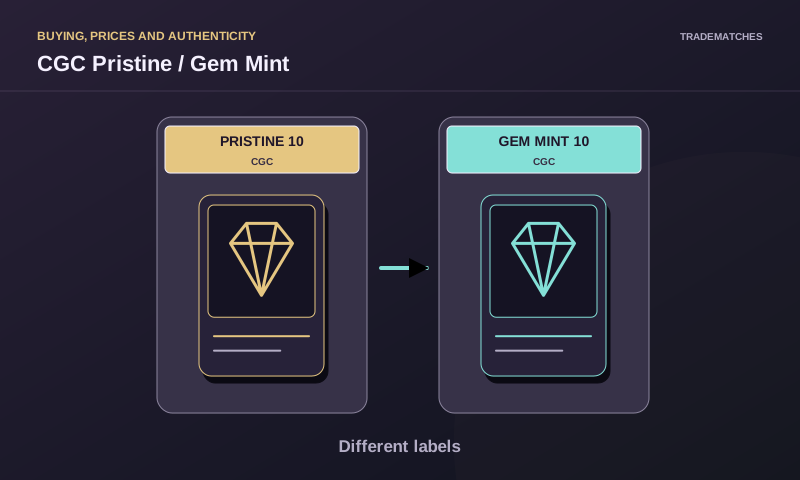
On the current scale of CGC Cards, Pristine 10 and Gem Mint 10 are different designations. In addition, the former Gem Mint 9.5 of CGC Trading Cards corresponds to Gem Mint 10 in the official transition table. That historical equivalence does not turn the current Mint+ 9.5 into a ten. Always read the label number, name and generation.
| Label text | How to interpret it |
|---|---|
| CGC Cards Pristine 10 | A current designation distinct from Gem Mint 10 |
| CGC Cards Gem Mint 10 | The current Gem Mint designation |
| CGC Cards Mint+ 9.5 | Current 9.5 grade; the legacy conversion does not apply |
| CGC Trading Cards Gem Mint 9.5 | Historical correspondence to Gem Mint 10 |
| CGC Trading Cards Perfect 10 | A retired grade retaining Perfect 10 status |
A ten can have two current designations
CGC distinguishes Pristine 10 from Gem Mint 10 by its published criteria. Pristine uses a specific label and requires the corresponding level in the aspects it evaluates. Gem Mint also has an overall grade of ten, but one of the criteria does not meet Pristine's requirement. The shared number does not eliminate that distinction.
Therefore, a "CGC 10" ad is incomplete if you want a specific category. Ask for the exact name and a readable image of the label. If you're looking for Pristine for a collection, a Gem Mint copy doesn't satisfy that same preference even if they're both ten. If you are simply looking for an encapsulated card that you like, you may be interested in another category, but the decision must start from a correct description.
What you can observe without becoming a grader
The official scale differentiates centering requirements and other characteristics. You can check images to detect an obvious misalignment or inconsistent data, but a photograph does not reproduce the entire evaluation. The reflection of a holder, perspective and compression can hide or exaggerate details. Don't promise a Pristine grade to an unevaluated card based on a frontal view.
In a purchase, use the images to check the identity and apparent state of the piece you will receive. If you need a professional evaluation, that's a different operation. Keeping those tasks separate helps avoid rejecting an authentic label because a reflection resembles damage, or buying an ungraded card on the strength of a grading guarantee the seller cannot substantiate.
The current Mint+ 9.5
Mint+ 9.5 continues to be a grade of the current scale. It is not a result that the buyer can rename as ten for remembering a historical change. The term Mint+ and the identity of the current service matter as much as the number. Copy the full label into your inventory to keep that information.
Imagine two ads: one shows an old label that says CGC Trading Cards Gem Mint 9.5 and the other a current CGC Cards Mint+ 9.5. The numbers match, but the designation and the generation differ. Applying the same conversion to both would be incorrect. First identify which one represents each photo and then consult the official key for the historical case.
The old Gem Mint 9.5
The legacy-grade key published by CGC relates CGC Trading Cards Gem Mint 9.5 to CGC Cards Gem Mint 10. It is a transition from a specific designation, not a general rule on any 9.5. The same page explains that their population and collection records reflect the updated scale.
If you consult a certificate and see an updated result other than the physical number of an old label, check this transition before concluding that a forgery exists. Then check that the identity and other data match. The existence of a historical explanation also does not eliminate the need to check the actual holder and the certificate of the specimen offered.
What happened to Perfect 10
CGC Trading Cards Perfect 10 appears as a retired grade that retains its Perfect 10 status. You must not present it as a current mode available for any new shipment or replace its name with another without explaining the context. Retired means you need to read it within the corresponding historical scale.
To archive an old copy, record what its label says and add a separate note about the current official treatment. Thus you retain information about the physical item and its current classification without mixing both. A collection with several generations of holders is easier to review when you do not quietly overwrite the old text with a new abbreviation.
Number, name and certificate
Do the check in three steps: identify the exact card, read the complete grade and designation, and check the official certificate. Compare language, edition, variant and numbering, in addition to the rating. A certificate of another printing of the same character does not validate the holder in front of you.
Also review the correspondence between front and back of the photographs. If the ad combines images of several pieces, you might be seeing a label of one copy and the card of another. Ask for consistent images of the particular copy. This request is especially useful when several units of the same product are advertised together with a representative photograph.
The autograph grade is separate information
The official scale includes autograph evaluations. If a label or record presents a grade related to a signature, do not confuse it with the condition grade of the card. Identify what each field is evaluating. A ten associated with an autograph does not automatically convert the card into Pristine 10.
In a sales or inventory description, separate card and signature when both appear. Write the card’s designation and, in another field, the autograph information. The reader can evaluate each aspect without having to guess what the number highlighted by the ad refers to. This clarity is more useful than an abbreviated title that only says ‘double ten’ without data.
Compare to PSA or BGS
There is no universal conversion that makes CGC Pristine, CGC Gem Mint, PSA 10 and BGS Black Label identical. Each service publishes its scale and designations. Comparing them may help you choose what to collect, but it does not allow you to say that a card will have a specific grade if you take it out of a holder and send it to another company.
If you evaluate a change of service operation, include its costs and the uncertainty of the result. An aesthetic preference for another holder may be a valid personal reason; a promise to raise the grade based only on similar names needs evidence that that comparison does not offer. Keep the presentation preference and a prediction that you cannot guarantee separate.
Buy a copy from Spain
Compare the total amount and identity of the copy, including transport and seller's conditions. This guide does not set import rates nor does it recommend sending every older slab for reholdering. Check whether your target requires a current presentation or whether you value keeping the historical piece as it is.
For two apparently equivalent copies, first gather designation, certificate and photographs. Then compare genuinely comparable transactions if you need to evaluate the price. Do not apply a fixed surcharge to any Pristine label or an automatic discount to an old one. The card, version and condition of the holder remain part of the collection decision.
Keep the label's history in your collection record
For an older copy, separate the physical label text from its designation under the current conversion key. If the slab says CGC Trading Cards Gem Mint 9.5, retain that transcription even when adding its official correspondence to Gem Mint 10. A future photograph will then match your record instead of appearing to show a different grade because of a catalogue error.
For a current Mint+ 9.5 copy, record exactly Mint+ 9.5 without applying the historical conversion. For Pristine 10, retain Pristine alongside the number. These three records remain searchable without losing the distinctions that matter. Include the certificate, card identity, language and a complete label photograph rather than replacing everything with a generic CGC ten field.
Use the same approach when selling. You can explain an older label's historical correspondence and link the official key while showing what the buyer will receive. Avoid a title suggesting a current slab when the photographs show the earlier generation. Designation correspondence does not physically change the holder or establish that a reholder service is included. A buyer wanting another presentation must assess that operation separately and check the available service, conditions and relevant uncertainty.
Frequently asked questions
Do Pristine 10 and Gem Mint 10 mean the same thing?
No. CGC maintains criteria and a specific designation for Pristine even if both current categories have grade ten.
Does every CGC 9.5 now count as a ten?
No. The transition corresponds to the old Gem Mint 9.5 identified by the official key. The current Mint+ 9.5 remains a different category.
Is Perfect 10 a current grade for new cards?
The official key describes it as a retired grade that retains its status for the corresponding historical pieces.