Curled foil cards: assessing them without heat or water
On this page
A curled foil card has a gradual bend that may relate to how its layered materials respond to environmental conditions. That is different from a crease, tear or surface separation. Start by documenting the shape and stabilizing storage; do not use heat, water, steam or force as a universal home repair.
General paper-conservation guidance helps explain environmental care, but it does not prove a treatment for every TCG foil construction. The sensible first task is assessing the object and its surroundings, not promising to make every card flat.
Distinguish a smooth curve from structural damage
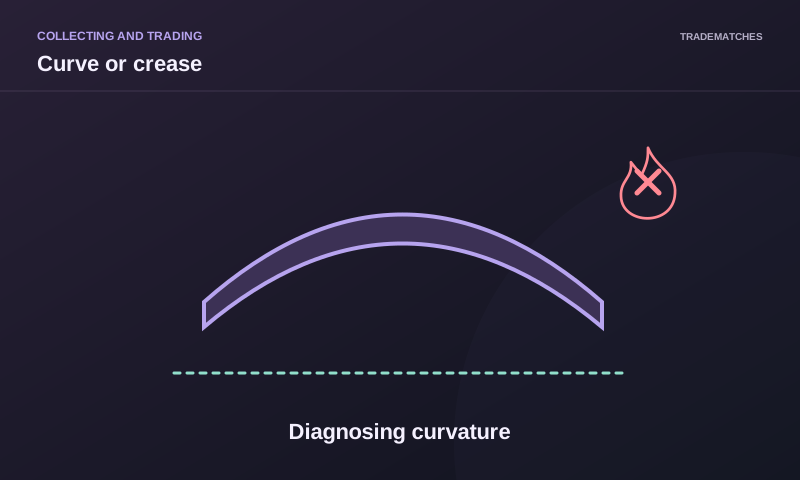
Inspect the card under ordinary diffuse light without pressing it flat. A broad, smooth curve across the card differs from a localized fold with a sharp line. Note whether the surface, edges and corners show any separate damage.
Look for cracking, lifting layers, staining or residue as well. Those observations can indicate a more complicated problem than shape alone. Do not treat a crease as harmless humidity curl merely because the card is also foil.
Take front, back and side photographs on a clean surface. The side view records the curve without requiring manipulation. Keep the date and storage context with the images so later comparisons concern the same card under reasonably comparable conditions.
Layered materials can respond differently
Paper-based materials interact with environmental moisture, and a card's additional layers can affect how the whole object changes shape. This is a general material explanation inferred from conservation principles, not a diagnosis of a particular manufacturer's laminate.
Different card products can have different coatings, thicknesses and constructions. A method reported to change one foil's shape does not establish the same response in another game, printing or individual condition.
The direction of a curve alone is not a reliable instrument for measuring humidity. Do not infer an exact environmental reading or a necessary treatment from whether the foil curves toward the front or back. Measure the environment separately if you need that information.
Review the storage location before changing the card
Check whether the card has been near a radiator, sunny window, damp wall or another source of changing conditions. A stable indoor storage location away from excessive heat, dampness and direct light is a practical first improvement.
Also inspect the enclosure. An overloaded binder, tight sleeve or uneven stack can impose mechanical stress. Environmental and physical causes can coexist, so moving the card without checking the enclosure may leave another source of deformation in place.
Record recent changes, such as moving the collection between rooms or receiving it through the post. These facts help explain the timeline, but they do not establish a single proven cause. Avoid assigning blame to the latest location without comparing the available observations.
Use environmental measurements carefully
A suitable room monitor can help you observe temperature and relative-humidity trends where the cards are stored. A single reading is less informative than a record of changes over time, especially if the room varies during the day.
General conservation recommendations concern stable conditions appropriate to the object. They do not justify repeatedly moving a card between improvised extremely dry and humid boxes to force a preferred shape.
If a valuable collection needs environmental assessment, ask a conservation professional about the particular materials and setting. A target chosen for one museum object should not be copied into a treatment recipe for every modern foil without checking suitability.
| Observation | Useful first response | What it does not prove |
|---|---|---|
| Broad smooth curve | Photograph and review storage | Exact moisture level or guaranteed reversibility |
| Sharp fold line | Record as structural damage | That ordinary storage will erase it |
| Layers lifting or surface cracking | Seek individual advice before manipulation | A safe universal flattening method |
| Several cards change in one enclosure | Inspect shared environment and support | That the card stock alone is defective |
Support the card without forcing its shape
Use a clean, appropriately sized enclosure that does not catch the corners or impose concentrated pressure. Support the card during handling and avoid repeated bending to test whether it “springs back.”
A protective holder can limit further handling, but it is not automatically a treatment. Do not describe a card as repaired merely because a rigid enclosure makes its outline appear flatter while pressure is applied.
If the card resists insertion, stop rather than forcing it. A sleeve or holder that works for a flat card may be awkward for a strongly curved or damaged one. Choose an appropriate temporary support or seek advice for the individual object.
Avoid heat as an improvised flattening tool
An iron, hairdryer, oven or other heat source can affect coatings, adhesives, printing and paper. The absence of an immediate visible mark does not establish that the treatment was harmless or suitable for that construction.
Do not copy a temperature and time from an unrelated card video as though it were a manufacturer-approved conservation procedure. A demonstration can show one result without documenting hidden changes, long-term stability or failed examples.
For a card whose value matters, the cost of an irreversible experiment can exceed the inconvenience of a visible curve. Documenting and storing it carefully preserves more options than applying an unverified treatment first and asking for assessment afterward.
Do not add water or steam to chase flatness
Direct wetting, steaming or placing a card beside a wet material introduces risks beyond its original shape. Moisture can affect surfaces, dimensions and layers, while an uncontrolled enclosure can create conditions you have not measured.
Likewise, drying a card aggressively is not a universal answer. A desiccant used in storage has a limited purpose and does not establish a safe corrective treatment for every foil. Do not equate “less humidity” with “better” without considering the object's needs.
If the card has actually become wet, that is a different incident requiring prompt, appropriate care. Do not use a general curl discussion as a complete water-damage procedure or delay professional advice while experimenting with household methods.
Pressure can hide a problem or create another
Heavy books, clamps and uneven weights can compress edges or imprint surfaces. A flat-looking card afterward may still have changes that matter to condition. The result should not be described as undamaged merely because the curve is less visible.
An individual conservation treatment may involve controlled procedures, but that does not validate arbitrary pressure at home. The professional evaluates the material, condition and goal before selecting a method.
Avoid repeated cycles of bending and pressing. Each handling episode creates another opportunity for wear or a localized crease. If ordinary supported storage does not produce an acceptable result, retain the documentation and seek an informed assessment.
Compare the same object over time
Use the initial photographs as a baseline. If you review the card later, use a similar support and viewing angle rather than pressing it flatter for the new image. Note any enclosure or environmental change between observations.
Do not claim causation from a single before-and-after photograph. A change may reflect the environment, support, viewing angle or another factor. Describe the observation accurately: the curve appears different under the recorded conditions.
This record is useful even if the shape does not improve. It helps distinguish a stable existing curve from new damage and gives a professional or potential buyer a clearer account of the object's recent history.
Describe curvature honestly when selling
Show a side view and disclose a noticeable curve. A flat photograph inside a tight holder can conceal the shape, so include an image that allows the buyer to assess the actual object without misleading pressure.
Condition grading considers more than the presence of foil or the visibility of a curve. Use the marketplace's current condition guide and identify any separate crease, surface issue or edge wear. Do not automatically assign a universal grade to every curved foil.
If you attempted a treatment or the card has a relevant damage history, describe it accurately. Do not advertise a home-treated object as factory-flat merely because a temporary photograph looks convincing. Clear disclosure reduces disagreement about what was offered.
Know when an individual assessment is worthwhile
Seek appropriate advice for severe deformation, valuable cards, separating layers or any situation where handling risks further damage. Provide the photographs, material identifiers, storage history and any previous intervention.
The expert's assessment can distinguish stabilization from treatment and help define a realistic goal. Complete visual flatness may not be achievable or desirable without an unacceptable trade-off. The article does not promise restoration or a particular grading outcome.
For ordinary collection care, a documented condition and stable supported storage can be a satisfactory result. It leaves the card identifiable and the decisions reviewable without turning a common physical observation into a series of uncontrolled experiments.
Frequently asked questions
Does every curved foil have the same humidity problem?
No. Layered materials and storage can contribute, but a curve alone does not prove one cause or an exact environmental condition.
Is a crease the same as ordinary foil curl?
No. A localized fold can involve structural damage and should be identified separately from a broad smooth curve.
Should I use an iron, water or heavy pressure to flatten it?
Do not treat those as universal home solutions. Document the card, improve appropriate storage and seek individual advice where its value or condition warrants it.