Fusion World deck checks: 50–60 cards and Super Combo
On this page
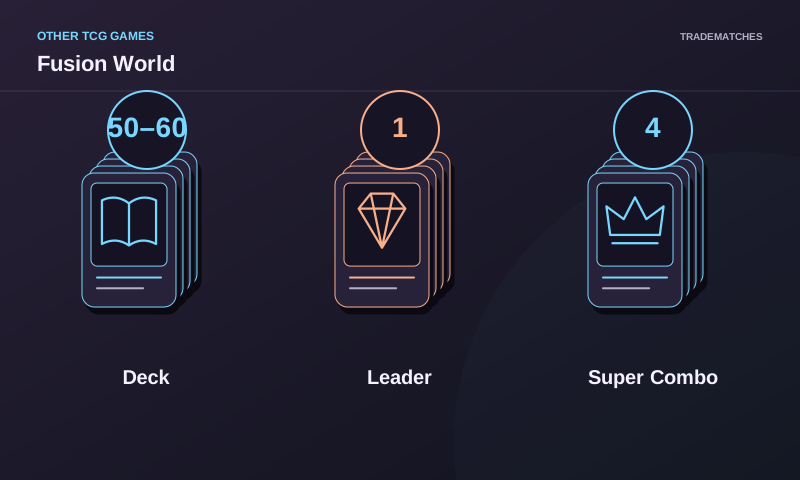
A normal Fusion World deck has one Leader plus 50–60 Battle and Extra cards, with up to four copies per card number and a separate overall Super Combo limit. Check the Leader's colours, any printed construction exceptions and the current banned/restricted list. A 51-card starter total can mean one Leader and a 50-card deck; it does not mean the main deck must contain 51 cards.
Count the Leader separately
Bandai's current official rules hub links the comprehensive rules and deckbuilding FAQs. The Leader is a separate required card rather than one of the 50–60 cards in the main deck. Counting it in the deck total can make a list appear legal when it contains only 49 main-deck cards.
For a hypothetical purchase, a seller offers “50 cards including the Leader.” If that means one Leader and 49 Battle/Extra cards, it is not a normal legal 50-card main deck. Ask for separate counts rather than debating whether the box's overall number sounds correct.
Likewise, a printed contents line can include accessories, bonus packs or other cards outside the playable list. Open the inventory into separate categories: Leader, main deck, spare cards and components. A ready-to-play product description and a mixed collector lot do not guarantee the same things.
| Item in a hypothetical deck package | Normal construction record |
|---|---|
| One chosen Leader | Separate Leader entry |
| Battle and Extra cards used in the list | Count toward the 50–60 main deck |
| Spare alternate-art copies | Count only if included in the list |
| Energy markers or play aids | Components, not main-deck cards |
| Additional Leaders in a collection lot | Alternatives, not simultaneous main-deck inclusions |
Check colours before buying supporting cards
The general construction rule ties permitted card colours to the Leader. A desirable card from a different colour does not become legal just because you can imagine charging it as energy. Examine the Leader's actual colour identity and the card's actual colour, then apply any specific construction exception that the current text provides.
For an original practice example, suppose a hypothetical Leader has only colour A. A list containing cards of colour B needs an applicable exception before those cards can be included. The fact that other decks in the same game use them does not establish permission for this Leader.
Do not import the deckbuilding rules of Dragon Ball Super Masters. Fusion World is a separate game with its own rules and card pool. Similar character names or artwork are not evidence that a Masters card is a playable Fusion World addition. Verify the game, product code and current official database entry before agreeing a trade.
Count copies by card number, not artwork
The normal four-copy limit is by card number. Alternate illustrations of the same numbered card are not four additional mechanical copies. Group the standard and parallel versions together when checking the list.
Imagine two standard copies and two parallel copies of one numbered card. That totals four. Adding another parallel because its picture differs would make five copies of that card number. Conversely, two cards depicting the same character may have different card numbers and different effects; a shared character name is not by itself the copy-limit identity.
A spreadsheet should have one row per card number, with separate quantity fields if you want to preserve information about finishes. Calculate the playable total across those variants. For a collector, separate finish columns are useful; for a deck check, they must not obscure the combined quantity.
Super Combo is a combined limit
Check the current Super Combo rule and card text as well as the normal per-number limit. You cannot assume that four copies of each different Super Combo card are allowed together merely because each number individually passes a four-copy check. The keyword's overall deck restriction is a separate test.
For a hypothetical list with three copies of Super Combo card A and two of Super Combo card B, the total is five. A normal four-card combined Super Combo allowance is exceeded, even though neither individual number exceeds four. Reducing B to one produces a total of four, assuming the rest of the list and Leader eligibility are correct.
Keep a separate sum in the inventory rather than expecting a per-card spreadsheet filter to catch this error. A sensible audit sequence is total main deck, copies per number, colours, Super Combo total and current restrictions. Passing one stage says nothing about the remaining stages.
Printed exceptions must be verified
The comprehensive rules recognise construction effects that modify ordinary requirements. If a card's current text supplies an exception, apply that exact exception; do not turn it into permission for unrelated cards. An exception to copy quantity does not necessarily change colour rules, and an identity-granting rule may need its own construction interpretation.
For a practice deck, write the specific rule exception next to the card number that uses it. Include its source and the relevant current text. “I saw someone play more copies” is not a rule explanation. The other list may have a qualifying card, a different Leader, an earlier legal environment or simply an error.
If you are purchasing a bundle advertised as a legal deck, ask which version of the official list and restrictions was checked. Legality is time-sensitive, while the physical cards remain the same. A statement made when the list was assembled may need another check before an October 2026 event or any later event.
Build an itemised trade list
A useful trade request gives Leader identity, card numbers, needed quantities and whether alternate art is acceptable. “Need blue Goku cards” is too broad to communicate a playable list. If you also collect character art, mark those cards as collection wants so they are not confused with deck requirements.
For an original budget exercise, suppose you already own two playable copies of a required number and one expensive parallel of the same number. You need one more copy to reach four; you do not need two. Whether you are willing to play the parallel is a separate choice about collection use, condition and protection.
Check each received card against the intended list. A wrong numbered version of the same character can leave the deck's role unfilled even if the lot's total count is correct. Record the discrepancy before sleeving the deck and treating the purchase as complete.
A final physical audit
Lay out the Leader separately. Count the main deck in groups you can verify rather than estimating by stack height. Group every shared card number across finishes, add the Super Combo quantities, inspect colour eligibility and read any exception used. Finish with the current official restrictions and the event's required list procedure.
This is a reproducible deck check, not a recommendation for a particular competitive build. It helps a beginner avoid spending money on incompatible cards and lets a seller describe a deck package accurately without promising tournament results.
Frequently asked questions
Is the Leader one of the 50–60 cards?
No. Count the normal main deck separately from its single chosen Leader. A package total including that Leader is not the main-deck count.
Do parallel artworks provide extra legal copies?
No. Group copies sharing the same card number for the ordinary copy-limit check, regardless of illustration.
Can I combine four copies of several Super Combo cards?
Not by relying on the per-number limit alone. Check the combined Super Combo restriction and any applicable specific rules before finalising the deck.