Foil-etched and traditional foil in Magic: how to tell them apart
On this page
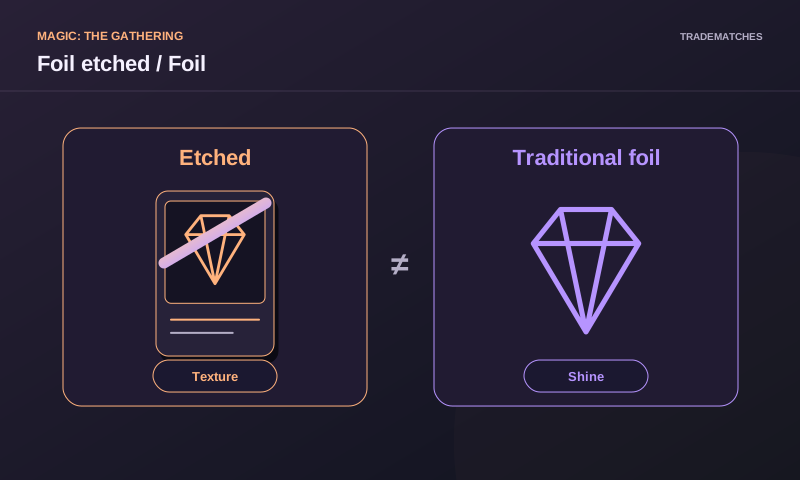
Foil-etched and traditional foil are different Magic card treatments. Shine in a photograph is not enough to identify your copy: some sets offer the same card, even in the same frame, with both finishes. Start with the set and collector number.
What to inspect on the actual card
Tilt it under soft light and compare reflections in the frame and art with official images of that printing. Traditional foil often has a broad, shifting reflection; etched has a different surface effect that may look more localised or granular depending on the product. Do not turn that observation into a universal rule: Wizards has used different treatments across sets.
Check the name, set code, number, language and frame. Then consult Wizards’ product guide to see whether that combination was printed as etched, traditional or both. If a catalogue photo hides the difference, ask the seller for a short video tilting the actual card.
Why the distinction matters in a trade
Different finishes can have different availability and prices. Listing only “foil” when multiple versions exist makes the other collector guess. State the precise treatment and attach an unfiltered photo; if you cannot confirm it, say so and postpone the valuation. A normal finish difference is not automatically a printing error.
Example listing
“Magic, set X, no. Y, English, retro frame, foil-etched confirmed against the official guide; corners and back photographed.” Each detail answers a separate question: identity, finish and condition. If the official guide documents only traditional foil for that printing, revisit your identification before advertising etched.
The edition matters more than a generic sheen
Wizards of the Coast has used traditional foil for many years and added foil-etched as another treatment. Both can exist for cards with the same name and art, but their exact appearance depends on the product. That is why a visual rule like "etched is always dark" or "traditional always shines throughout the illustration" can fail. Start by identifying the collection, collector number, language, and frame. Then consult the official guide for that collection to see which versions were produced. Light over the card helps confirm; it does not replace the catalog.
For example, Modern Horizons 2 offered cards with a retro frame in normal, traditional foil, and foil-etched versions, with different distributions between envelopes. Commander Masters described its foil-etched with a matte frame and special varnish. The word "etched" designates the treatment family, but the visual result of a collection does not automatically apply to another. If you are buying a specific copy, look up the correct set guide and compare photographs of the same print.
How to inspect the physical card
Remove the card from a very reflective sleeve, if it is safe for its condition, and observe it with diffuse light from several angles. Look at the frame, the text, and the illustration separately. A reflection that changes when tilting the card can be a clue for traditional foil; a localized effect or a different surface can point to etched. However, the camera, lighting, and variations between sets can deceive. Do not rub the surface or try to fold it to "test" the treatment: you could damage it without obtaining a reliable conclusion.
If you only have photos, ask the seller for a short video tilting the card with stable lighting and a clear image of the lower number. A front-facing photo with flash can make any foil look like a white spot. If the advertisement shows a promotional image of Wizards instead of the actual copy, there is still a need to verify the actual copy you will receive. Describe exactly what data you need: name, code, number, and treatment; this avoids a vague conversation about whether "it shines a lot."
The collector number helps, but it is not always sufficient
The number and set code narrow the search to a print, but some products include different finishes for the same card or number. That is why after the code you need to confirm the specific treatment. A database can show several related entries, and an official product guide explains in which envelopes they appeared. Use both data: the physical card to identify the print and the guide to check if that combination existed. Do not automatically assume a finish for a card just because another of the same collection had it.
Example: two ads share the same name and number, one says traditional foil and the other etched foil. If the official guide indicates that this card was made in both versions, there is no contradiction; you need to verify which photo shows each one. If the guide does not register one of the combinations, ask for clarification before paying. An error in listing can be honest, but the buyer should not assume the risk of guessing.
Foil-etched is not a rare game item
The treatment describes the print, not changes the text of the rules of the card. A foil-etched version of a playable card is used according to the same current text as another print of the same card, subject to the legality of the format and that the piece is a normal game card. Do not confuse foil-etched with a card of art, a thick display card, or a promotional item not suitable for tournament. Eligibility depends on the type of product and format; the sheen alone does not grant or remove permission.
For collecting, it can matter a lot the finish. Two identical playable versions in rules can attract different buyers and have different prices. When trading, "foil" is an incomplete description if the collection offers traditional and etched. Add the treatment, edition, number, language, and condition. This way the other person can compare the correct offer and not a more common variant.
Availability in envelopes: verify the set
The location of each treatment changes between products. In Modern Horizons 2, Wizards explained that certain foil-etched appeared in Collector Boosters while normal and traditional foil versions of retro frames were available in other envelopes. In Commander Masters, the etched variants had another distribution. Do not use an old phrase like "etched only appears in Collector Booster" for all future sets. If you buy envelopes expecting a specific version, read the current collection guide before spending.
This same caution applies to probabilities. Knowing that a variant appears in a certain type of envelope does not guarantee opening it in a box. If you are looking for a specific card and finish, comparing the cost of buying the individual copy with opening product may be more reasonable. The article does not predict prices or future rates; the method is to identify the exact version and review its official distribution.
Why comparative photos can deceive
A mobile phone automatically adjusts exposure and white balance. Two photos of the same card can show different tones and make it seem like different treatments. Bright sleeves add their own reflections. That is why compare under the same light and, if possible, with an official reference card from the same collection. Do not compare a etched foil of Commander Masters with a traditional foil of a different collection to decide which card you have; the design differences mix variables.
Also check if the apparent change in shine comes from wear, dirt, or a printing defect. These factors affect the condition, not necessarily the type of foil. A card can be etched and have scratches; another traditional one may reflect less because the photo is dark. Separate treatment and condition in your sale description.
A useful card for a trade
Before posting, write: full name, collection and code, number, language, treatment, condition of the front and back, and if you have photos of the exact copy. If you are unsure about the treatment, indicate it as a doubt and ask for a second review; announcing it as etched without proof can generate a dispute. A buyer may value one version much more than another, so an imprecise label affects the economic decision. Transparency is more useful than an enthusiastic but ambiguous description.
If you receive a card different from the described one, compare it first with the official product card and with the photos in the ad. Explain to the seller the noticeable difference, for example, "the ad indicated etched foil and this copy corresponds to the traditional foil finish of the same collection." Do not base the entire complaint on "it shines differently" without identifying the print. The set data and finish allow better resolution.
Common mistakes
One: calling etched any foil that seems dark. Two: thinking that the same finish looks the same in all sets. Three: using only the number without confirming there were multiple variants. Four: describing "foil" when there are two treatments. Five: assuming that a finish changes playability. To avoid these, identify the print, consult the official guide, observe the real card, and record the treatment separately from the condition. It is a repeatable method for new cards without memorizing each visual effect Wizards publishes.
Frequently asked questions
Does every Magic card have an etched version?
No. Check the set guide; a traditional foil printing does not imply an etched one.
Is the collector number enough?
Sometimes it helps, but not always. Compare the physical finish with the product-specific guide.