Pauper legality: rare printings and downshifts
On this page
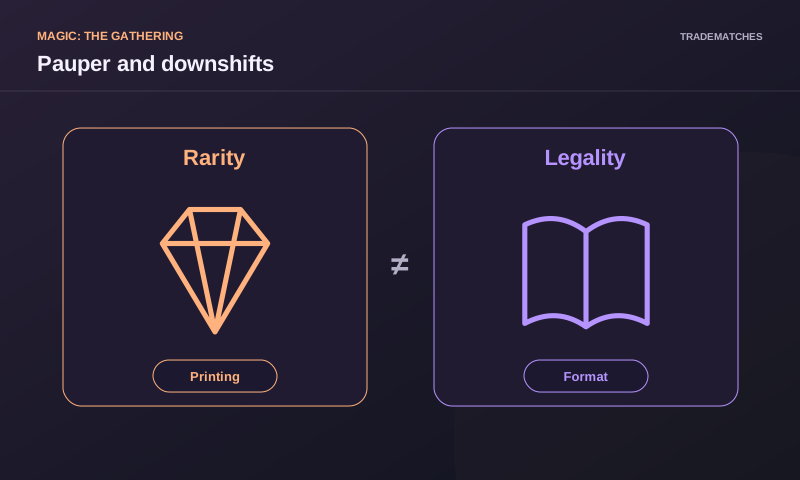
A rare copy or foil can be legal in Pauper if that card has a valid common printinging on paper or Magic Online and is not prohibited. The rarity of your copy is not the only one that decides. You must review the print history, the origin of the common printing and the list of prohibitions in force before purchasing or registering the deck.
Pauper checks the card and its history
The format admits cards that have had a common printinging on the products covered by its definition. Once a card meets that requirement, you can use another version of the same card, including higher rarity versions or different treatments. This allows you to choose an illustration that you already have without the rarity symbol of that copy automatically invalidating the deck.
The check is done by card identity, not by character or visual resemblance. Two cards with different names and similar effects do not share the rarity history. If you use a translation, confirm the equivalent name on the official database. A search by the name may show related versions or cards that do not justify the legality of the one in your hand.
What a downshift means
A downshift occurs when a card appears at a lower rarity than it had in another printing. For Pauper it is especially important that there is a common printinging that meets the requirements. You don't need to physically get that common if you already have another valid copy of the same card; you do need to be able to identify where the eligibility condition comes from.
Imagine a card originally published as uncommon and reissued as common in an admitted product. The higher-rarity copy is not physically transformed, but the card history may allow you to play it in Pauper. The right procedure is to seek common printinging and review prohibitions. Don't announce that "all the uncommons of that set can be played" by the fact that one has received a downshift.
Magic Online and Arena are not equivalent
The official definition mentions paper and Magic Online. You must not convert any common designation on MTG Arena into tabletop Pauper eligibility. Arena and Magic Online are different platforms, with different catalogues and formats. An image search or an application that mixes data can hide where the rarity you're seeing comes from.
When a card only seems common in digital, identify the platform. Then check its official eligibility for Pauper. Events called "Pauper" within another platform may use specific rules that do not match the table format. If you go to a Spanish store, the event details should clarify which format is played; do not bring a deck of a digital event without reviewing it.
A promo with a common symbol needs another check
The official page clarifies that common promos are legal when the card meets the defined requirements for the format. You should not treat an isolated promotional label as a universal exception. Find out the product and criteria that correspond to it before adding it to a list. A rarity symbol in a cropped image provides less information than the full printing record.
If the information from two sources differs, please refer to the current definition and the format-specific announcements. Some decisions require formal clarification, as was the case with special products in 2026. Saving the reference allows you to check the applied rule; it does not replace the revision of later changes.
Valid rarity does not mean allowed card
A card may have been common and prohibited in Pauper. The list of prohibitions is a second independent filter. Nor does a reduction of rarity oblige the format authorities to keep the card available if its impact leads to a ban. Before buying a group of four copies, check both conditions.
To avoid errors, use two columns: common printinging that justifies eligibility and status in the current list. Add the date of consultation. Such a review is particularly useful when a deck list comes from an old article, a recorded game or an event prior to a change. A deck that was legal may require replacements today.
The September 2026 Zeta case
The official announcement about Zeta shows why the news should be read to the end. Wizards explains a review of its initial decision and establishes legality on paper since September 7, 2026, with addition to Magic Online on September 23. It also announces preventive prohibitions of Narcomoeba and Price of Progress. Do not use only the first paragraph of the news as the final state.
The practical lesson is not to memorize an indefinite exception. It is to distinguish initial decision, update, effective date and platform. The announcement itself indicates that the environment may require further action. This guide was revised on October 1, 2026; for a later event, reopen the official list. Do not convert the availability of a card on that date into a promise of permanent legality.
How to review a card in three steps
First identify the name of the card and its printings. Second, locate a common printing that meets the format definition. Third, review the official list of prohibitions and notes of any advertisement that may affect it. Then check the number of copies, language and physical conditions of the copy you are going to play.
If you do not find a common acceptable, do not fill the void with the assertion of a sales announcement. Ask the organizer with the name and printing you think is valid, or use another card until you resolve it. A cheap offer of four copies does not prove that they can be played, and an expensive offer does not prove that they are prohibited either.
Main deck and sideboard
Pauper uses a main deck of at least 60 cards and a sideboard of up to 15 when used. The ordinary limit of four copies is counted between the two, with corresponding exceptions such as basic land or specific text. You cannot avoid a ban by placing the card on the sideboard; it is also part of the construction of the event.
Check the last-minute substitutions on both sets. A card you add in response to a pairing must overcome the same eligibility check as the main threats. If you have several illustrations or languages of the same name, count them together. Physical variety does not create additional card names.
What to buy to play and what to keep for collection
A premium legal print offers the same gaming function as another legal print on that card, without prejudice to checking updated text and physical conditions. Decide if you want to pay for finish, illustration or edition and separate that cost from competitive need. To complete a deck, you may already have a version that serves.
When looking for a copy among other collectors, specify the name and what printings you accept. If you prefer the common one for visual uniformity, say it as a preference. If you need a legal card, avoid presenting the rarity of your copy as sufficient proof: provide the history or reference you have checked. This facilitates exchanges without mixing collection value and rules.
Keep a legality reference you can review
Before buying a doubtful card, record three things: a qualifying common printing, the banned list you checked and the review date. You do not need photographs of every version ever released. You need to explain why that card identity meets the rarity requirement and remains permitted. A link to the rare printing you like does not replace the common-printing reference that establishes eligibility.
Consider a hypothetical card first printed as uncommon, later as common in a qualifying product and then as rare. The latest copy does not become ineligible solely because of its rarity symbol, provided its identity has the necessary history and is not banned. Conversely, a common card on the banned list does not become legal when you choose a printing from another year. Keeping these records avoids repeating the same research whenever you change a copy's finish or artwork. Recheck bans near the event: rarity history and current permission belong in separate fields.
Frequently asked questions
Can I play a rare one if there's a common legal one?
Yes, if it is the same card, it meets the requirements of the format and is not prohibited. The rarity of the chosen specimen does not have to be common.
Does an Arena common qualify for tabletop Pauper?
You mustn't take it for granted. The official definition refers to paper and Magic Online; check the qualifying printing history and the specific format.
Can a prohibited card be carried on the sideboard?
No. Sideboarding is also subject to the legality of the format. Check its contents along with the main deck.