Pokémon Ancient Traits: why they are not Abilities
On this page
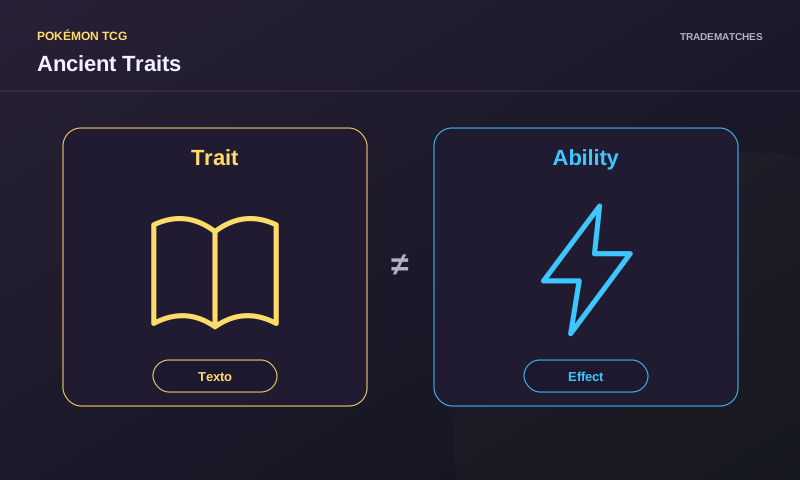
An Ancient Trait is a distinct category of Pokémon card text, not an Ability or an attack. Effects that stop Abilities therefore do not automatically stop an Ancient Trait. Identify the trait's separate banner and read its conditions before deciding whether an opposing effect can interfere with it.
This distinction is useful both at the table and when cataloguing older cards. “Ancient” in a modern Pokémon name or expansion description is not enough. The historical XY mechanic has a specific presentation and rule identity, and it should not be confused with later Ancient-themed cards.
Find the trait banner on the card
Ancient Traits appear in a separate coloured banner near the top of certain Pokémon cards. Their names use distinctive symbols, such as the Greek letters associated with different trait families. Look for that dedicated text area rather than treating every sentence above an attack as an Ability.
Use the official Pokémon glossary and the appropriate historical rulebook to confirm the category. A database page can help establish the card's name, number and expansion, but some older online entries omit text displayed inside artwork or unusual banners. If the web entry appears incomplete, consult the card image and rulebook instead of concluding that the printed trait has vanished.
An album description should say “Ancient Trait” and include the actual trait name when it matters to your collection. Calling the card an “Ancient Ability” may seem harmless, but it creates an incorrect rules expectation and makes searches less precise for people looking for a particular mechanic.
A trait and an Ability can coexist
Classify each part of the card separately. A Pokémon can have ordinary attacks, an Ability and an Ancient Trait if its printing provides them. The existence of the trait does not reclassify all the other text, and an effect that disables an Ability can still disable the real Ability while leaving the trait alone.
Consider a hypothetical card with a defensive trait and an Ability used to draw a card. If the opponent applies a restriction on Abilities, do not say that the entire Pokémon is immune because it has an Ancient Trait. The drawing Ability and the defensive trait answer different rules questions.
Likewise, retaining a trait does not allow the Pokémon to ignore attacks, damage or every Trainer effect. It only preserves the text of that trait against a restriction that does not apply to its category. Any protection comes from the trait's particular wording, not from a universal immunity granted by the banner.
| Printed element | What it does | Does an Ability-only restriction automatically cover it? |
|---|---|---|
| Attack | An attack used through the attack procedure | No; read the restriction's scope |
| Ability | The Pokémon's Ability text and conditions | Yes, when the restriction applies to that Pokémon |
| Ancient Trait | A separate historical text category | No |
| Pokémon-EX rule | A rule attached to that Pokémon category | Not merely because it is printed text |
| Modern Ancient label | A different card designation | It is not the historical trait mechanic |
Read Omega Barrier as a scoped protection
Primal Groudon-EX is a familiar historical example associated with Omega Barrier. Its protection concerns the opponent's Trainer effects, with an exception for Pokémon Tools. This is much more specific than “nothing can affect this Pokémon.” Refer to the card's exact trait text when checking a particular interaction.
Ask what the opponent is actually doing. Damage from an attack is not made into a Trainer effect by the fact that a Trainer helped prepare the attack. A player's action can involve several cards, but the source and scope of the effect affecting the Pokémon determine the protection check.
The exception for Tools also matters. Do not shorten the trait to “immune to Trainers” in a deck note and forget the exception during a game. A compact reminder should preserve the limitation, because an omitted clause can reverse the answer to the precise interaction you are trying to resolve.
Alpha Growth changes the ordinary attachment
Another useful example is Alpha Growth, which can change the ordinary Energy attachment from hand by allowing an additional Energy attachment under its printed conditions. It does not establish a general licence to attach extra Energy every time any attack, Ability or Trainer attaches one.
For a practice turn, separate your normal attachment from effect-based attachments. If you attach through the ordinary once-per-turn procedure to a Pokémon with the relevant trait, check the trait's permission for the second card. If an Item subsequently attaches Energy from another zone, read that Item and the trait separately rather than automatically repeating the trait's benefit.
This exercise also helps prevent counting the same permission twice. Record which ordinary attachment you used and which extra attachment the trait allowed. The order may look like two similar physical movements, but their legal causes are different. A clear announcement is easier to verify than moving several Energy cards and explaining afterwards.
Trait names describe different effects
Do not learn one Ancient Trait and apply its effect to every Pokémon with a similar banner. Different names provide different modifications, and the Greek letter alone is not an instruction to copy another card's text. Some affect attacks, some attachments and some defensive interactions.
A collection organised by traits should therefore contain a text field or reference for each actual trait. Grouping everything into a single “special ability” category loses the reason a player might seek one printing rather than another. The same Pokémon species can have unrelated ordinary printings with none of the relevant trait text.
When comparing two candidates for a historical deck, evaluate the trait alongside the card's own attacks, HP, retreat requirement and evolution route. A desirable trait does not guarantee that the rest of the card fits your plan. Conversely, a modest attack can still have collection interest because of the printing's distinctive category.
Historical Ancient Traits versus modern Ancient cards
Pokémon has reused broad thematic language across different eras. The Ancient label appearing on later cards is not evidence that those cards use the historical Ancient Trait rules. Identify the expansion, printed category and complete text rather than connecting cards through a shared English word.
For example, an older XY card with a dedicated Omega or Alpha trait banner belongs to this discussion. A later card whose design marks it as Ancient has its own contemporary card identity. Search effects referring to the modern label should not be assumed to find every historical trait card.
This matters for buying too. A listing titled “Ancient Pokémon lot” may refer to either theme, a mixed collection or simply a seller's description. Ask for the actual collector numbers and photographs. A seller's category is a navigation aid, not an official rules definition or a guarantee that the lot contains the mechanic you want.
Build a reliable collection entry
Record the full Pokémon name, expansion, collector number, language, finish and condition first. Then add Ancient Trait as a separate feature, with the trait's actual name. Keeping identity and mechanic separate lets you find the correct card even if different marketplaces use different descriptive tags.
Photograph the banner clearly when offering a card. A cropped image showing only the Pokémon's artwork can hide the feature that makes the printing relevant. At the same time, do not use a clear banner to imply the rest of the card is Near Mint; front, back and defect photographs serve a separate purpose.
If a collection goal is “one card with each trait,” define whether different languages or finishes count as alternatives or additional targets. That is a personal collecting choice rather than an official complete-set rule. Writing it down prevents an expanding checklist from becoming an accidental promise to buy every variation.
Check the format before building around a trait
These cards come from an older period of Pokémon TCG. Their rule identity remains useful for historical or eligible formats, but being a genuine official card does not make them legal in current Standard. Check the event's card pool and restrictions before purchasing a competitive package.
For an agreed casual game, tell the other player that your deck includes historical traits and keep their text accessible. Explain the specific interaction when it arises rather than opening with a claim that the cards bypass all modern rules. Clear boundaries make older mechanics easier to enjoy without turning every turn into a dispute.
Frequently asked questions
Does stopping all Abilities also stop Ancient Traits?
Not solely on that basis. Ancient Traits are not Abilities. Check whether the effect has additional wording that applies to the trait's particular action or to the Pokémon more broadly.
Is every card labelled Ancient an Ancient Trait card?
No. Historical Ancient Traits and later Ancient card designations are different categories. Use the banner, expansion and actual card text to identify which one you have.
Does an Ancient Trait prove that a card is rare or expensive?
No. The mechanic identifies a feature of the printing. Rarity, condition, language, demand and the exact variant require their own checks; the banner alone supplies neither a price nor a grading result.