Pokémon Fossils: Trainers played as Basic Pokémon
On this page
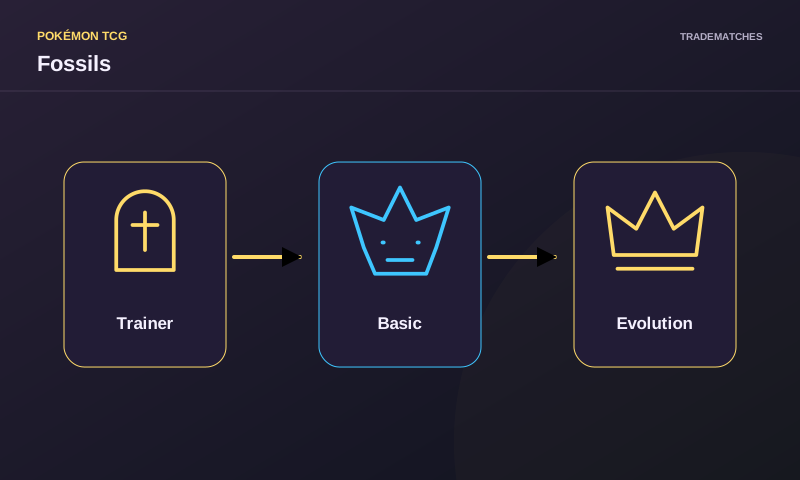
A Fossil Trainer is a Trainer card outside play, but its own text can let you play it as a Basic Pokémon. That change of role is why a Fossil can occupy your Bench and evolve while still failing a search for a Basic Pokémon in your deck. Read the specific Fossil and the evolution's “Evolves from” line: different generations use different systems.
This guide concerns the physical Pokémon TCG. Pokémon TCG Pocket has its own cards and procedures, so an example from the mobile game is not evidence for a tabletop ruling.
Identify the system before building the evolution line
“Fossil Pokémon” describes a theme, not one universal card category. Some printed Pokémon are ordinary Basic Pokémon. Others evolve from a Trainer that has been played as a Pokémon. Historical Restored Pokémon use a separate stage and enter through a named Item effect. The artwork showing an ancient creature does not tell you which procedure applies.
Start with the card you want to evolve into. Read its stage and the exact name after “Evolves from.” Then find that predecessor's card text. A collector might own a Fossil Item and a Pokémon of the right species, yet have two cards from incompatible systems. Similar illustrations and a shared fossil theme do not make an evolution legal.
For example, the official rulebook links Rare Fossil and Unidentified Fossil to Pokémon that explicitly name them as predecessors. A historical Restored Omanyte instead refers to Helix Fossil Omanyte's effect. Those are different instructions, even though both routes eventually lead to a fossil species.
The card's role depends on its zone
The official glossary describes Fossil Trainers as Trainers that act as Basic Pokémon when put into play. In the hand, deck and discard pile, the Fossil is not a Basic Pokémon. Therefore, a search whose only eligible cards are Basic Pokémon cannot take a Fossil Trainer from the deck merely because you intend to play it as one afterward.
Read the search instruction independently of your future plan. A card that finds an Item might reach an eligible Fossil Item, while a card that finds a Pokémon might reach an ordinary printed Pokémon. Neither permission should be inferred from the other. The relevant question is what the card is in the zone being searched.
This also matters when recording a deck list. Keep the printed Trainer classification visible in your records instead of moving every Fossil into the Pokémon category because of its battlefield role. An inventory can include a note about its function without changing its identity.
Playing a Fossil onto the Bench
A Fossil that says to play it as a Basic Pokémon supplies its own permission. Follow that text, including its HP, Pokémon type and restrictions. Once it is in play, it occupies a Pokémon position and uses the Bench's capacity. It is not a spare Trainer you can place beside the playmat without counting it.
Imagine a Bench with four ordinary Pokémon and room for one more. Playing an eligible Fossil fills that last position. You cannot then add a sixth Pokémon just because one of the five started as an Item. When a later effect refers to Pokémon in play, examine the Fossil's text and current role rather than its original location in your collection.
Placing it on the Bench also creates a decision about timing. If your objective is to evolve on a later turn, delaying the Fossil can delay the whole line. Conversely, filling your last Bench position can prevent a different Basic from entering. The useful comparison is between those concrete board needs, not between “a Trainer” and “a real Pokémon.”
Opening hands require special care
Do not assume that the words “play as a Basic Pokémon” let a Fossil serve as your opening Active Pokémon. Modern Fossil Trainers are not Basic Pokémon in your hand during setup. You still need an eligible Basic Pokémon to establish the opening position and satisfy the deck's requirement to contain a Basic.
Historical rulebooks and cards can create confusion here. Some old materials describe Fossils differently during setup, and a nostalgic format may use a particular historical rules reference. Agree on that reference before playing. A current physical-game ruling should not be replaced by a remembered sentence from an old booklet.
If your opening hand contains only Fossil Trainers and no eligible Basic, apply the proper mulligan procedure for the format. Do not quietly select a Fossil because it will have HP once played. Its later in-play role does not retroactively change the opening hand.
Evolving requires the printed predecessor
After the Fossil is in play, an Evolution card must name that Fossil as its predecessor. Match the words, not the species you hope it represents. A card that evolves from Rare Fossil does not automatically evolve from Unidentified Fossil, Armor Fossil or another ancient-looking Item.
The usual evolution timing still matters unless a specific effect changes it. Playing a Fossil does not grant an immediate free evolution simply because you paid no Energy to establish it. Check when the predecessor entered play and whether an effect actually authorizes an exception.
Try laying the entire line on the table before sleeving a historical deck. Put the proposed Fossil beside the first Evolution, then read the predecessor line aloud. Continue upward through the next stage. This quick exercise detects a mismatched generation more reliably than sorting cards by Pokémon species alone.
Restrictions are printed on each Fossil
Armor Fossil's official card entry illustrates why reading the whole text matters. It has its own HP and instructions about Special Conditions, retreating and voluntary discard. Those restrictions are not safely reconstructed from the general rule that the card acts as a Basic Pokémon.
If a Fossil cannot retreat, attaching enough Energy does not remove that restriction. A switching effect and retreating are different procedures; inspect the switching effect rather than treating them as interchangeable. Likewise, immunity to Special Conditions does not necessarily mean immunity to damage, counters or every other attack effect.
Do not extend one Fossil's wording to every Fossil in your binder. A later card may have different HP, a different discard instruction or an additional Ability. A strategy built around an old example must be checked against the exact printing you will use.
Knock Out and voluntary discard are different events
A Fossil played as a Pokémon can be involved in the normal consequences of a Knock Out, subject to its text. Some Fossils also allow their controller to discard them from play during their turn. If the card says that voluntary discard is not a Knock Out, you should not award a Prize merely because the Fossil ended up in the discard pile.
Compare two situations. An opposing attack removes the Fossil's remaining HP; you resolve the resulting Knock Out as instructed. In another turn, you use the Fossil's printed permission to discard it. The destination may look the same afterward, but the event that moved the card differs.
That distinction also affects effects looking for a Knock Out. Announce the procedure clearly before moving the card. A casual “I get rid of this” can hide whether you used a printed action, resolved damage or followed a different effect.
Restored Pokémon follow another route
Restored Pokémon are neither ordinary Basic Pokémon nor Evolution cards simply because they have an evolution above them. The historical rulebook's Omanyte example enters the Bench through the named Fossil Item's effect. You cannot ordinarily place that Restored card from your hand as though it were a Basic.
Once the Restored Pokémon is established, its next Evolution can follow the normal predecessor and timing requirements. The exceptional part is getting the Restored stage into play. Keep those two questions separate when checking a deck: “How does this first Pokémon enter?” and “What can evolve from it afterward?”
For a collection arranged by playable lines, give these systems separate labels. That prevents a buyer from receiving a visually attractive but unusable bundle whose opening stage has no matching enabling Item.
| Card or location | What to check | Mistake to avoid |
|---|---|---|
| Fossil Trainer in the deck | Printed Trainer subtype | Searching for it as a Basic Pokémon |
| Fossil played on the Bench | Its in-play instructions and HP | Ignoring Bench capacity |
| Evolution above a Fossil | Exact predecessor name | Matching only the fossil theme |
| Historical Restored Pokémon | Named enabling Item effect | Playing it directly as a Basic |
| Fossil leaving play | Knock Out or another instruction | Awarding a Prize for every discard |
Frequently asked questions
Can a Basic Pokémon search find a Fossil Trainer?
Not simply because that Fossil can later be played as a Basic Pokémon. In the deck it is a Trainer; the search must actually permit that card category or another applicable identity.
Can I use any Fossil under a fossil Evolution?
No. Match the Evolution's exact predecessor name and follow the relevant entry procedure. Different Fossil and Restored systems do not become compatible because they depict related species.
Does a Fossil discarded voluntarily always give a Prize?
No. Check the card's discard instruction. If it explicitly says the action does not count as a Knock Out, apply that wording rather than treating the discard destination as proof of a Knock Out.