Pokémon GX attacks: one shared use per game
On this page
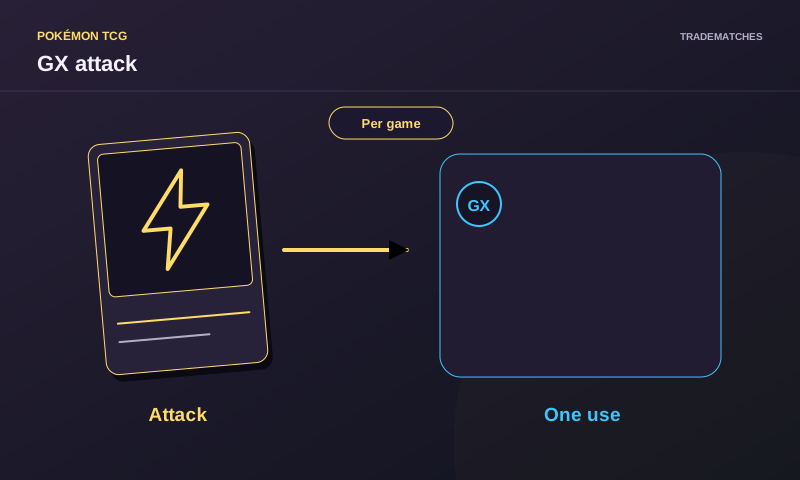
A player can use only one GX attack during a Pokémon TCG game, regardless of how many Pokémon-GX they have. The limit belongs to the player, not to each card. After using the GX attack, turn the GX marker over; switching, evolving or playing another Pokémon-GX does not create another allowance.
GX cards remain useful for historical formats and collection projects. This article explains their printed mechanic in the physical TCG; it does not assume that an older GX card is legal in today's Standard format.
Recognize the GX attack rather than the card's suffix alone
A Pokémon-GX normally has a distinctive GX attack among its attacks. Identify that particular attack and read its Energy requirement, instructions and reminder about the once-per-game limit. Other attacks on the same card are not all GX attacks just because the Pokémon's name ends in GX.
For example, a Pokémon-GX can use an ordinary attack on one turn and its GX attack later, provided all requirements are met. After the GX attack is spent, the ordinary attacks remain available under the usual rules. You do not have to retire the Pokémon from play or stop attaching Energy to it.
The suffix also does not tell you the Pokémon's stage. There are Basic Pokémon-GX and Evolution Pokémon-GX. Establish the Pokémon legally before considering its attack: the special attack does not bypass the evolution line.
One allowance shared across all your Pokémon
Suppose your Active Pokémon-GX uses its GX attack. On a later turn, you bring a different Pokémon-GX into the Active Spot. That second Pokémon's GX attack is unavailable because you already used your one allowance. The same applies if the first Pokémon was Knocked Out, returned to the hand or left play another way.
Keeping several GX attacks in a deck can still be sensible. They are alternative options for a single important turn, not a promise that all will be used. One may solve a difficult board, another may improve your hand, and another may offer a finishing attack. The choice changes with the game state.
When evaluating a deck list, write “available GX options” rather than “number of GX attacks I can make.” This makes the resource budget explicit and prevents planning a sequence that depends on two separate uses.
Pay the attack's actual Energy requirement
The once-per-game limit is an additional restriction, not a substitute for paying the attack requirement. Count the attached Energy that supplies the necessary types and amounts. A Colorless symbol can be satisfied by Energy of an appropriate supplying effect; a specific type still requires that type unless something changes the requirement.
Energy cards do not always supply exactly one unit, and Special Energy may have conditions. Read what the attached cards currently provide before deciding that the GX attack is legal. Counting the number of physical Energy cards can produce the wrong answer.
Also read attack instructions that require discarding Energy or another action. Do not treat a large GX label as permission to ignore those words. A planning note should distinguish what must be available to use the attack from what the attack tells you to do during its resolution.
TAG TEAM GX attacks can have an additional threshold
TAG TEAM Pokémon-GX share the one-GX-attack allowance. Their special feature is that many GX attacks offer an additional effect when the Pokémon has extra Energy attached as specified. That extra requirement does not give you a second GX attack later if you use the simpler version now.
Pikachu & Zekrom-GX provides an official example. Its Tag Bolt-GX attack has a printed basic Energy requirement and a further clause involving extra Lightning Energy. Read that clause as an additional condition for the extra effect, not as a universal rule that every TAG TEAM needs the same number or type of extra Energy.
Before declaring such an attack, announce which part you expect to apply and show the relevant attached Energy. That lets both players verify the threshold while the cards are still easy to inspect. If a different TAG TEAM uses different wording, recalculate from that card rather than memorizing one example.
Do not confuse GX with VSTAR Power or an Ability
The visual treatment of a powerful once-per-game feature is not enough to identify its rules. GX attacks are attacks. VSTAR Powers belong to another mechanic and can be an attack or an Ability. Ordinary Abilities on a GX Pokémon also follow their own text, not the shared GX attack limit by association.
That matters when a card affects attacks but not Abilities, or when a Pokémon is prevented from attacking. A GX attack does not become an Ability because its effect draws cards or changes the board instead of dealing damage. Look at where it appears and how the card labels it.
If your format contains multiple special mechanics, track each allowance according to its own rules. Do not merge different markers merely because both are usually turned over after use. Their similar physical reminder function does not make their legal permissions interchangeable.
Decide when to spend the allowance
Because the GX attack is a single choice, compare its immediate effect with the realistic alternatives in your deck. A guaranteed useful effect now can be preferable to saving an attack for a Pokémon you may never establish. Conversely, spending it for a small advantage can remove a later answer to a known problem.
Use a concrete turn forecast. Ask which Pokémon can realistically become Active, how much Energy you can attach or move, and what the opponent might remove before your next turn. A theoretical strongest attack is irrelevant if you cannot legally reach its setup.
For example, imagine one GX option gives you a useful hand immediately and another requires an additional evolution and several attachments. If the second option is unlikely to become available before the opponent takes their last Prize, saving the allowance may have no practical value. This is a decision framework, not a claim that one card is always better.
Keep the marker and the announcement consistent
Place the GX marker where both players can see it and establish which side means unused. After using the attack, change the marker promptly. A face-down marker is a reminder of a game event; it does not itself create or remove a rules permission independently of what happened.
If the marker was accidentally left on the wrong side, do not silently take advantage of that mistake. Explain the earlier attack and, in an organized event, call a judge if the game state is disputed. The correct handling of an error depends on tournament procedure, not on whichever marker position is more convenient.
A simple learning exercise is to play two GX Pokémon on opposite sides of the mat and make one shared marker sit between them. Physically sharing the marker makes it obvious that each card does not have a separate personal use.
Check restrictions before declaring the attack
Having an unused marker and enough Energy does not guarantee permission to attack. The Active Pokémon must be able to attack under the ordinary game rules and any effects currently applying to it. Special Conditions, turn restrictions and card effects may matter.
Read a restriction's duration precisely. “During your next turn” and a lasting restriction attached to a particular Pokémon do not necessarily behave the same way when that Pokémon changes position or evolves. Resolve the specific interaction from the current rules and card text rather than assuming that GX attacks are exempt.
This is also why a failed or disputed declaration should be handled carefully. Establish whether the attack was legally used and which effects occurred. Do not invent a general rule that every unsuccessful attempt either always spends or always preserves the allowance regardless of the cause.
| Situation | GX allowance | Practical consequence |
|---|---|---|
| A GX Pokémon uses an ordinary attack | Still unused | A legal GX attack can be chosen later |
| You use a GX attack | Used for the game | Other GX options are no longer available |
| The GX attacker leaves play afterward | Still used | A new Pokémon does not reset it |
| A TAG TEAM misses its extra-Energy threshold | Same shared allowance | Read whether the basic attack remains legal |
| Another special mechanic has its own marker | Check that mechanic separately | Do not infer identical permissions |
Buying a GX card for a historical deck
Identify the exact name, set and collector number before buying. GX and ex are different printed categories, and a similarly named Pokémon from another era may not supply the attack your deck needs. A Full Art version may share game text with another printing while having a different collecting purpose.
Check the format's current legality and any permitted reprints separately from the rules of the mechanic. A perfectly authentic GX card can be ineligible for the event you plan to attend. If your goal is a casual historical deck, agree on the card pool with the other player and include the correct evolution and Energy support.
Frequently asked questions
Can each of my Pokémon-GX use its own GX attack?
No. Your Pokémon share one GX attack allowance for the whole game. Including several cards gives you choices about which attack to use, not additional uses.
Can a Pokémon-GX keep using its ordinary attacks afterward?
Yes, provided the usual attack requirements and restrictions are satisfied. Spending the GX allowance does not disable the card's other attacks.
Does extra Energy let a TAG TEAM use a second GX attack?
No. Extra Energy may unlock the additional effect described by that TAG TEAM's GX attack. It does not create another once-per-game allowance.