PVC or polypropylene card sleeves: reading the material
On this page
For sleeves touching trading cards, look for a declared suitable material such as polypropylene rather than choosing solely by colour, thickness or an “archival” label. Flexible PVC can contain plasticizers that migrate, making unidentified soft PVC a poor direct-contact choice. A sleeve's exact formulation, fit and condition still matter; no material label guarantees permanent protection.
This is a material-selection guide. The appropriate sleeve also depends on card size and intended use, but choosing a protective format does not answer what its plastic is made from.
Identify the polymer before interpreting claims
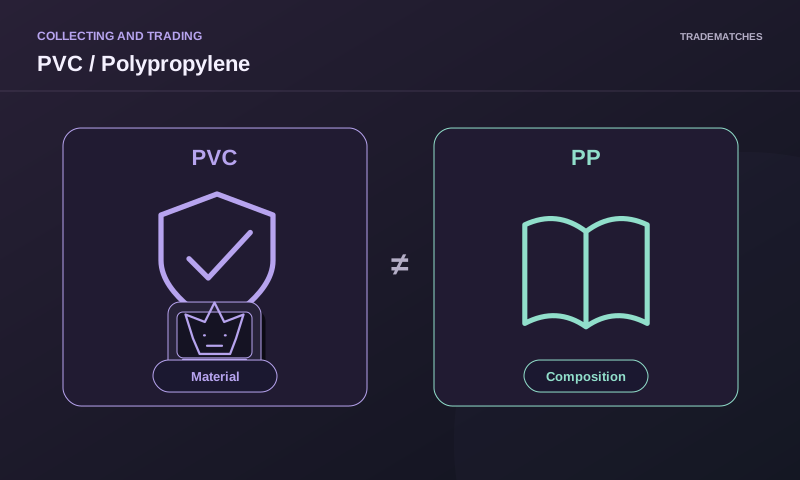
Polypropylene is commonly abbreviated PP, while polyvinyl chloride is PVC. These are different materials, not two names for a thick and thin version of the same sleeve. Polyester, often identified as PET, is another material used in conservation contexts.
Find the manufacturer's specification for the exact product rather than relying on a marketplace title. A reseller may describe an entire category as “plastic sleeves” without identifying the polymer. Product photographs can help match the package, but transparency alone does not identify its chemistry.
Keep the product code or packaging with your collection supplies. That allows a later specification check if you buy a refill or discover that two similar-looking products have different material descriptions.
Flexible PVC deserves particular attention
Conservation guidance discusses risks from flexible PVC and its additives, including plasticizer migration. The relevant concern is the actual formulation and contact situation, not a claim that every object containing the letters PVC will immediately damage every nearby card.
For a soft sleeve directly touching a collectible, prefer an identified suitable alternative rather than an unknown formulation. This is a precaution based on material-selection principles, not a prediction of the exact date or appearance of damage on your particular card.
Rigid products and mixed constructions require their own assessment. A hard external holder is not automatically chemically identical to a flexible sleeve. Likewise, putting a questionable material outside another layer does not establish that the whole enclosure has been evaluated for long-term storage.
Polypropylene is a useful specification, not a complete guarantee
Major card-protection manufacturers publish products described as polypropylene, non-PVC and acid-free. Those specifications provide more useful information than a generic claim that the sleeve is “premium.” Check that they apply to the exact item you are buying.
The polymer alone does not establish every aspect of quality. Seams, surface cleanliness, dimensions, additives and physical condition also influence the product's suitability. A dirty or tightly fitting PP sleeve can still cause a handling problem.
Use the specification as one part of a practical selection process. Identify the material, match the card dimensions, inspect the product and use it without forcing the card. That sequence addresses both chemical uncertainty and ordinary mechanical damage.
Acid-free and non-PVC answer different questions
“Non-PVC” identifies an excluded polymer, while “acid-free” is a different product claim. Neither phrase alone fully describes every component or proves a specific lifetime. A product can advertise one while leaving another relevant detail unspecified.
Similarly, “archival” can be a broad marketing word unless accompanied by useful material and testing information. Do not treat it as a universal certification whose meaning is identical across every manufacturer and marketplace.
Ask what material touches the card and which specification supports the claim. A clear answer is more valuable than a decorative badge. If the seller cannot identify the exact product, compare an alternative with published manufacturer information.
| Label or specification | Useful question it answers | What it does not establish alone |
|---|---|---|
| Polypropylene or PP | Identifies a polymer | Exact fit, cleanliness or lifetime |
| Non-PVC | Excludes PVC as stated | Complete formulation of every layer |
| Acid-free | States an acidity-related claim | All conservation risks are absent |
| Thickness in microns | Describes material thickness | Chemical identity or card compatibility |
| Archival | Signals a storage claim | A universal certification without supporting details |
Thickness is not chemical identity
A thicker sleeve is not automatically made from a better material. Ultra PRO publishes thickness measurements for different sleeve categories, but those numbers describe dimensions of the film rather than proof that one product is chemically suitable.
Microns used for sleeve film are also not the same product measurement as holder capacity expressed in points. A rigid holder sized for a card thickness and a flexible sleeve film measurement answer different fitting questions.
Compare like with like. First confirm the material and intended card size, then consider thickness and handling. Choosing the largest printed number without understanding the unit can lead to a product that is awkward, oversized or unsuitable for the intended use.
Fit should protect without stressing edges
A sleeve that is too tight can catch corners or require force during insertion. One that is excessively loose can permit movement inside a larger enclosure. Select dimensions appropriate to the game's card size and any outer protection you intend to use.
Test the fit with a low-value card of the same dimensions before inserting an important collectible. Inspect the opening and seams for roughness or defects. The test checks physical usability, not long-term chemical behaviour.
Do not trim, heat or chemically treat a sleeve to make it fit. Altering a protective product can introduce uneven edges or unknown effects. A correctly specified replacement is usually a more straightforward way to solve a fit problem.
Every touching layer deserves a check
A card can contact an inner sleeve, binder pocket or another enclosure during storage. Knowing the inner sleeve's material does not identify every other layer. Review the relevant manufacturer information for those products as well.
Labels, adhesive tape and improvised padding can introduce additional contact risks. Keep adhesive away from the card and avoid arrangements that press a label's glue against a sleeve opening or exposed edge.
The overall enclosure also needs appropriate support. A suitable film cannot prevent damage if a card is bent by an overloaded binder or crushed in a badly fitting box. Material choice works alongside physical arrangement and careful handling.
Do not identify unknown plastic with destructive tests
Colour, smell and flexibility are not reliable standalone polymer identifiers for a collector. Avoid flame tests, hot needles, solvents or other improvised chemical tests around cards and storage supplies. They can create hazards without providing a dependable product specification.
If the material is unknown, ask the manufacturer or replace the direct-contact product with an identified one. That is a practical response to missing information rather than a claim that you have diagnosed the original sleeve as harmful.
For a valuable object already stuck to or affected by an enclosure, seek appropriate conservation advice before separating it. Pulling aggressively or applying a solvent can damage the surface even if replacing the enclosure is ultimately necessary.
Inspect sleeves as part of normal collection care
Look for splits, grime, tackiness, deformation or other changes during routine handling. A sleeve with a visible problem should not be treated as protective forever merely because its original packaging used a reassuring label.
If changing a sleeve, handle the card with clean, dry hands and support it carefully. Avoid repeated unnecessary removal, which can create edge and surface wear. Record an unusual enclosure problem so you can check other cards stored in the same product.
Do not infer that every film must be replaced on a universal calendar. The useful interval depends on use, product condition and environment. Visible changes and manufacturer guidance provide a more defensible basis than an invented lifespan for all sleeves.
Storage conditions still influence the result
Suitable contact materials do not remove the need for stable storage away from excessive heat, dampness and direct light. Keep cards supported in a clean enclosure and avoid locations where environmental conditions fluctuate sharply.
General conservation guidance explains material and environmental principles, but it does not test every modern TCG laminate or sleeve combination. Applying those principles to cards is a practical inference, not a brand-specific guarantee of permanent preservation.
For particularly valuable or damaged pieces, a professional assessment can address the individual object and enclosure. The goal is to make a documented choice based on available information rather than treating a single marketing phrase as a complete conservation plan.
Build a simple buying checklist
Record the product name, code, declared polymer, card dimensions and intended use. Check the specification on the manufacturer's page, compare the actual package and inspect a sample before moving the collection into it.
If a product description is incomplete, identify the missing information rather than filling it in from another item by the same brand. Two product lines can have different materials or dimensions even when they share a logo.
Choose a product whose relevant specifications you can verify and whose fit you can use safely. That makes replacement purchases easier and provides a clear record if you later review how a particular group of cards was stored.
Frequently asked questions
Does a thicker sleeve prove it is safer for long-term storage?
No. Thickness is a physical measurement, not a polymer identification or a complete conservation guarantee.
Is non-PVC the same claim as acid-free?
No. They describe different properties. Check both the declared material and the supporting product information.
Can I identify an unknown sleeve by smell or a flame test?
Do not rely on those methods. Ask for the specification or choose an identified suitable replacement; destructive testing is unnecessary for this buying decision.