Yu-Gi-Oh! Link materials and Link Rating
On this page
A Link Summon requires an exact Link Rating total, enough physical monsters and the right material characteristics. Meeting only one of those requirements is insufficient. An ordinary monster contributes one; a Link Monster can contribute either one or its entire Link Rating. It cannot contribute an intermediate number.
That explains why a Link-3 cannot count as two materials, and why a single Link-4 does not automatically satisfy a recipe requiring two or more monsters. The calculation follows the official Yu-Gi-Oh! rulebook. The examples below use hypothetical recipes so their arithmetic is easy to separate from individual card effects.
Read the material line before adding numbers
A Link Monster's material line can require a minimum number, specific monster types, Effect Monsters, names or other characteristics. Its Link Rating supplies the total you must reach. These instructions work together; the printed rating does not cancel the restrictions written above the effect.
For a hypothetical Link-4 requiring “2+ Effect Monsters,” begin by counting how many actual monsters you intend to use. You need at least two. Then check that each selected monster satisfies the Effect Monster requirement. Only after those checks should you calculate their possible rating contributions.
For a hypothetical Link-3 requiring exactly three monsters, a Link-2 and one ordinary monster produce a possible total of three, but only two physical monsters are present. The rating calculation works; the recipe does not. You need a combination satisfying both at the same time.
A Link Monster has two contribution choices
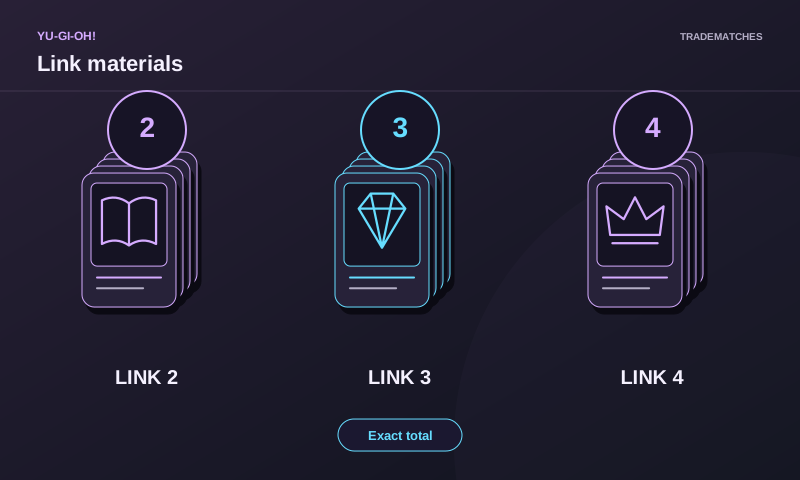
Each Link Monster used as material can count as one or as its own full Link Rating. A Link-2 therefore offers one or two. A Link-3 offers one or three. A Link-4 offers one or four. The choices do not include every integer between those endpoints.
An ordinary non-Link monster offers one contribution for this calculation. Its Level, Rank, ATK and DEF do not increase that contribution. A high-Level monster is still one, and a powerful monster does not count as several because its combat statistics are high.
| Selected monster | Allowed contribution | Not allowed merely from that rating |
|---|---|---|
| Non-Link monster | 1 | Its Level or Rank as a contribution |
| Link-2 | 1 or 2 | Counting as 3 |
| Link-3 | 1 or 3 | Counting as 2 |
| Link-4 | 1 or 4 | Counting as 2 or 3 |
Choose a contribution separately for each selected Link Monster. You are not choosing a new rating for the target, nor changing the material's printed rating permanently. You are deciding how that material contributes to this specific Summon calculation.
The total must match exactly
Suppose the target is a hypothetical Link-4 requiring two or more Effect Monsters. A Link-3 Effect Monster plus an ordinary Effect Monster can contribute three plus one. The total is four and the physical count is two, so those two checks work, provided all other restrictions are met.
A Link-3 plus a Link-2 offers totals of two, three, four or five, depending on their separate contributions. The useful total for a Link-4 is three plus one. Counting both at their full ratings gives five, which is too much for that target.
Do not treat the printed rating as a threshold that can be exceeded. “At least four” is different from “exactly four.” Extra material cannot be added casually after a valid total has been found; the whole selected combination must remain a legal recipe.
Two Link-2 monsters and one ordinary monster
For a Link-4, this combination can work numerically. Count one Link-2 as two, the other Link-2 as one, and the ordinary monster as one. The result is four from three physical monsters.
Counting both Link-2 monsters as two gives five and fails the exact total. Counting both as one gives three and also fails. The availability of a valid choice makes the combination potentially usable, but you still need to check the target's material wording and every applicable effect restriction.
A single high-rating monster
A single Link-4 can contribute four, but it remains one physical monster. If the target requires “2+ monsters,” this selection is illegal even though the arithmetic matches. You cannot split one card into two physical monsters by changing its contribution.
Similarly, two monsters whose contributions reach three cannot satisfy an exact three-monster recipe. Keep a separate physical count on paper if necessary. It prevents most mistakes caused by using “materials” to mean both actual monsters and numerical contributions in the same sentence.
Characteristics remain mandatory
If the recipe requires Effect Monsters, a Normal Monster does not qualify just because it contributes the missing one. If it requires a particular Type, an unrelated Type does not qualify merely because a Link Monster supplies most of the rating.
An effect that changes a monster's characteristics can matter, but evaluate the actual state and text. Do not assume a card qualifies because another printing has different text or because a similarly named monster has the required Type. The specific selected monster must satisfy the relevant requirement.
Tokens require particular care. They are Normal Monsters, so they are not automatically valid for an Effect Monster-only recipe. Their creation effect may add further restrictions. The numerical calculation is necessary, but it cannot answer those separate eligibility questions.
Other restrictions can stop a valid sum
For example, an otherwise valid pair of Effect Monsters is insufficient if an applicable effect prohibits the intended Special Summon. Do not spend material contributions trying to solve a permission problem: first identify the restriction, then determine whether any legal target or procedure remains available.
A card effect may restrict which monsters you can Special Summon, which materials you may use or which summons remain available that turn. A mathematically valid Link-4 combination does not override such a restriction. Read effects already resolved as well as effects currently visible on the field.
Monster placement is another independent check. Once you have a legal combination, the summoned monster still needs a legal destination under the current placement rules. The official rules update should be used alongside the rulebook rather than relying on an older explanation of all Extra Deck monsters.
For a practical calculation, do not begin with arrows and ignore the recipe, or begin with the recipe and ignore placement. These are different checks in one Summon. An error in any required check can make the intended play unavailable.
Work through a board without guessing
Write down the target's rating and its complete material line. Count your candidate monsters physically. Under each Link Monster, write its two contribution options; under each other monster, write one. Then test combinations against the exact target.
For a hypothetical Link-5 with a Link-3, a Link-2 and an ordinary monster, the available totals depend on those options. Three plus one plus one reaches five. Three plus two plus one reaches six and fails. One plus two plus one reaches four and fails. All three candidates remain three physical monsters whichever options you choose.
After finding an exact total, check every candidate against the recipe. If the target requires three Effect Monsters and your ordinary monster is Normal, the example still fails. This last review is what separates a useful calculation from a shortcut that accidentally produces an illegal Summon.
Explain the intended play clearly
A short written example can help a new player see why a failed combination fails. For a Link-3 requiring three monsters, write “Link-2 plus ordinary monster: rating 3, physical count 2.” The missing requirement becomes visible immediately. For a Link-4 requiring two or more monsters, write “one Link-4: rating 4, physical count 1.” These examples separate two mistakes that otherwise sound like the same dispute about materials.
In a casual game, state the selected monsters and how each Link Monster contributes before moving cards. “This Link-3 counts as three, this other monster counts as one” is clearer than “I have four materials” when only two cards are on the field.
At an event, give a judge the full material line, the selected monsters and any restrictions applying that turn if a disagreement arises. Avoid moving the monsters first and reconstructing the board from memory. The exact state can affect whether the combination was legal.
Frequently asked questions
Can a Link-3 count as two?
No. Its normal contribution choices are one or its full Link Rating of three. It does not offer an intermediate contribution of two.
Can I use more rating than the target needs?
No. The selected contribution total must match the target's Link Rating exactly, while also satisfying the material line.
Does one Link-4 count as four physical monsters?
No. It can contribute four to the rating calculation, but it remains one monster for a recipe requiring a minimum number of actual monsters.