Yu-Gi-Oh! reviving a properly summoned monster
On this page
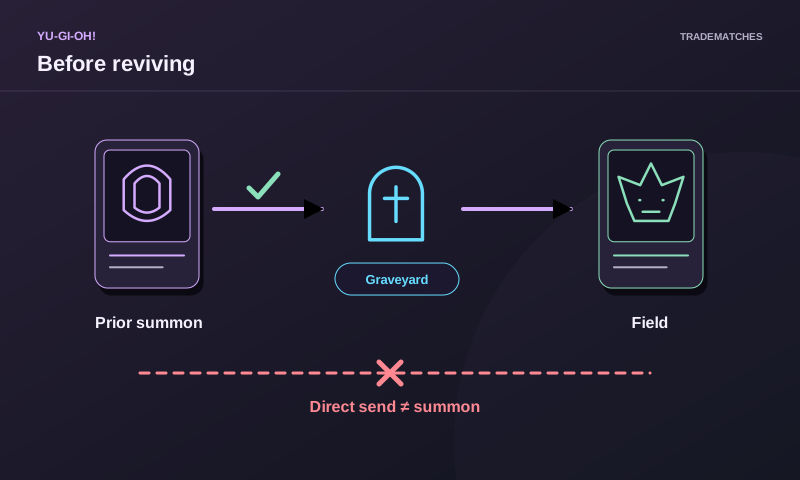
An Extra Deck monster sent straight to the Graveyard is not automatically available for revival. Monsters requiring a proper initial Special Summon must first complete that procedure. Reaching the Graveyard, being revealed or having the right name does not establish that history. Even a properly summoned monster must still satisfy the revival effect and any remaining restriction.
Check two independent gates
The first gate is the monster's prior summon. Fusion, Synchro, Xyz and Link monsters have appropriate initial procedures, as do Ritual monsters and other Special Summon monsters. The second gate is the effect attempting to summon them now. Its target conditions, location, remaining restrictions and current board all need to permit the revival.
Konami's rulebook explains the prior-summon requirement, while its Problem-Solving Card Text article on Special Summons distinguishes wording requiring a first correct summon from wording requiring a particular method for every summon. Do not collapse these into one question. Having passed the first gate does not guarantee permission through the second.
For a hypothetical Synchro monster properly Synchro Summoned and later destroyed, a suitable generic revival may be possible. The same printed card milled directly from the Extra Deck has a different history. Both cards are in the same zone, but only one has completed the initial procedure.
Four routes to the Graveyard
| How the hypothetical monster arrived | Was the proper initial summon established? | Revival check |
|---|---|---|
| Correct Synchro Summon, then destroyed | Yes, assuming that summon completed | Check effect and remaining restrictions |
| Sent directly from Extra Deck | No | Generic revival cannot repair missing history |
| Attempted proper summon was negated | No completed summon | The attempt alone is insufficient |
| Put on the field by an effect that did not perform its proper summon | Not by that movement alone | Read the effect and monster's procedure |
These examples concern monsters whose rules require the proper first summon. Ordinary Main Deck monsters are not all subject to the same special prerequisite. Do not impose it on every monster discarded from a hand.
The exact physical copy has a history
Suppose three copies of a hypothetical Synchro monster are in your Graveyard. Copy A was properly Synchro Summoned. Copy B was sent there directly from the Extra Deck. Copy C reached the field through an effect that did not Synchro Summon it. You cannot transfer A's qualifying history to B and C merely because all three have the same name.
When announcing a revival, identify the eligible copy clearly and preserve the zone information needed to distinguish it. A card's card number helps identify its printed identity, but it does not record what happened to that copy during this duel. Those are separate kinds of information.
If your deck frequently sends Extra Deck monsters directly to the Graveyard for their effects, practise explaining that distinction. A Graveyard effect may be available without the monster being available for revival. The card can still contribute to the deck through a different legal action. “Cannot revive” does not mean “has no effect or use in this zone.”
A negated summon is not a successful summon
An attempt that is negated has not completed the required initial procedure. Paying materials or moving cards during the attempt does not establish successful summoning history by itself. This is different from successfully summoning a monster and then having one of its effects negated.
Use an imaginary sequence to separate them. In version one, a correct summon completes, the monster enters play, and an opponent later negates its effect and destroys it. Its summon history is not erased merely because the effect failed. In version two, an applicable response negates the summon itself; that successful initial summon never happened.
The two sequences can leave similarly arranged Graveyards while carrying different eligibility. State precisely what was negated when asking about revival. “My card was negated” is too broad: the summon, activation and effect are separate objects or events, and their consequences differ.
“Must first” and continuing restrictions
Read whether a monster requires a particular initial method or insists on that method whenever it is summoned. A “must first” requirement can leave room for later alternative summons after the proper first procedure. A continuing “must be” requirement can still prevent a generic revival even after the monster was properly summoned.
The complete current text matters. An older printing might use wording that has been standardised or changed by errata. Read the official database entry rather than reasoning from a remembered phrase. An effect that ignores Summoning conditions also requires careful checking: it does not provide a universal way to erase the rules requirement that a Special Summon monster was properly summoned first.
For deck testing, create two columns called “first-summon prerequisite” and “later-summon restriction.” Fill both for a particular monster. If the first column is satisfied but the second blocks the effect you intend to use, buying more generic revival cards will not solve that interaction. You need an effect actually capable of the intended procedure.
Do not assume history survives every reset
Returning a monster to a hand, Main Deck or Extra Deck can reset the relevant prior-summon information. That is different from ordinary movement between public locations after a successful summon. Once a card has returned to the Extra Deck, sending it directly to the Graveyard again does not let you rely on a summon it completed before that reset.
Keep the example simple. A properly summoned hypothetical Link monster goes to the Graveyard and is later returned to the Extra Deck. A different effect then sends that card from the Extra Deck to the Graveyard without summoning it. The current trip to the Graveyard has not established the missing initial summon. Do not treat the card as permanently certified for the rest of the duel.
Card-specific effects can create unusual movements and permissions, so verify the actual sequence before applying a general example. If the question concerns a face-down or banished card, explain the orientation and movement as well. Those details are more valuable than a blanket rule that “once summoned, always summonable.”
Check the proposed revival before paying for it
At the table, identify the monster and its current official text. Establish how that copy entered the Graveyard. Confirm that its relevant proper summon completed. Read the effect you intend to use, including the target type and any cost. Check continuing restrictions and current effects before declaring the action.
That order also helps build a deck. A monster sent directly to the Graveyard may be included as a resource for a Graveyard ability, while a properly summoned monster may be intended as a recurring threat. Giving both roles the label “revival target” creates unrealistic test results and can lead to unnecessary purchases.
Frequently asked questions
Can Monster Reborn revive any monster in the Graveyard?
No. The target must be eligible. Proper initial summon requirements, continuing Summoning restrictions and other current effects can prevent revival.
If one copy was properly summoned, does that qualify the other copies?
No. The relevant history belongs to the specific card that completed the procedure, not every card sharing its name.
Does negating a monster's effect erase a successful summon?
Not by itself. Distinguish effect negation after a completed summon from negating the summon so that the required procedure never successfully completed.