Yu-Gi-Oh! Ritual Summoning: steps and materials
On this page
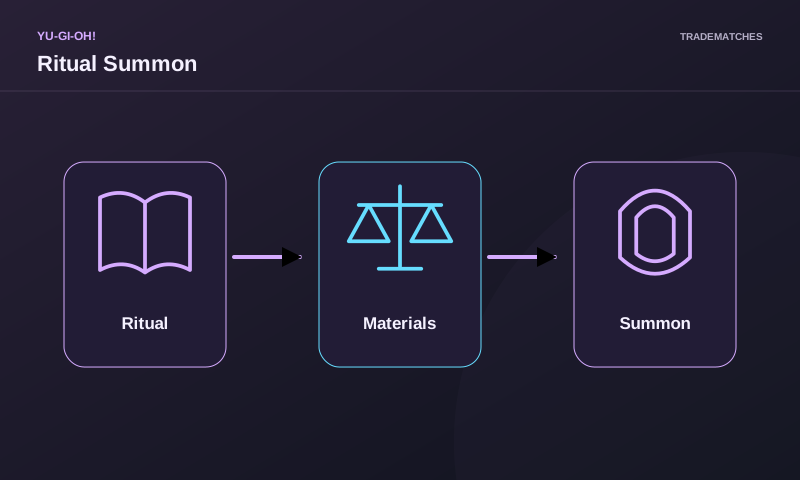
A Ritual Summon is made by means of a card or effect that authorizes it and materials that indicate its text. In the basic procedure, the Ritual Monster is in hand and a Ritual Spell asks for Tributes whose Levels meet a quantity. Not all Ritual cards use the exact same source of materials or the same calculation: read the effect you are resolving.
The Ritual Monster normally belongs to the Main Deck
The color and type of the card identify a Ritual Monster. Unlike Fusion, Synchro, Xyz and ordinary Link Monsters, it does not start automatically in the Extra Deck because it needs a special procedure. The basic preparation places the corresponding Rituals in the main deck. Its Summoning method and your construction area are different questions.
Don't put all the "difficult to Summon" monsters in the Extra Deck. If a card has particularities, like other combined categories, see its exact treatment. To learn the procedure, start with an ordinary Ritual and its Spell, without mixing advanced card exceptions with the general rule you try to understand.
The pieces you must have available
You need the Summoning effect, a Ritual Monster that can be Summond by him and usable materials according to the instruction. Some Spells refer to a specific name; others to a broader set. Having any Ritual in your hand does not prove that your Spell allows you to Summon it. Identify the relationship between the two before activating.
Also check the places from which you can take materials. The basic procedure uses hand or field monsters, but a particular card may authorize other mechanisms. Don't send cards from the Deck to the Graveyard or banish resources to pay for a Spell that doesn't allow it. The fact that another Ritual strategy does that does not make the method a common rule.
Levels, not ATK or similar number of stars
If the text uses Levels, add the Levels of the permitted materials. Your ATK and DEF don't replace that. The Xyz Monster Ranks and the Link Ratings of Link Monsters are also not Levels for an instruction that requires adding Levels. Don't turn one printed number into another because it occupies a similar visual position.
Imagine a Level 6 Ritual and a Ritual Spell that asks for a total of Levels of 6 or more. Two Level 3 materials could reach the total. A Level 7 material could also do so if the text and the selection rules allow. The example changes if the Spell requires exactly 6: that 7 no longer meets. The word ‘exactly’ is part of the requirement.
Do not tribute unnecessary materials
In an ordinary Ritual that allows you to reach or exceed the Level, you cannot add unnecessary Tributes after the set already meets the requirement according to the rules. The possibility of exceeding a figure is not an invitation to empty your hand at will. Select the legal material required by the effect and avoid using Ritual as a free discard mechanism.
If your combination includes materials with special values or effects that allow them to be used in another way, see the specific text and its rules. A basic sum guide does not solve all exceptions. To test a new combination, write down what value each card brings and what instruction authorizes using it, instead of just saying that it “counts for the whole requirement.”
Activation and resolution
The Ritual Spell starts a Chain when it is activated. The time when you select or use materials depends on their text and the applicable procedure. Do not announce that you have paid a cost if the Tributing is part of the effect when resolving. That distinction may matter if the activation or effect is negated, or if the availability of the material changes.
If the opponent responds and the situation changes, re-evaluate what the effect demands when resolving. Having a valid combination when thinking about your turn does not guarantee that all the pieces remain present after an answer. Do not try to replace a piece from an area that the effect does not allow. If you cannot complete a part, apply the rule of the card and the corresponding rules.
Tributing is not destruction.
The materials of a Ritual that are sacrificed are not destroyed simply by participating in the Summoning. Protection from destruction does not necessarily prevent a card from being used as a Tribute. The effects that are activated when a card is destroyed and those that are activated when it is Tributed or sent to the Graveyard have different conditions.
To check a material ability, describe what happened with the correct verb. 'I used it as a material' may be insufficient to know if a trigger was met. Read the Ritual procedure and the condition of the other card. If there is a replacement that changes the destination, you will also need to include it in the check.
Summon later from the Graveyard
Monsters that require a proper Summoning procedure need to comply before they can use certain subsequent Special Summoning effects. Don't suppose sending a Ritual directly from the Deck to the Graveyard leaves you ready to retrieve it to the field with any card. The history of how it got there may matter.
Imagine you discard a Ritual Monster without having properly Summoned it. Having it now in the Graveyard does not prove that a resurrection card can bring it. If it was first Summond through its procedure and then sent there, the situation may be different, subject to the restrictions of both texts. Consult the concrete effect before building a strategy around that recovery.
The exceptions are read in context
Some strategies use monster effects, alternative materials, or cards that change the Summoning area. You don't need to memorize all of them to learn the basic Ritual. You do need to recognise that the particular text can modify the general rule. The phrase “Rituals always come out of hand” may be too absolute in the face of these cards.
A useful practice sheet has four fields: what effect it Summons, what Ritual you can choose from, where it takes materials and how much it requires. Add subsequent restrictions where they exist. If you can complete those fields by reading the card, you have a basis for explaining the sequence without copying a video that may use another print or an old rule.
Preparing purchases for a Ritual strategy
Search for the exact numbers and names of the pieces and review the list of Forbidden and Limited cards applicable in Spain. Don't buy four copies of a Spell because another TCG allows that amount: Yu-Gi-Oh! uses its own construction limits. Also distinguish TCG and OCG cards when the goal is a local tournament.
Before paying for collection versions, test the list with permitted means of practice in your group and check that the lines work. For the event you will need supported copies. Knowing that the general mechanism exists does not demonstrate that a specific combination is authorized or that the material printed in another region has the same legality.
Prepare the materials before activating
Check the proposed play physically: a Ritual Monster in the zone required by the effect, the card authorising the Summon and valid materials. A hand containing several Ritual-related cards may still lack one of those elements. Read which zones the effect permits materials to come from. Do not add a card from the Graveyard or Deck simply because a different Ritual Spell would allow that.
For practice, compare an instruction requiring exactly Level 6 with one requiring 6 or more. Level 4 and Level 2 materials total six and can satisfy either requirement if otherwise valid. Level 4 and Level 3 total seven, so the wording matters. If a single Level 7 material already satisfies a requirement of 6 or more, do not add another unnecessary material just to trigger its effect when Tributed. The Summoning permission does not make material selection unlimited.
Then consider whether an opposing response could change a required piece's availability before resolution. Do not reconstruct the result using the initial state if the situation has changed. Separating preparation from resolution makes it easier to explain why an apparently possible play does not necessarily produce the expected Summon.
Frequently asked questions
Are the Ritual Monsters going to the Extra Deck?
Ordinary Rituals are placed in the Main Deck. They don't go to Extra Deck just for having a special Summon.
Can I use Xyz Ranks as Levels?
Not for an instruction asking for Levels. Rank and Level are different properties; use only materials that meet the requirement.
Should we add up exactly the Ritual Level?
It depends on the text that Summons it. Some instructions allow to reach or exceed one figure and others require an exact amount.