Can you play Magic art cards in a deck?
On this page
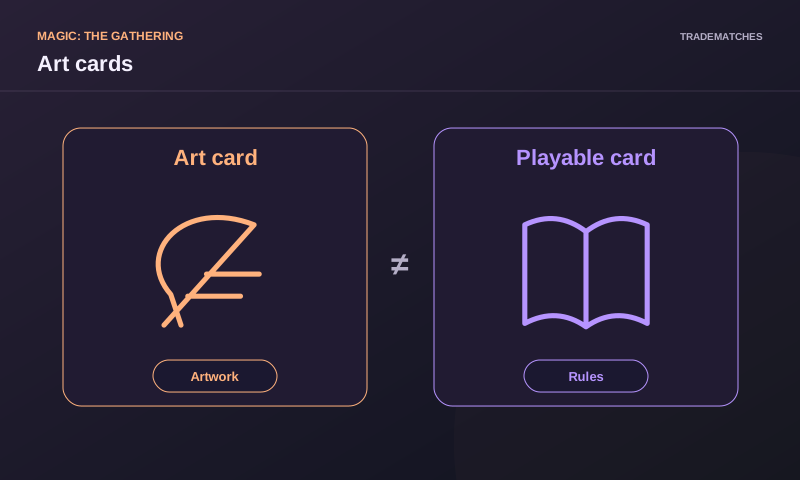
No. A Magic art card is a collectible object showing the artwork of a game card, not a playable copy of that card. Even if the image and name match a real spell, you cannot put the art card into your deck as though it carried that spell’s rules.
How to recognise one
The front is mostly full artwork, while the back usually identifies the art or artist. It lacks the normal game frame, cost, type line and rules text. Wizards has placed art cards in booster slots described as non-playable, alongside possible tokens or play aids.
Some have a gold-stamped artist signature. That stamp makes it a collectible art-card variant; it does not turn the object into a game card or show that the corresponding playable card was signed.
What to do when you open one
Store it apart from deck cards and label it “art card” in your inventory. If you offer it, photograph both sides and mention any signature stamp. Use the artwork name or product reference, but do not select the playable printing by mistake on a trading platform.
For example, you can display an art card of a planeswalker next to its playable counterpart to enjoy the full illustration. Building a deck still requires an official playable copy that is legal in the chosen format.
The apparent exception
Your casual table might allow an art card as an informal reminder, but it remains a non-playable object and is not automatically a valid tournament substitute. Check the event rules if you need to represent a card in a special way.
The short answer: they are collectible pieces
An art card of Magic shows an illustration of the game's universe, but it is not the playable card that has cost, type, and rule text. Although the art represents a spell that does exist in a collection, the art card does not occupy its place in a deck. The confusion arises because it can come from the same product as playable cards, have a similar size, and show a recognizable name. To decide, look at the physical object and its function: if it is the art sheet that Wizards has identified as such, keep it as a collectible or reference visual, not as a regulatory copy of the spell.
This does not make it useless. It can interest someone who collects illustrators, worlds, stamped signatures, or a complete set of art cards. The value and use are different questions. A piece can have collection demand and still not be able to occupy a legal place in a deck. When registering your inventory, create a separate category so that it does not appear as a playable copy when someone asks for four cards to play.
Physical signs to recognize it
An art card dedicates almost the entire front to the illustration. On the back, it usually shows information about the work or the artist instead of the normal back of Magic. It does not present the mana cost set, type line, and rule box that you expect from a regular card. Some may include the name of the art or a stamped signature. None of these details replace the game text. If an advertisement shows only the front, ask for a photo of the back and any numbering of the series before buying it as a playable card.
Example: you recognize the image of a famous creature and buy the piece believing you can include it in Commander. When you receive it, you see it has no text or back of Magic. It is an art card; you will need a playable print of the creature for the deck. If the seller correctly described it as an art card, the confusion is resolved by learning the category. If it was advertised as a playable card, document the discrepancy on the purchase platform.
A envelope can mix different objects
Wizards has explained in their product guides that certain envelopes include a space for an art card in addition to the spaces for playable cards. The composition of the envelopes has changed over the years, so it is advisable to consult the guide for the specific collection. Seeing an art card when opening an envelope does not mean it has automatically replaced a rare one or that it has the legality of the rest of the content. Classify each element by type: playable cards, tokens, help cards, art cards, and any special insert.
This separation also helps to evaluate a lot. A photo with one hundred pieces may include twenty art cards and eighty regular cards. If the seller announces "one hundred cards to play" without distinguishing them, the count does not accurately describe the content. Ask for a list or photos where the categories are visible. When you sell, specify the number of art cards separately to avoid misleading expectations.
The stamped signature does not change its function
Some art cards have a stamped or golden seal that identifies a collectible variant. It is not a handwritten signature of a playable card or a special permission to use it as the spell represented. For a buyer, "art card with stamped signature" is a more accurate description than "Magic card signed." The second phrase could imply a regular card autographed by an artist, a very different object. Observe if the signature is part of the printing and compare it with the official information of the product.
If you are looking for an authentic signature of a person, ask for proof of the process and detailed photographs. A factory-printed mark does not prove that the artist held that example. It also does not invalidate the collectible value of the variant: it is simply necessary to name it correctly. When exchanging, separate "normal art card," "art card with stamped signature," and "hand-signed playable card."
Art card, token, and substitute card
A token represents something created by rules during the game; an official substitute card can represent a double-faced card in certain zones; an art card shows art. They can have similar sizes, but they are not interchangeable. Do not use an art card as if it were an official double-faced substitute without consulting the rules of the event: it lacks the specific function of that object. Do not place it in the main deck just because it has a back you like. The regulation and purpose printed on each piece decide its use.
In a casual game, two players may agree to use an object as a marker or visual aid. This does not make the art card a legal copy of the represented card for a tournament. If you only want to show which creature appears in the art of a token, say it as visual support and keep the real playable cards in the deck. Clarity avoids misunderstandings about how many copies you have.
How to store them without losing the collection
Store art cards separately from playable cards, by collection and number if they have them. A sleeve or folder protector protects them as other printed items, but the inventory should clearly indicate "art card." If an application only has the name of the represented card, add a note to avoid confusing it with a playable copy. This is important when calculating which pieces you need for a deck: an art card can visually fill a folder, but it does not fill the game list.
For a thematic collection of an artist, look for the name of the illustration and all its variants. Some art cards show an enlarged work that allows you to appreciate details hidden under the game's frame. That is a legitimate reason to keep them, different from their competitive utility. A good inventory description can include artist, set, number, presence of a stamped signature, and condition.
What to ask before buying online
Request photos of both sides and the collection number. Explicitly ask if it is an art card or a playable card. Compare the result with Wizards' product guide. If you need the card for an event, confirm cost, type, text, and correct back of the playable print you are looking for. The low price of an art card may seem like a bargain compared to a popular card, but they are different objects. Do not pay for urgent shipping for a piece that does not solve your deck needs.
If the purchase is for a collection, the finish and condition can be decisive. Check edges and surface, and ask if the supposed seal is stamped or a real signature. A clear photo and precise description allow comparing equivalent offers. Avoid using the prices of playable cards to automatically value art cards with the same drawing; the demand can be very different.
What to do if you already mixed one with your deck
Remove it and recount the playable cards. If the art card occupied one of the spots in the list, the real copy of that card is missing; get a legal print before the tournament or replace the spot with another allowed card. Check also that the minimum size and format restrictions are still met. In a test game, point out the confusion to others to avoid the error from becoming a shared list. It is better to detect it at home than during a deck review at an event.
The same discipline helps with thick display cards, tokens, and other envelope inserts. Always ask if the object has the structure and legality of a playable card, not just if it shows a famous name. The official product guide is the best starting point when the finish is unknown.
Common errors
One: thinking that sharing an illustration is equivalent to sharing rules. Two: believing that a stamped signature makes the piece playable. Three: counting art cards as deck copies in the inventory. Four: describing an art card as a normal signed card. Five: using it as an official substitute without reviewing the rules. Correct them by classifying the object by its physical format and the product's space it comes from. The answer to "can you play it?" remains clear: you need the corresponding playable card.
Frequently asked questions
Is a gold-stamped art card a signed playable card?
No. It is a variant of the art card, not a signature on the game card.
Can I use it as a tournament proxy?
Do not assume it is an allowed substitute. Check event policy and bring the required playable card.