Cardmarket DAC7: 30 sales and €2,000 in Spain
On this page
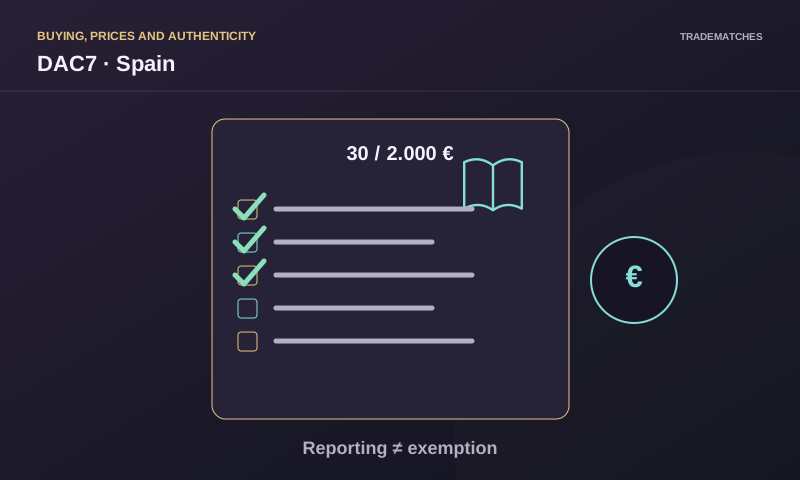
For sales of goods, the DAC7 excluded-seller condition combines fewer than 30 relevant activities with no more than €2,000 of consideration in the reporting period. Both conditions must hold. Reaching 30 activities or exceeding €2,000 can therefore matter for reporting. These figures are not an exemption from tax and do not calculate your profit.
For a Cardmarket seller resident in Spain, three questions need separate answers: what the platform reports, which information it requests from you, and how your actual transactions are treated under existing tax rules. Confusing them makes both record keeping and any later tax discussion harder.
Read the two conditions together
The Spanish tax authority's seller FAQ gives the excluded-seller condition for goods. The activity count must be below 30, while the total consideration must not exceed €2,000. The boundaries are different: 30 is not below 30; exactly €2,000 does not exceed €2,000.
The following examples are invented solely to show the comparison. They do not estimate typical TCG sales, classify a business or calculate tax. They assume the amounts and activities have already been determined correctly for the platform and period being assessed.
| Relevant activities | Total consideration | Meets this goods-seller exclusion? |
|---|---|---|
| 12 | €450 | Yes, both conditions hold |
| 29 | €2,000 | Yes, both conditions hold |
| 30 | €200 | No, the activity condition fails |
| 1 | €2,000.01 | No, the amount condition fails |
| 45 | €2,600 | No, both conditions fail |
Do not replace relevant activities with the number of cards in your collection. A parcel, an order, several cards and a completed sale are not interchangeable counting units. Use the platform's reporting explanation and records, and ask it to explain a discrepancy rather than inventing your own reporting definition.
Reporting does not create a new tax
The AEAT explains that DAC7 concerns information and does not change sellers' existing tax obligations. An amount appearing in a report is not, by itself, your taxable profit. Equally, staying within the reporting exclusion does not establish that every transaction is free of tax consequences.
Consider two hypothetical collectors receiving the same total sale proceeds. One sold items previously acquired for a higher amount; the other bought items specifically for resale. The sale total alone cannot explain their acquisition evidence, expenses, regularity or legal circumstances. That is why a table of reporting thresholds cannot substitute for an individual tax assessment.
Do not use a Cardmarket balance figure as a shortcut either. Money available to withdraw describes the account's operational state. It does not automatically identify the consideration in the DAC7 reporting period, your acquisition cost or the tax treatment of each sale.
Know which obligation belongs to the platform
Modelo 238 is an information return associated with reporting platform operators. Receiving a request for seller information does not automatically mean an ordinary collector must submit the operator's return personally. Your role may include providing or confirming accurate details through the platform's own process.
Cardmarket's tax-requirements help page explains its collection of relevant seller data. Follow the instructions shown in your account and its current official guidance. A request for identification should be checked through the authenticated platform, particularly if an unexpected email includes an unfamiliar upload link.
You do not need to publish your tax identification details in a card listing or send them to a buyer to prove that a transaction is genuine. Keep reporting information separate from public collection photographs and private arrangements with other collectors.
Build records that answer the actual questions
A useful sales record connects the platform order identifier, date, items, amount, fees and any refund or cancellation. Preserve the original statements and confirmations instead of retaining only a screenshot of the final account balance. If records are corrected, keep enough information to explain the correction.
Keep acquisition evidence separately where available: invoices, purchase confirmations and records showing which card or lot was acquired. A mixed collection may contain gifts, old purchases, exchanges and newer purchases with quite different evidence. Label gaps rather than manufacturing a historical cost after the sale.
For a lot, record the cards included and the transaction as the platform records it. Do not claim that splitting a lot into rows in your spreadsheet changes how the operator counts relevant activities. Your spreadsheet should help reconcile the underlying transaction, not rewrite it.
Reconcile before assuming the report is wrong
Suppose your own spreadsheet says 28 transactions but the platform shows 30 relevant activities. Compare the period, transaction status, date convention and whether your record omitted any order. Save the platform explanation and the documents that account for the difference.
Similarly, if the reported amount is higher than your withdrawals, look at fees, balances left in the account, refunds and the platform's definition of the reported field. Those are possible reconciliation questions, not a universal formula for calculating Cardmarket's report. Use the statement's own field definitions.
If a discrepancy remains, contact the platform through its support channel with identifiers and a concise explanation. If the issue concerns your Spanish tax return, take the records and the official reporting explanation to an appropriate tax adviser. A properly organised transaction history makes that advice more useful than an isolated total.
Avoid the most misleading shortcuts
Do not treat the thresholds as a target for hiding sales, as a declaration that you are automatically a professional seller, or as an automatic tax bill. None of those conclusions follows from this information-reporting test alone. Accurate records remain useful on either side of the boundaries.
The same caution applies to internet summaries using expressions such as more than 30 sales. For the goods-seller exclusion stated by AEAT, the exact count condition is fewer than 30. Read the primary wording whenever an example falls exactly on a boundary.
This article covers the reporting distinction and practical documentation for Spain, checked on 7 October 2026. It does not determine the personal tax treatment of your collection. That depends on facts which the threshold calculation does not capture.
Frequently asked questions
Does selling exactly €2,000 automatically trigger reporting?
That amount alone does not fail the amount condition: the stated exclusion allows consideration that does not exceed €2,000. The activity condition must also hold. With 30 relevant activities, this exclusion fails even at a much lower amount.
Are sale proceeds the same as profit?
No. Proceeds describe money received under the transaction. Assessing profit or tax treatment requires additional facts, including acquisition evidence and the applicable rules. Do not assume the platform's report calculates that assessment for you.
Must every Cardmarket seller file Modelo 238?
No. The platform-operator reporting return and a seller's existing tax obligations are different matters. Follow any legitimate seller-data request and assess your own tax obligations separately.