Cardmarket pre-orders: when should they ship?
On this page
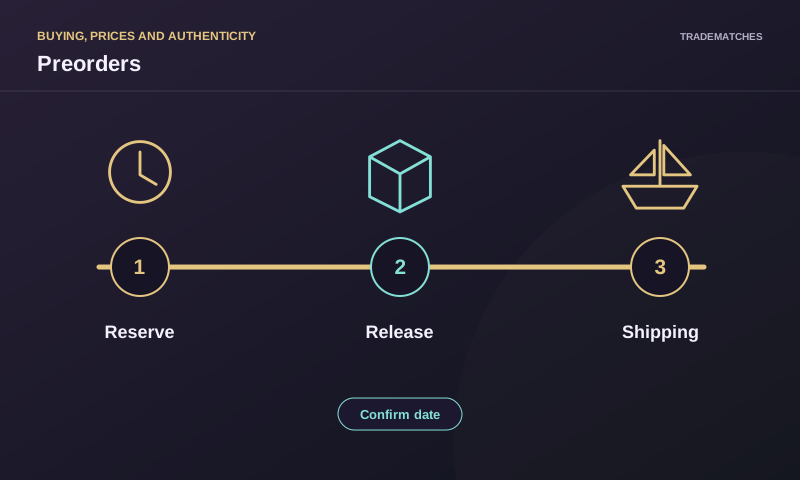
In a Cardmarket pre-order, the general rule expects the seller to send the product on its release date. That does not mean it must arrive at your address that same day. The seller's eligibility and Magic's specific rules also matter. Check product, date and mode before ordering cards for an upcoming event.
What are you buying before launch
A pre-order is an operation on a product whose calendar still conditions the shipment. It should not be evaluated as if the card was already available to leave immediately. Read the product page and ad to identify relevant version, language, content, and date. The name of an expansion is not enough to distinguish a box, an individual card and a particular variant.
If you need a card for Friday launch, enter transportation time into your decision. A correct departure on Friday can arrive after your event. Do not attribute a promise of immediate delivery to the seller just because the page shows that day as a launch. For a need with a rigid date, confirm in writing what service and expectation it offers before committing.
Who can offer presales
Cardmarket's general policy considers established professional sellers eligible with at least a thousand professional sales and a year or more in that condition. Permission must be requested and treated as a platform privilege. Complying with figures in your account does not mean that you can activate presales on your own without the corresponding authorization.
As a buyer, that information helps you understand why one store can offer a product before release and another does not. Do not infer fraud solely because two accounts have different options. As a seller, check the status of your privileges and current documentation before listing stock. A long history as a private seller does not automatically replace the requirements expressed for the professional account.
The commitment to send
The official page places the obligation of pre-sales to comply with orders on the date of launch indicated for the product. It also warns that non-compliance can lose pre-sale privileges. Vendor planning should be based on units that you can deliver, not on the expectation that you will get stock after closing purchases.
For the buyer, the useful question is ‘when is this product shipped?’, followed by ‘which shipping service will be used?’. For the seller, it's "do I have confirmed stock that allows me to fulfil these orders?" They're different checks. High demand does not itself change the date the platform displays nor does it allow you to promise an amount that you cannot yet support.
Launch and prerelease are not synonymous
Some games allow events before the general sale and some products follow specific calendars. Do not copy the date of a store prerelease as the release date of any item. Identify which product you are viewing, which rule of your game applies, and which date Cardmarket publishes for that product page.
An individual card obtained at an event and a sealed box from another presentation may have different situations. To document your purchase, save the product reference and date you checked. A screenshot of general news of the expansion does not necessarily demonstrate the commitment of a particular shipment, especially if the operation includes versions or products with different dates.
The Magic Exception
Cardmarket publishes a specific section for Magic: The Gathering. It describes the role of WPN status in professional pre-sales and allows private sellers to offer individual cards from the date of store prerelease events. For individuals it indicates a maximum of 75 items listed during the pre-sale period.
The same section includes review through support for professionals who may meet the requirements even if they do not have the status indicated. Therefore, do not reduce the whole policy to ‘only a store can sell before’ or ‘any individual can offer any product’. See the exact case. Documented exceptions should not be automatically extended to other games.
Mix pre-orders and available products
Before confirming a cart, check whether the shipment brings together available cards and products with future release. Do not assume that the first ones will travel separately or that you will receive two packages without agreement. Look at the actual shipment organization and ask the seller if you need a division that the operation doesn't specify.
This problem is easy to overlook when you add an ordinary card to a pre-order to save postage. Savings can change your calendar if everything depends on the future product. Compare the cost and date of separate transactions with the grouped one. You don't need to guess the market: you need the purchase structure to match the date you'll use each card.
Evaluate a purchase without predicting prices
A pre-order can ensure a specific transaction, but does not guarantee that the later price will rise or that you have chosen the cheapest option. Future offers, availability and demand may vary. Decide how much you are willing to pay for that exact identity and how useful it is to receive it after launch, without turning a market expectation into a fact.
Compare language, edition and condition, in addition to the amount. Two advertisements may look like the same card and represent variants that interest different audiences. If you need it to play, a version priced higher for its finish may not add utility. If you are looking for it for collection, confirm that the finish and numbering are precisely the ones you intend to reserve.
Follow-up when the date arrives
Check the status of the shipment and the seller's communication. A tracking number alone does not show that delivery should take place on that day; check the carrier’s tracking events and distinguish label creation, admission and delivery. Do not mark an order received until you have the contents and have checked them against the order.
If an incident appears, retain dates, product and status. Contact the order channel and use support if you need to resolve a breach. Do not invent a grace period or automatically apply a normal order rule to a presale with a specific calendar. Presenting the exact information allows the platform to determine the relevant procedure.
Buy from Spain for an event
Count days of transportation and consider whether the seller is in another country. Dispatch on the published date can comply with the policy and still not serve for a Spanish tournament that weekend. Also check if you need to register a list before you have the card and if you can use another legal copy while waiting.
The practical decision is to separate a collection purchase from a competitive need with a deadline. For the second, require an expectation of availability that you can check and prepare an alternative. For the first one, you might care more about a specific version than the immediate arrival. There is no justification for assuming that launch, dispatch and receipt occur at once.
Plan a pre-order around a fixed deadline
Suppose you want a card for a Saturday tournament and the product releases on Friday. A pre-order dispatched on Friday may satisfy the general policy while still giving you no reasonable expectation of having the card on Saturday. Reading release as delivery does not solve the problem. You need to confirm physical availability, transport and any additional commitment made by the seller.
Compare three possibilities: receiving the pre-order in time with a verified expectation, obtaining a legal copy another way or playing a replacement you already have. Do not register a list dependent on an uncertain arrival without understanding the event's conditions. If you are buying for a collection with no fixed deadline, you may accept a different timetable. That personal preference does not change the platform's dispatch requirement.
Sellers should make the same distinction to avoid ambiguous promises. State the product being offered and the dispatch date you can meet. If someone asks about a particular tournament, explain the transport expectation without guaranteeing an unconfirmed outcome. A reservation records a transaction. It does not turn a set's release date into a universal arrival guarantee for every country and destination.
Frequently asked questions
Must a pre-order arrive on release day?
The general rule refers to shipment on that date. Arrival depends on transportation and any additional commitments you have checked.
Can any professional seller offer presales?
Not automatically. The policy sets eligibility and request for privileges, as well as specific conditions for Magic.
Can individuals sell Magic before the general release?
The specific section allows individual cards from prerelease store events and limits listings during the period. Always check the current policy and the specific product.