Cardmarket Trustee Service: what does it protect?
On this page
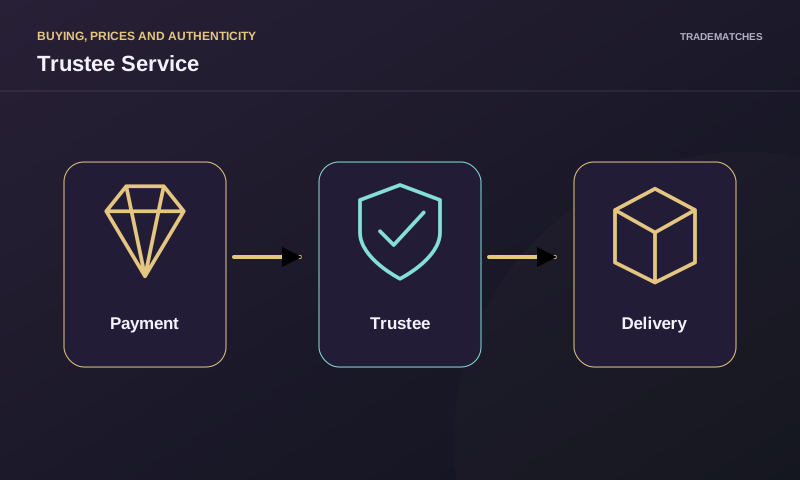
Trustee Service is the protection of Cardmarket that retains the payment to the seller for shipments with tracking until the buyer confirms the arrival or the incident is resolved. It does not replace checking the received order.
When does it come into effect
Cardmarket indicates that the service applies to shipments with tracking, with few exceptions, and that there is a fee based on the value of the order. Review the visible conditions during the purchase: do not assume that all economic shipments without tracking have the same coverage.
Confirm only after inspecting
When receiving the package, compare the quantity, language, version, and condition with the advertisement. If there is a problem, use the order messaging and keep the incident open before pressing confirm arrival. Cardmarket warns that the payment protection ceases to apply upon confirmation. Keep photos and packaging until the discrepancy is resolved.
Tracking does not mean correct delivery
A scan in the destination country does not prove that the package has arrived at your address. Cardmarket differentiates states such as entry into the country and real delivery. If the shipment does not appear, check the tracking and contact the seller from the order; the procedure depends on whether it is lost, returned, or marked as delivered.
What exactly does the retention do
Cardmarket's Trustee Service is a mechanism for certain shipments with tracking: the platform retains the payment intended for the seller until the buyer confirms the arrival or the situation is resolved according to its process. The practical idea is to give time to check that the order has arrived before releasing the money. It does not mean that Cardmarket has physically inspected each card, guaranteed its condition, or that any shipment without tracking has identical coverage. Before paying, check on the order page if the service applies and what transportation was selected.
Cardmarket explains that it is offered for shipments with tracking with few exceptions and that it charges a fee linked to the value of the order. The exact amount can vary and it is advisable to read the current tariff table instead of memorizing an old number. If you compare two shipping methods, include transportation and fee in the total cost, as well as the price of the cards. An order that seems cheaper at first glance may have different tracking and protection conditions.
Tracking allows verification of delivery
The seller must provide the tracking number associated with the shipment. With that code, you can check the status with the postal operator. Cardmarket recommends sharing it within the platform's messaging so that both parties have the same reference. Check that the number corresponds to the correct order and that the tracking events are updated. A status like "arrival in the destination country" does not mean "delivered to the address." Neither does an arrival at the office imply that you already have the cards in your hands.
This difference is essential before confirming. If the package is still in transit or waiting for pickup, check the operator's details and act accordingly. If it is marked as delivered but you don't find it, do not confirm by routine: contact the seller and use the appropriate incident path. The retention is useful precisely while you can verify the facts. Pressing "arrived" just because the app reminds you of a notification can close a stage before you have resolved the problem.
What to check when you receive the package
Open the order on Cardmarket and compare each item with the paid list. Verify the card name, edition, language, finish, quantity, and announced condition. Also check if the packaging arrived intact. If everything matches, confirm the arrival from the order. If a card is missing, the version is different, or the condition does not match, write to the seller from the same operation and keep clear photos of the card and the package. The retention gives you a margin to clarify the problem, but the platform needs specific information to manage an incident.
Do not mix "a package has arrived" with "the order is correct." Confirmation has consequences for the release of payment and the closure of the transaction. Cardmarket recommends resolving content issues before confirming. If the seller offers a partial refund or a resend, leave the agreement documented within the platform. An external message may be difficult to relate to the shipment when support is involved.
Retention is not universal insurance
It is tempting to translate Trustee Service as "guaranteed purchase." That expression hides conditions. The service is linked to certain shipments with tracking and a specific confirmation and investigation process. If the order does not arrive, it is not automatically refunded the next day; a postal investigation may be required. Cardmarket explains different steps and timeframes depending on the situation. Check the status of your shipment and open the corresponding incident. Retention protects a process, not the possibility of delays or disagreements.
If you choose a shipment without tracking to save money, check what protection and process apply. Do not assume it has the same Trustee Service. For a high-value card, compare the savings from shipping with the difficulty of proving where a tracking-less shipment is. This is a cost and risk decision you must make before buying. The order confirmation screen and official help are the references to know which service actually applies.
When the seller marks the shipment
Once the seller indicates that the order has been sent, check the date and code. A status marked as "sent" is not yet a delivery. There may be time for national or international transport and different postal milestones. If the code does not move during a reasonable period, write to the seller from the order page with the date, shipment number, and what the operator shows. Cardmarket has procedures for investigating losses and timeframes for activating certain options; avoid jumping to a conclusion without checking them.
The seller usually has more information about how the package was deposited, while you can confirm if it arrived at your address. Communication within the platform creates a shared record. Ask specifically and politely: "The tracking has not changed since that day, can you verify the deposit and open an investigation if applicable?" That phrase is more useful than declaring a scam before checking the transport. If there is no response or no agreement, use support from the shipment.
If the package does not arrive
Cardmarket explains a process for shipments with tracking that do not arrive: check the tracking, contact the seller, and once the temporary conditions of the interface are met, mark the non-receipt incident. The Trustee Service help describes an option that appears after a period since the seller confirmed the shipment and can initiate an investigation. The specific timeframes and the available screen must be checked in the current help and in your order, as the process may change. Do not confirm arrival to try to "unlock" a claim: it is the opposite of what you want to communicate.
Postal investigation can take time and have various results: location and delivery, return to the seller, or declaration of loss. Each result leads to a different solution. Keep the order number and tracking. If the operator marks it as delivered but you do not have it, report the exact fact; this case is not the same as a package still in transit. The protection works better when both parties describe precisely what has happened.
If the seller asks to confirm before
Confirm only when you have received and inspected the shipment according to Cardmarket's conditions. A seller may need to charge, but that need does not convert a arrival in the country or a promise of resend into a delivery. Respond with the real status: "I have not yet received it" or "I have received it, but this card is missing and I am reviewing it with you." Keep the conversation within the order. If the tracking shows a delivery and you are not home, check first if someone authorized picked it up or if it is in an office, and communicate the result.
Official help also includes processes for the seller to request confirmation when a shipment appears delivered and the buyer does not respond. That is why it is not advisable to ignore legitimate messages: check the package as soon as possible and respond. If there is an incident, open it within the timeframe and with evidence better protects your position than letting days pass without communication.
Common errors when interpreting the service
The first is believing that all Cardmarket purchases include Trustee Service. The second is confusing "in the country" with "at home." The third is confirming before inspecting. The fourth is negotiating a solution outside the platform and losing the context of the order. The fifth is assuming an instant refund even though a postal investigation is pending. Before buying, check the shipment and the fee; after, follow the tracking; upon receiving, compare the items; if there is a problem, report it from the order. It is a simple and more reliable sequence than a generic promise of protection.
Common questions
Does Trustee cover all shipments?
Cardmarket offers it for shipments with tracking with some exceptions; check the specific order.
Can I claim after confirming arrival?
You could contact support, but the payment retention protection ends upon confirmation; check before.