Digimon Card Game keywords explained: Blocker, Decoy, Partition, Evade, Barrier and more
On this page
In the Digimon Card Game, Blocker lets you suspend one of your Digimon in the battle area to make an attack hit it instead, Decoy deletes one of your Digimon to save another from an opponent's delete effect, and Partition plays specific digivolution cards for free when the Digimon is removed. Those are the keywords players search for most, and this guide covers them first, followed by Evade, Barrier, Piercing, DNA Digivolution, the breeding area, the memory gauge and the rest. Everything below was checked on 21 October 2026 against the official Comprehensive Rules Manual, version 4.3 (last updated 18 September 2026), and Bandai's official rule Q&A. Rule numbers are in brackets and Q&A answers are cited as Q plus their number.
Three general rules come up again and again. Card text beats the rules when they conflict, which is why a card with <Rush> can attack the turn it is played (1-3-1). If you are asked to do something impossible, you simply don't do it, and you do as much of a partly impossible instruction as you can (1-3-2). And a "when X would happen" effect is an immediate-type effect: it steps in just before the event, which is how Evade, Barrier, Decoy, Armor Purge and Partition can stop or change a deletion (15-8-5). There is no Spanish edition of the game: Bandai's own page lists Europe, including Spain, as an English-version region, so the keyword names below are the official English ones. Our guide to card languages and editions explains why that matters when you trade.
All keywords and rules at a glance
| Keyword or rule | What it does | Rule |
|---|---|---|
| <Blocker> | Suspend this Digimon to become the new attack target | 12, 16-5 |
| <Barrier> | Trash your top security card to avoid deletion in battle | 16-25 |
| <Evade> | Suspend this Digimon to avoid any deletion | 16-22 |
| <Decoy> | Delete this Digimon so another of yours isn't deleted by an opponent's effect | 16-18 |
| <Partition> | Play the specified digivolution cards free when the Digimon is removed | 16-29 |
| <Jamming> | Not deleted by losing to a Security Digimon | 16-9 |
| <Piercing> | After deleting a Digimon in battle while attacking, check security | 16-7 |
| <Rush> / <Blitz> | Attack the turn it is played / attack while your opponent has memory | 16-15, 16-16 |
| <Alliance> | Suspend another Digimon to add its DP and <Security A. +1> | 16-24 |
| <De-Digivolve> | Trash cards from the top of an opponent's Digimon | 16-12 |
| <Armor Purge> | Trash this Digimon's top card to avoid deletion | 16-19 |
| <Save> / <Material Save> | Place cards under one of your Tamers | 16-20, 16-21 |
| <Recovery> | Add cards from your deck to the top of your security stack | 16-6 |
| <Retaliation> | When deleted in battle, delete the Digimon it battled | 16-13 |
| <Reboot> | Also unsuspends in your opponent's unsuspend phase | 16-11 |
| <Delay> | Trash this Option from the battle area for an effect | 16-17 |
| <Collision>, <Fortitude>, <Raid>, <Security A.> | Forced blocks, replay after deletion, target switch, extra checks | 16-30, 16-27, 16-23, 16-4 |
| Overflow (ACE) | Lose memory when an ACE card leaves the field or a stack | 4-19 |
If a card shows a keyword that isn't in this table, or you recognise the same idea under another name from a game you already play, the TradeMatches keyword glossary can be filtered to the Digimon Card Game and links each term to the section of this guide that explains it.
Blocker: when a Digimon can block
A Digimon with <Blocker> can block if it is in your battle area, can be suspended and isn't already the attack target: during the block timing you suspend it and the attack switches to it. That is the whole mechanic (12-1-1, 12-1-7-1). Blocker is a persistent effect that only grants permission to block; it doesn't force you to (16-5-1, 16-5-2).
When the block happens
Every attack runs through five timings in order: attack declaration, counter timing, block timing, confirming whether the attack is successful, and end of attack (11-1-3). The block comes after [Counter] effects and before any security check or battle, so you decide with the attacker and its target already known.
Limits
- One block per attack. Two Digimon can't block together, and a second block can't be declared during a block (12-1-2, 12-1-3).
- A Digimon that can't suspend, usually because it is already suspended, can't block (12-1-4).
- The Digimon being attacked can't block that attack (12-1-5).
- There must still be an attacking Digimon in the battle area (12-1-6).
- A Digimon with several instances of <Blocker> still blocks only once per block timing (16-5-3).
- Only Digimon in the battle area block (4-3-7). A Blocker sitting in the breeding area does nothing.
Worked example
Your opponent attacks you directly with a 7000 DP Digimon. You have an unsuspended 6000 DP Digimon with <Blocker>. If you block, the attack target becomes your Blocker, the attack is confirmed as successful against a Digimon, and a battle follows instead of a security check (11-5-1-3). Your 6000 DP Digimon loses and is deleted (14-2), but your security stack is untouched. If you don't block, the attacker checks your top security card. Because Digimon can only attack the opponent or a suspended Digimon (11-2-7-1), your unsuspended Blocker is normally safe from being attacked directly, which is what makes it a good wall.
Two interactions from the Q&A: after <Raid> switches an attack target you can still block (Q273), but once you have blocked, <Raid> can't switch the target again because its timing has passed (Q274). <Reboot> is the usual partner for Blocker, because it lets a Digimon that attacked on your turn stand up again for your opponent's turn (see Reboot).
Barrier and Evade: two ways to avoid deletion
<Barrier> stops a deletion in battle by trashing your top security card; <Evade> stops any deletion, from a battle or from an effect, by suspending the Digimon that has it. Both are immediate-type effects that step in just before the deletion, and both are optional (16-25, 16-22, 15-8-5).
| <Barrier> | <Evade> | |
|---|---|---|
| Which deletions | Only "deleted in battle", including against a Security Digimon (Q284) | Battle or effect (Q261) |
| Payment | Trash the top card of your security stack | Suspend this Digimon |
| When you can't pay | No security cards left | The Digimon is already suspended (Q262) |
| Deleted by <Retaliation> | Can't stop it, that is an effect (Q283) | Can stop it if unsuspended |
| 0 DP | Not a battle deletion | Can be activated, but the Digimon is deleted again at 0 DP (Q264) |
When either keyword prevents a deletion, the Digimon was never deleted, so its [On Deletion] effects don't trigger (Q265, Q285). You can't resolve [On Deletion] first and then save the Digimon. It also means the attacker's <Piercing> doesn't trigger, because Piercing needs your Digimon to be deleted in battle (Q266, Q287). Trashing a security card for Barrier does count as a card leaving your security stack, so "when a card is removed from your security stack" effects trigger (Q288). Suspending for Evade counts as an effect suspending the Digimon (Q268).
The trap with Evade
Attacking suspends the attacker (11-2-1), so an attacking Digimon with <Evade> normally has nothing left to pay with when it loses a battle. Evade shines on your opponent's turn, on an unsuspended Digimon hit by a delete effect. If an effect later unsuspends it in the same turn, Evade can be used again (Q267).
Example: your opponent's Option deletes your unsuspended Digimon that has both keywords. Barrier can't help, because this is not a battle. You suspend it with Evade and it stays. Later that turn it is attacked while suspended and loses the battle: now Evade can't be paid, but Barrier can, if you still have a security card.
Decoy: deleting one Digimon to protect another
<Decoy> lets you delete the Digimon that has it so that another of your Digimon, matching the colour or condition in brackets, isn't deleted by an opponent's effect. It is written like <Decoy (Black)>: only your other black Digimon can be protected (16-18-1). Decoy is an immediate-type effect, and deleting the Decoy is the optional condition. Once you delete it, the protection is mandatory (16-18-2, 16-18-3).
What Decoy can and can't stop
- It works only against an opponent's effect that deletes. A Digimon that loses a battle can't be saved with Decoy (Q224).
- It doesn't work against 0 DP. Lowering DP isn't a delete effect, and a 0 DP deletion is done by the rules, not by an effect (Q225, Q85).
- <Retaliation> deletes by effect, so Decoy can answer it (Q229).
- The protected Digimon keeps its digivolution cards and its [On Deletion] effects don't trigger, because it wasn't deleted (Q221, Q222).
- The Decoy Digimon itself is deleted, so its own [On Deletion] effects do trigger (Q223).
Several deletions at once
If one effect deletes two of your Digimon that Decoy could protect, one Decoy saves only one of them (Q226). Two Decoy Digimon can save one each (Q227). If the effect is deleting the Decoy Digimon and the protected Digimon at the same time, you can still use Decoy to save the other one (Q228).
Example: your opponent plays an Option that reads, in effect, "delete 1 of your opponent's level 6 or lower Digimon" and chooses your black level 6. You have a level 3 with <Decoy (Black)>. You delete the level 3, the level 6 stays with its whole stack, and any [On Deletion] effect on the level 3 resolves.
Partition: playing digivolution cards when the Digimon is removed
<Partition> triggers when the Digimon would leave the battle area other than by your own effects or a battle, as long as it has one of each specified card in its digivolution cards; you may then play one of each of those cards for free. It is printed with the cards it needs, such as <Partition (green Lv.5 & blue Lv.5)> (16-29-1). It is optional, but if you use it you must play every specified card, not just one (16-29-3, 16-29-4, Q315).
Conditions in practice
- Both specified cards must be in the digivolution cards. One green Lv.5 without a blue Lv.5 doesn't trigger it (Q312). Having more than the minimum is fine (Q313).
- Losing a battle doesn't trigger it, and neither does your own effect that removes the Digimon. It is protection against your opponent's removal: deletion, return to hand or deck, and so on (16-29-1).
- It triggers even if one specified card can't be played, such as a DUAL card with no play cost; you then play what can be played (Q314).
- The Digimon with Partition still leaves. Partition doesn't save it, it leaves two Digimon behind.
Because the cards are played, they are new Digimon on the field: [On Play] effects on them trigger (15-16-2-1), and they can't attack the turn they are played unless something says otherwise (7-1-2-1). Partition is usually discussed alongside DNA Digivolution, since a DNA Digimon's stack tends to contain exactly the two Digimon the keyword asks for (see DNA Digivolution).
Example: your Digimon with <Partition (green Lv.5 & blue Lv.5)> has a green Lv.5 and a blue Lv.5 under it. Your opponent returns it to your hand with an effect. Before it leaves, you play the green Lv.5 and the blue Lv.5 from its digivolution cards without paying their costs. The top card goes to your hand and the rest of the stack is trashed as it leaves (4-7-8).
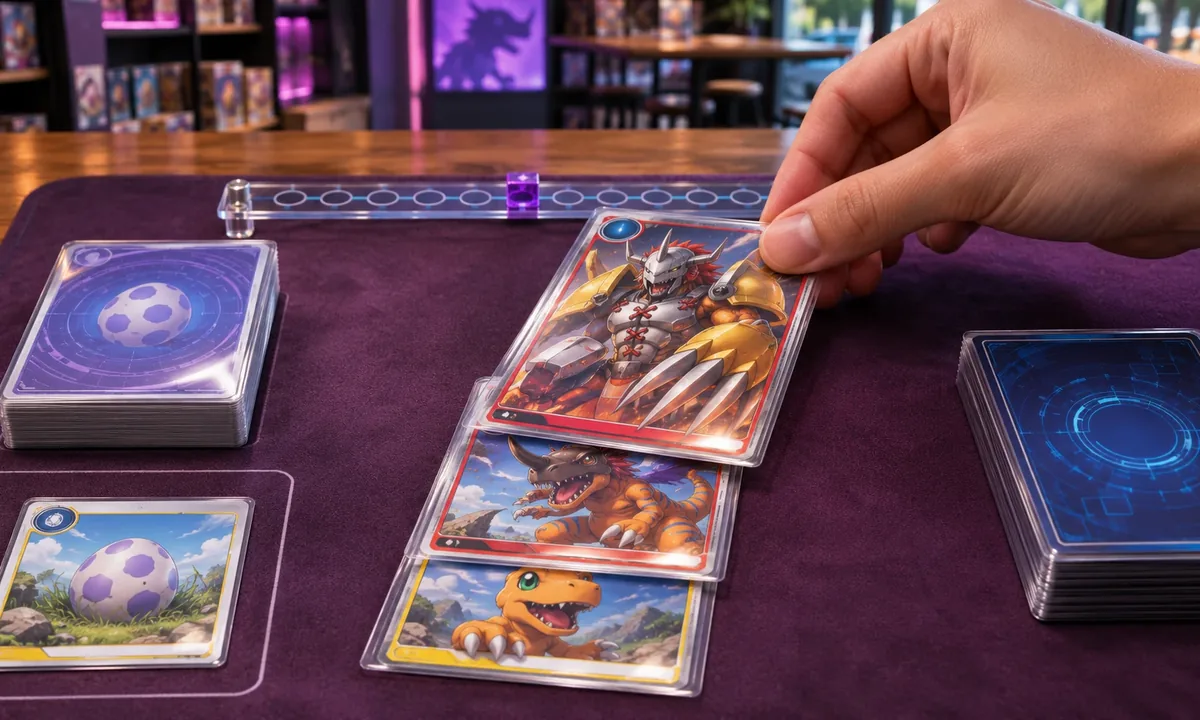
Breeding area vs battle area
The breeding area holds a single card, the Digimon you hatched, and it is almost completely shielded: effects can't choose, affect or reference it, and its own effects don't trigger, unless the effect mentions the breeding area. The battle area is where Digimon attack, block and fight, and it holds any number of cards. Together they form "the field" (3-4-6 to 3-4-8).
The official rule manual (Official Rule Manual 6.0, "Game Areas" page) lays out each player's areas like this: security on the left, deck and trash on the right, the breeding area at the bottom next to the Digi-Egg deck, and the memory gauge between the two players.
What you can do in the breeding phase
Once per turn, in your breeding phase, you choose exactly one of three things: hatch the top card of your Digi-Egg deck, move your Digimon from the breeding area to the battle area, or do nothing (6-4-1). You can only hatch if the breeding area is empty and your Digi-Egg deck has cards (4-18-2, 4-18-3). Only a Digimon with DP can be moved, so a Digi-Egg must digivolve first (4-17-2). You can't trash the card in the breeding area just to hatch again (Q20), and running out of Digi-Eggs doesn't lose you the game (Q21).
What is shielded
- Your opponent's "suspend 1 of your opponent's Digimon" or delete effects can't choose it (3-4-7-5, Q30).
- You digivolve it in your main phase like any other Digimon, but its [When Digivolving] effects don't trigger there (3-4-7-4, Q22, Q27).
- Conditions such as "if you have a Digimon with <Blocker>" don't count it (Q32).
- Moving it isn't playing it, so [On Play] effects don't trigger (Q23). The Q&A also confirms that a Digimon moved to the battle area can attack that same turn, even one hatched this turn, provided it wasn't played (Q67, Q68).
Three things do reach into the breeding area: (Rule) text on a card, which always applies wherever the card is (2-3-4-1); <Training>, which says it can activate there (16-41-1); and colour requirements for Option cards, which a Digimon in the breeding area can meet (Q372). An ACE card trashed from the breeding area also processes its Overflow (Q439).
Jamming and Piercing
<Jamming> means the Digimon isn't deleted when it loses a battle against a Security Digimon; <Piercing> means that when your attacking Digimon deletes an opponent's Digimon in battle, it checks security just before the attack ends. Jamming is persistent (16-9). Piercing is a trigger-type effect whose security check is mandatory (16-7-1 to 16-7-3).
Jamming in detail
Jamming covers only losing a battle to a Security Digimon. The flipped card's [Security] effect still activates as usual (Q160). If the attacker has extra checks from <Security A. +1>, it survives the lost battle and carries on checking (Q161). Jamming says nothing about deletion by a [Security] effect, only about the battle.
Piercing in detail
- Only your opponent's Digimon may be deleted. If both are deleted in a tie, there is no check (Q152).
- Beating a Security Digimon doesn't trigger it (Q151).
- It works when the attack target was switched to a Digimon, for example by a block (Q150).
- One check per attack, however many times it triggers; <Security A.> still adds cards to that check (16-7-5, Q153).
- If the attack already checked security because it reached the player, Piercing adds nothing (Q155).
- With 0 security cards, Piercing doesn't win you the game (Q542).
- If an effect ends the attack, the Piercing check never happens (Q5974).
- If the battle triggers your opponent's [On Deletion], that resolves first, then Piercing (16-7-4).
Example: your 9000 DP Digimon with <Piercing> attacks a suspended 6000 DP Digimon. It wins the battle, your opponent's [On Deletion] resolves, and before the attack ends you check one security card. If the defender had <Retaliation>, your attacker is deleted before that check, so it never happens (Q173).
DNA Digivolution: costs, stacking and attacking
DNA Digivolution stacks two of your Digimon in the battle area that match the requirements, such as "Blue Lv.4 + green Lv.4: Cost 0", places the DNA card on top, pays that cost and draws a card; the result is a new, unsuspended Digimon that can attack that turn. It is done from the hand in your main phase (8-2-1, 6-5-1-2-2).
Rules that differ from normal digivolution
- Both Digimon must be yours and in the battle area. The breeding area doesn't count (Q383, Q388).
- They can be suspended or not; the new Digimon always enters unsuspended, and that doesn't count as unsuspending (8-2-2-1-1, Q382, Q394).
- The Digimon on the left of the requirement goes on top, each with its own digivolution cards underneath, without reordering. A lower level can end up above a higher one, which is normal (8-2-2-2, 8-2-2-3, Q381).
- It counts as a different Digimon. Effects on the originals end, [Once Per Turn] uses reset, link cards are trashed, and if one of them was attacking or being attacked, that attacker or target no longer exists (8-2-2-1-2 to 8-2-2-1-6).
- It can attack even if both originals were played this turn (8-2-2-1-7, Q384).
- A single multicolour Digimon can't fill both halves; the number of Digimon must match (Q391).
- An effect that says "digivolve" can't be used to DNA digivolve; only effects that specifically perform DNA digivolution can (8-2-2-4, Q395).
Effects that change digivolution costs also apply to DNA digivolution (8-2-2-5, Q389). <De-Digivolve> on a DNA Digimon trashes from the top like any other stack and doesn't split it back into two Digimon (Q390).
Example: you have a green Lv.4 with two cards under it and a blue Lv.4 with one card under it, both played this turn. You DNA digivolve into a Lv.5 that requires "green Lv.4 + blue Lv.4". Your stack, from the top: the Lv.5, the green Lv.4, its two cards, the blue Lv.4, its one card. You draw one card, and the new Digimon can attack immediately.
Rush and Blitz: two different permissions to attack
<Rush> lets a Digimon attack the same turn it was played; <Blitz> lets a Digimon attack while your opponent has 1 or more memory, which is the moment your turn would otherwise end. They solve different problems and are often confused (16-15, 16-16).
Rush
Rush is persistent: it overrides the rule that a card can't attack the turn it was placed on the field (7-1-2-1). Digivolving into a card with Rush the same turn lets it attack, and digivolving into a card without Rush takes that permission away (Q189, Q190). If paying for the card moves the memory to your opponent's side, the turn ends before you get to attack (Q188).
Blitz
Blitz is usually printed as "[When Digivolving] <Blitz>". It needs the memory to be at 1 or more on your opponent's side when it activates (16-16-3, 16-16-5). That makes it the answer to an expensive digivolution that hands the memory over: you still get to attack before the turn passes. Once the attack is declared, it continues even if the memory comes back to your side (16-16-4, Q195), and the turn ends after the whole attack has resolved (Q199).
Blitz doesn't override the "played this turn" rule (Q196), and it can't start an attack during another attack (11-2-4, Q197). If the memory is on your side when Blitz would activate, it can't be used even if it later moves (Q193).
Example: you are at 2 memory and digivolve for 4 into a card with [When Digivolving] <Blitz>. The memory goes to 2 on your opponent's side. Blitz activates, you attack, and your opponent starts their turn with 2 memory.
Mulligan: redrawing your opening hand
Each player may redraw their opening hand once: you return all five cards, shuffle and draw five new ones, and only after that do you set your five security cards. Bandai introduced the mulligan on 1 April 2023 (official news page), and it is now rule 5-2-1-4 and 5-2-1-5.
- Shuffle your deck and your Digi-Egg deck (5-2-1-1, 5-2-1-2).
- Play rock-paper-scissors. The winner goes first; they don't get to choose (5-2-1-3, Q8).
- Draw five cards. Starting with the first player, each player may declare a redraw, once (5-2-1-4, Q7).
- A redraw replaces the whole hand, never part of it (5-2-1-5, Q7).
- Place the top five cards of your deck face down as security, one at a time and without looking, so the top card of the deck ends at the bottom of the stack (5-2-1-6, Q10).
- Put the memory marker at 0 and start the first player's turn (5-2-1-7, 5-2-1-8).
The first player doesn't draw in their first draw phase (6-3-1-1). Because security is set after the mulligan, a redraw doesn't change what is already in security: those cards are still unknown and come from the reshuffled deck.
That order also makes the two hands independent, because the first hand goes back into the deck and is shuffled before you draw again. With 4 copies of a card in a 50-card deck, a 5-card hand contains at least one 35.3% of the time (hypergeometric: 1 − C(46,5)/C(50,5)). If you redraw every hand that misses it, you start with it in 58.1% of games (1 − 0.647²). To run the numbers for your own list, open the opening hand probability calculator, choose Digimon (50 cards, 5-card hand) and enter how many copies you play.
Security checks step by step
When your Digimon's attack on the player succeeds and they have security cards, you flip their top security card: a Digimon card battles your attacker, an Option or Tamer card can activate its [Security] effect, and the card is then trashed unless it went somewhere else. If they have no security cards and your attack can check, you win (11-5-1-1, 11-5-1-2, 1-2-3-1).
The procedure
- Reveal the top security card. It leaves the stack and isn't in any area; a Digimon card becomes a Security Digimon (13-1-6 to 13-1-8-1).
- Resolve effects triggered by the check. [Security] effects activate immediately, ahead of other effects, and don't need colour requirements (15-16-10-2, Q373).
- A Security Digimon battles the attacker by comparing DP. It is never deleted, but your attacker is deleted if it loses or ties (14-2, 14-2-3).
- The revealed card is trashed, unless an effect put it in the hand or the battle area (13-1-8-4).
- If the attacker can make more checks, it makes the next one (13-1-8-5).
Only one security check happens per attack. <Security A. +1> doesn't add a second check, it lets that one check flip more cards, one at a time (13-1-2, 13-1-3, and Bandai's April 2026 clarification). If the attacker leaves the battle area, for instance by losing to the first Security Digimon, the remaining cards aren't checked (13-1-5). A negative total means zero cards (16-4-4). An Option card's [Security] effect activating isn't "using" an Option card (Q50).
Example: your 7000 DP Digimon with <Security A. +1> attacks the player. The first card is a 4000 DP Security Digimon: you win the battle and it is trashed. The second card is a 9000 DP Security Digimon: your attacker loses and is deleted, and the check ends there.
Alliance: adding DP without a second attack
When a Digimon with <Alliance> attacks, you may suspend one of your other Digimon to give the attacker that Digimon's DP and <Security A. +1> for the attack. The suspended Digimon doesn't attack, it only supplies DP (16-24-1, Q277).
- The DP added is the supporting Digimon's DP at the moment you suspend it. Later changes to it don't change the bonus (16-24-4, Q281).
- If the supporting Digimon leaves the battle area during the attack, the attacker keeps the DP and <Security A. +1> (16-24-5, Q280).
- The attacker gets exactly <Security A. +1>, not the supporter's own <Security A.> value (Q282).
- You need a Digimon you can suspend, so an already suspended one can't help (15-7-4).
- Alliance, [When Attacking] and "when suspended" effects trigger together, and you pick the order (Q279).
Example: a 5000 DP attacker with Alliance suspends your other 5000 DP Digimon. It now attacks with 10000 DP and checks two security cards (Q277).
De-Digivolve: trashing the top of a stack
<De-Digivolve X> makes you declare a number from 1 to X and trash that many cards from the top of the chosen Digimon, but it can't trash anything from a level 3 or lower Digimon. Once activated, you can't choose 0 (16-12-1 to 16-12-4).
- It isn't deletion. [On Deletion] effects on trashed cards don't activate (Q170).
- If a level 2 card ends up on top, it has no DP and is trashed by the rules, not deleted (Q165, 17-1-3-2-1).
- The check is made after all the declared cards are trashed, not card by card (Q172).
- A level 3 on top stops it, even with higher-level cards underneath (Q171).
- The new top card keeps the stack's orientation; a suspended Digimon stays suspended (4-7-6).
- If a Tamer card ends up on top, the stack becomes a Tamer, without counting as played (Q168).
- When one effect de-digivolves several Digimon, you declare one number for all of them (Q6527).
Effects with a set duration from a trashed card, like "for the turn", carry on; [Your Turn], [Opponent's Turn] and [All Turns] effects from that card stop (Q166).
Option cards and colour requirements
To use an Option card from your hand you need a Digimon or Tamer of the same colour on your field, and the field includes your breeding area; a multicolour Option needs every one of its colours. You also pay its use cost, its [Main] effect activates, and it is then trashed (4-22-2, 4-22-3, 9-1, Q372).
- One multicolour Digimon or Tamer can cover several colours at once (4-22-4, Q372).
- Option cards sitting in the battle area don't meet colour requirements (Q218).
- [Security] effects don't need colour requirements (Q373), and neither do effects you activate without using the card (4-22-5), such as <Delay> (Q216).
- An effect that says "use a blue Option card" still needs every colour of a blue/green Option (Q375).
- You can use an Option with no targets for its effect (Q92).
<Use Req.> is the keyword that changes this (16-42). On 16 October 2026 Bandai changed its reminder text to "Specified conditions meet color requirements" to make it easier to read. Bandai's example: with <Use Req. ≪[DATA SQUAD] trait≫>, a [DATA SQUAD] trait Digimon or Tamer in your battle or breeding area meets the colour requirements. Option cards on the field still don't count (Q6525). This change is recent: check the official page again before publishing.
Inherited effects: which text is active
A Digimon gains the inherited effects printed on the cards stacked under it, but none of their other information: not their name, colour, traits or main effects. The top card's main text is active; the cards underneath contribute only the "Inherited Effect" box (4-3-3, Q95).
The diagram shows where each part of a stack comes from: how it is built when you digivolve, following the procedure in rule 8-1-3, and what each card contributes once it sits underneath.
- An inherited effect needs a stack; a single card can't use its own (15-3-1).
- Whatever card category it comes from, even a Tamer card, an inherited effect is a Digimon effect (15-3-2).
- Once a Digimon becomes a digivolution card, its main effects stop and its inherited effect takes over (Q63).
- Face-down digivolution cards have no information, so their inherited effects don't work (4-7-9, Q4679).
- Cards under a Tamer, placed with <Save> for example, aren't digivolution cards until that Tamer digivolves (Q93).
- Gaining an effect isn't gaining the text: a Digimon with an inherited <Blocker> isn't a "card with <Blocker> in its text" (4-23-2, Q427).
- Rearranging a stack doesn't reset an inherited effect's [Once Per Turn] count (Q4990).
In the breeding area inherited effects don't trigger either, unless they mention the breeding area (3-4-7-4). That is why a stack can look powerful in the breeding area and do nothing until it moves.
ACE cards and Overflow
Overflow is a rule on Digimon ACE cards: when the ACE card moves from the field, or from under another card, to any other area, its owner loses the memory printed in its Overflow value. The card list shows Overflow values of −3, −4 and −5 (card list filters, 21 October 2026). It isn't an effect, it doesn't trigger, and it is processed immediately, even in the middle of something else (4-19-1, 4-19-2, Q432, Q434).
When it applies and when it doesn't
- It applies when the ACE is deleted and trashed, even if an effect then plays it from the trash (Q437).
- It applies when the ACE is trashed from under a Digimon, for example to pay for a "trash 1 digivolution card" protection (Q436).
- It applies in the breeding area. That changed with version 2.0 of the rules, in 2024: older cards that say "from the battle area" are read the same way (Bandai's rule-change notes, Q439, Q440).
- It doesn't apply when the ACE moves onto the field or under a card. Playing it from a stack or placing it under a Tamer with <Material Save> doesn't cost memory (4-19-3, 4-19-4, Q435, Q438).
- If several Overflows happen together, the turn player handles all of theirs first (4-19-5).
"ACE" isn't part of the card name: WarGreymon ACE is a [WarGreymon] for effects (2-3-1-4, Q430). Example: it is your turn and you are at 2 memory. Your ACE with an Overflow of −4 is deleted. The memory goes straight to 2 on your opponent's side, the [On Deletion] effects then resolve, and if the memory is still on their side when everything is done, your turn ends.
The memory gauge and when the turn ends
Your turn ends when the memory is at 1 or more on your opponent's side and all processing has finished; whatever memory you leave them is what they start with. One gauge with 10 on each side is shared by both players (1-4-2, 6-1-4-1).
- Paying a cost moves the marker toward your opponent by exactly that amount (4-2-2).
- Memory can't go past 10; anything beyond is lost (1-4-2-2, Q40). From 0 you can't pay a cost of 11 (Q29).
- Passing in your main phase moves the memory to 3 on your opponent's side (6-5-1-7-1).
- Paying for a card that crosses the centre doesn't end the turn on the spot: its [On Play] or [When Digivolving] effects resolve first (Q31, Q57).
- If an effect brings the memory back to 0 or your side before everything resolves, your turn continues (6-6-4, Q54).
Example: you are at 3 memory and digivolve for 5. The marker goes to 2 on your opponent's side. You draw your digivolution card, resolve [When Digivolving] and, if one of those effects gains you 2 memory, the gauge returns to 0 and you keep playing.
Here is the same example on the gauge, together with the check that decides whether the turn passes to your opponent.
DigiXros: materials and cost
DigiXros lets you place cards named in the requirements from your hand and/or battle area under the Digimon you are playing, reducing its play cost by the stated amount for each card. It reads like "DigiXros -2: [Shoutmon]×[Ballistamon]×[Dorulumon]×[Starmons]" (7-2-1).
- One of each named card, unless the requirement gives a number such as "4 [Vemmon]" (7-2-2-5, Q417).
- You may use only some of them, but not zero once declared (7-2-2-4, Q418).
- You declare it just before paying the cost, after any "when this card would be played" effects (7-2-2-2).
- Cards from the battle area leave the field, and the cards under them are trashed (7-2-2-7, Q420).
- The card on the left of the requirement goes on top of the materials (7-2-2-8).
- It works when an effect plays the card, even from outside the hand, and a DigiXros play isn't itself "played by an effect" (Q415, Q423).
Example: with "DigiXros -2" and four named cards, placing three reduces the cost by 6. Assembly is the related rule that uses cards from your trash, and it needs the exact number stated (7-3).
Armor Purge: which card is trashed
<Armor Purge> prevents a deletion by trashing the top card of the Digimon itself, so the card underneath becomes the Digimon. It is optional, and once you trash the card the deletion is prevented (16-19, Q230).
- It needs at least one card underneath (Q234).
- No deletion happens, so [On Deletion] effects and the opponent's <Piercing> don't trigger, and neither does your <Retaliation> (Q231, Q236, Q237).
- If a DP reduction still leaves the new top card at 0 DP, it is deleted (Q233).
- Effects with a duration and "all of your Digimon" effects stay; other effects from the trashed card are lost (Q232).
- An attacking Digimon that purges keeps attacking, but its new top card's [When Attacking] doesn't trigger (Q240, Q241).
- A level 2 left on top is trashed; a Tamer left on top makes it a Tamer (Q238, Q239).
Save and Material Save
<Save> lets you place the card under one of your Tamers; <Material Save X> lets you place X of the deleted Digimon's digivolution cards that appear in its DigiXros requirements under a Tamer. Both are optional (16-20, 16-21).
- New cards go to the bottom of the cards under the Tamer (4-4-2, Q244, Q254).
- With <Save>, the deleted Digimon's other digivolution cards are trashed (Q242).
- <Material Save> happens before the deletion. If you use it, you must place as many cards as you can, up to X, and copies of the same card are allowed (16-21-3, 16-21-5, Q252, Q253).
- A card that is placed with Material Save doesn't trigger its inherited [On Deletion] (Q259).
- The cards under a Tamer become digivolution cards, with active inherited effects, once that Tamer digivolves (Q246, Q256). If the Tamer leaves, they are trashed (Q247).
- A Digimon that digivolved from a Tamer isn't a Tamer, so you can't Save under it (Q255).
Watch the order with <Save> and another [On Deletion] effect on the same card: once Save moves the card from the trash, the other effect can't activate (Q248).
Recovery: adding cards to security
<Recovery +X> places the top X cards of your deck face down on top of your security stack, one at a time, without looking at them. It works with 0 security cards (16-6, Q144 to Q146, Q556, Q557).
You can't use your Digi-Egg deck for it (Q148), and an empty deck doesn't lose you the game when Recovery tries to take cards from it (Q147). The cards go on top, so they are the first ones your opponent checks.
Retaliation: deleting after losing a battle
When a Digimon with <Retaliation> is deleted in battle, the opponent's Digimon it battled is deleted too. It is mandatory and it is an effect (16-13).
The rules say it triggers when "just" the Retaliation Digimon is deleted in battle (16-13-2). Being deleted by an effect or by 0 DP isn't being deleted in battle. Because the second deletion is an effect, <Barrier> can't stop it (Q283), but <Decoy> can (Q229). If your <Piercing> attacker is deleted by Retaliation, it never makes its Piercing check (Q173). Deleting a Retaliation Digimon in battle still counts as "deletes an opponent's Digimon and survives the battle" for the attacker (Q174).
Example: your 4000 DP Digimon with Retaliation is attacked by a 9000 DP Digimon. It loses and is deleted, then Retaliation deletes the attacker.
Reboot: unsuspending on your opponent's turn
<Reboot> unsuspends the Digimon in your opponent's unsuspend phase as well as in yours. It is mandatory, happens at the same time as your opponent's own unsuspending, and multiple instances still unsuspend it once (16-11, Q164).
That is what makes a Digimon with Reboot and <Blocker> so useful: it can attack on your turn and still block on theirs, because blocking needs a Digimon that can suspend (12-1-4). It also means it can't be attacked on their turn, since only suspended Digimon can be attack targets unless a card says otherwise (11-2-7-1).
Delay: which turn you can activate it
A <Delay> Option sits in your battle area and you activate it by trashing it, but not in the same turn it was placed there. In practice that means your next main phase at the earliest (16-17-1, 16-17-3, Q207).
- The Option card has to be placed in the battle area by an effect, often its own [Main] effect (Q208).
- Activating Delay costs no memory, needs no colour requirements and isn't "using" an Option card (Q210, Q216, Q217).
- It is activated in your main phase, one at a time; there is no limit on how many you have (Q211, Q212, Q6129).
- It can't go back to the hand and it can't be attacked (Q213, Q214).
Empty deck: when you lose
You lose when your deck has 0 cards and you have to draw in your draw phase. An empty deck at any other moment doesn't end the game (1-2-3-2, Q16).
A draw from an effect with no cards simply doesn't happen (1-3-2). You can still digivolve without the bonus draw (8-1-2-8). <Recovery> with no cards doesn't lose you the game (Q147), and neither does an empty Digi-Egg deck (Q21). The danger is only at the start of your next turn.
Collision, Fortitude, Raid and Security A.
<Collision> gives all your opponent's Digimon <Blocker> while the Digimon is attacking and forces them to block if they can (16-30). A Digimon unaffected by effects doesn't gain Blocker, but the obligation applies to the player, so a Digimon that already has Blocker must block (Q318, Q319). If the attack target can't be switched, there is no block (Q4689).
<Fortitude> plays the Digimon from the trash for free when it is deleted while it has digivolution cards. Only that card comes back, and it is a new Digimon: [On Play] triggers and [Once Per Turn] resets (16-27, Q304, Q305, Q310). It is mandatory (Q309). Cards of any kind underneath count as digivolution cards (Q303).
<Raid> may switch the attack target to your opponent's unsuspended Digimon with the highest DP when it attacks. It ignores "can't be attacked" because the target is switched after declaration, and you choose among ties (16-23, Q271, Q272).
<Security A. +X> changes how many cards one security check flips. Two instances of +1 flip two extra cards, but the Digimon doesn't count as having +2 (16-4-3).
Finding the cards you are missing
If a deck needs one more Blocker or the two Lv.5 cards a Partition asks for, write down your spare cards and the ones you want on the printable trade list and take it to your store or tournament, which is where Digimon cards change hands. The TradeMatches app does not support the Digimon Card Game yet, so those lists can't be added to the app. If you are just starting, how to get started with Digimon Card Game covers which Starter Deck to buy and how to finish the deck, and our guide to preparing for a first TCG event covers what to bring.
If the card you are waiting for is in a set that hasn't reached shops yet, the release calendar can be filtered to the Digimon Card Game and lets you add each date to your own calendar.
FAQ
Can a suspended Digimon with Blocker still block in Digimon?
No. Blocking is done by suspending the blocker, so a Digimon that is already suspended can't pay for it. Reboot is the usual way around this.
Is DP dropping to 0 a deletion by effect?
No. The game rules delete a 0 DP Digimon at the next rule check, so Decoy can't save it and Evade only delays the same deletion.
Does a Digimon in the breeding area count for Option colours?
Yes. The Q&A confirms a Digimon in your breeding area can meet an Option card's colour requirements, even though most effects can't touch it.
Can I DNA digivolve with my breeding area Digimon?
No. Both Digimon have to be in your battle area, and both have to be yours.
Is there a Spanish version of the Digimon Card Game?
Not today. Bandai lists Japanese, English, Simplified Chinese and Korean versions, and Europe plays with English cards.
Sources and checks
On 21 October 2026 we read the Comprehensive Rules Manual 4.3 section by section for every keyword in this guide, along with Bandai's rule Q&A for each keyword, its April 2026 rule-change notes and its 16 October 2026 note on <Use Req.>. The Official Rule Manual 6.0 is published as images only, so we used it for orientation and cite the Comprehensive Rules instead.
- Digimon Card Game Comprehensive Rules Manual, Ver. 4.3 (PDF, last updated 2026-09-18)
- Official rules page, Card Q&A and Rule Q&A
- Rule changes (CRM 4.0 and Official Rule Manual 6.0, and earlier versions)
- Regarding changes to <Use Req.> (16 October 2026)
- Rules of use for Japanese, English, Simplified Chinese and Korean versions
- Mulligan is effective on April 1, 2023
- Official Rule Manual Ver. 6.0 (PDF)