Digimon Recovery: adding cards to security
On this page
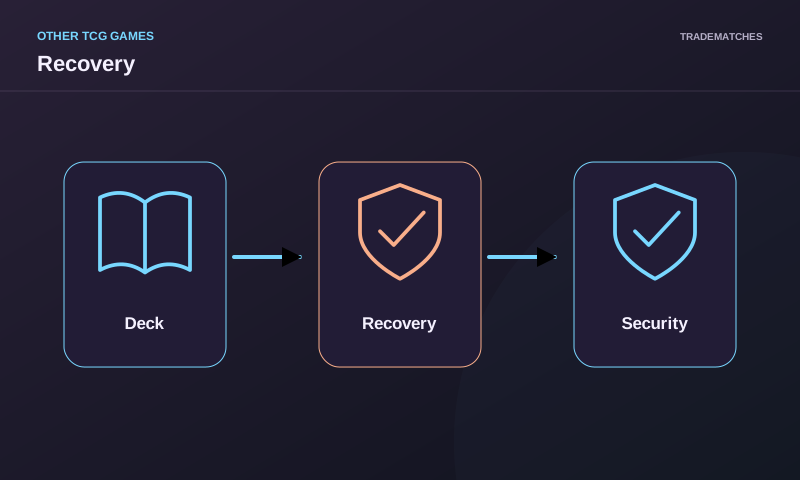
Recovery in Digimon places the specified number of cards from the specified area face-down on top of your security stack. It does not draw those cards into your hand and does not immediately activate their Security effects. Read the full effect to identify the source, number and any condition before moving cards.
Adding security and performing a security check are different procedures. This guide focuses on the addition: what moves, where it goes and what information you may use while resolving it.
Read the source as well as the plus number
The current comprehensive rules define Recovery using a specified area and a specified number. Older printed forms such as Recovery +1 (Deck) make the source explicit in the keyword notation. Other effects and current wording can specify the relevant area through the full instruction.
Do not assume a card comes from the hand simply because that would be convenient, or choose a card from the trash when the effect uses the deck. The source is part of the procedure, not an optional preference added by the player.
Likewise, Recovery +1 is not a request to restore security to its starting amount. It adds the stated number when the effect can do so. If you already have several security cards, apply the actual number and any conditions rather than treating the original starting stack as a universal maximum.
Recovery does not automatically trigger on every turn
Recovery is processing within an effect. The surrounding card text tells you when that effect happens: for example, a particular play, digivolution or other qualifying event. Merely controlling a card that mentions Recovery does not grant unlimited recovery.
Read limits such as once per turn and requirements about your security count. Those can determine whether the effect is available or whether the relevant instruction is performed. The keyword defines the movement but does not erase the conditions printed around it.
When several effects are pending, resolve them under the game's timing rules. If one changes the security count before another checks a condition, the exact sequence can matter. Do not calculate every effect using an unchanged snapshot of the stack from the start of the turn.
Move the cards face-down to the top
Rule 16-6 describes the destination as the top of the security stack and the orientation as face-down. Placing a recovered card on the bottom is not equivalent simply because the total count increases by the same amount.
The order can affect which card is later checked first. Use the source effect and relevant rules to determine the procedure rather than rearranging the security stack to obtain a preferred sequence. Keep the cards physically distinct from the deck during the movement.
For a basic Recovery +1 (Deck) example, take the appropriate top deck card and place it face-down on top of security. You have increased security by one and reduced the deck by one. Your hand has not gained that card.
Do not inspect hidden cards without permission
The fact that you are moving a card does not automatically authorize looking at its face. A deck card moved face-down to security normally remains hidden unless the actual effect instructs a reveal or look action.
Follow the full wording when an effect uses a publicly known source or separately reveals a card. The resulting information can differ from ordinary hidden deck recovery, but the permission comes from that effect, not from an assumed right to inspect any recovered card.
At a tournament, accidental exposure or extra movement should be handled under the applicable correction policy. Pause and call a judge instead of quietly exchanging the card for another. That preserves the information history needed to assess the situation.
| Procedure | Destination | Immediate result |
|---|---|---|
| Recovery from the deck | Face-down top of security | Security increases; hand does not |
| Drawing a card | Hand | A different action and information change |
| Security check | Revealed security card is processed | Follow check and Security-effect rules |
| Effect specifying another source | Source and destination in that text | Read the complete instruction |
Security effects do not activate on arrival
A Security effect is associated with the appropriate security-check timing. Placing an Option or another card into security through Recovery does not, by itself, activate that effect. You are adding a card, not checking it.
Suppose the recovered card happens to be an Option with a powerful Security effect. That effect does not immediately perform its instructions merely because the card joined the stack. It may become relevant during a later qualifying check.
Similarly, a Digimon placed in security is not played into the battle area by ordinary Recovery. Any later Security instruction that plays it must arise from the relevant card and check procedure. Keep zone movement and card play distinct.
Count the actual stack after processing
After the effect finishes, verify the new security count. If you had two cards and successfully added one, you now have three. Announce the count without exposing hidden faces so both players can maintain an accurate public game state.
Security counts can influence other effects, but those effects need their own timing and conditions. Adding one card does not automatically re-run every earlier condition checked during the turn. The moment specified by each effect governs the relevant count.
If a resolving effect combines trashing security and Recovery, follow the written sequence. The net count alone does not describe which cards moved or which events occurred. Two instructions that cancel numerically can still have different information and trigger consequences.
The underlying effect determines special timing
Bandai's BT08 Q&A supplies a useful specific example for Angemon BT8-024. Its recovery-related effect tied to a Digimon that would digivolve occurs after declaring that digivolution but before paying the digivolution cost. That is a card-specific timing clarification.
Do not transfer that timing to every Recovery effect. A different card may resolve on play, when digivolving or at another stated event. The shared keyword does not make the surrounding trigger identical across cards.
When teaching the interaction, show the full card and the official Q&A together. Explain which part describes Recovery's movement and which part defines when Angemon's particular effect happens. That prevents a specific ruling from becoming an incorrect general rule.
Recovery can change the deck's remaining resources
Deck-based Recovery moves a card away from the draw supply. In a long game, that trade-off can matter even though the added security is immediately useful. Track the remaining deck rather than assuming every defensive increase is free of other resource consequences.
If the specified source has too few cards, consult the game's processing and loss rules for that exact situation. Do not invent cards, substitute another zone or rely on a remembered empty-deck rule from a different TCG.
For practical planning, compare the actual recovered amount with the number of attacks or checks the opponent can produce. More security can provide time, but it does not universally prevent defeat or guarantee a helpful Security effect among the added cards.
Evaluate count and card quality separately
Ordinary recovery from a hidden deck increases the number of cards in security without letting you select the ideal one. Its defensive value can come from the additional check the opponent must perform, even when the recovered card has no useful Security effect.
A different effect that deliberately places a known card can supply a different planning opportunity. Read its source and selection wording instead of assuming all Recovery produces chosen security. The keyword's movement and a card's selection instruction are separate details.
Avoid promising that recovery guarantees removal, a free play or another specific result. Unless an effect fixes the card being added, those outcomes depend on hidden deck contents and later processing. Describe the count benefit and the uncertainty honestly.
Handle repeated recovery cleanly
When resolving several separate recovery effects, complete each one under its own instruction and timing. Announce the changing security count as needed, and preserve the proper top placement. Do not casually shuffle the stack together to make the additions look neat.
A written practice sequence can help: start with two security, apply one deck recovery, then resolve a separate effect whose condition references the current count. Compare the state after each step. This shows why ordering matters beyond the final number of cards.
If an effect grants Recovery more than once or uses a larger number, read the precise wording rather than treating every visual keyword as a separate automatic trigger. The full effect and current rules determine what processing actually occurs.
Verify the card before a disputed recovery
Identify the card number, trigger, source area, amount and any count restriction. Then inspect whether the effect authorizes looking or revealing. Move the permitted cards to the top of security in the correct orientation and verify the resulting count.
This procedure is short enough to use at the table and precise enough to answer most ordinary questions. It also makes clear when a specific official Q&A is needed, especially for effects that recover during another action's processing.
Use the latest comprehensive rules from Bandai's rules page. An older printed reminder can still help identify a card, but the current rule definition and individual clarification provide the reliable basis for unusual source or timing interactions.
Frequently asked questions
Does Recovery activate the added card's Security effect immediately?
No. Ordinary Recovery adds the card face-down; it does not perform a security check.
Can I choose a different source if my deck is low?
Not unless the effect permits it. The specified source is part of the instruction and cannot be replaced by preference.
Are recovered cards placed on the bottom of security?
The current keyword definition places them face-down on top. Follow any explicit modifying instruction on the actual effect.