Gundam Card Game: 50 cards plus 10 resources
On this page
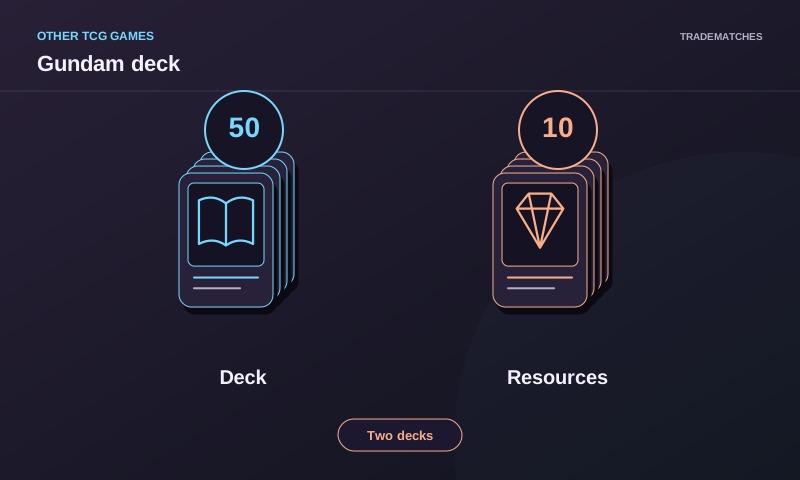
For a game of Gundam Card Game, you prepare two separate decks: exactly 50 cards in the main deck and exactly 10 cards Resource in the resource deck. Do not mix them together.
What goes into each deck
The main deck is built with Unit, Pilot, Command and Base. The Resource deck has its own ten-card deck; the official FAQ specifies that only Resource cards go there. Having ten cards of any kind is not enough. Also keep tokens and damage markers separate, as they are game materials.
Colors and duplicates in the main deck
The general rule allows up to two colors in the main deck and up to four cards with the same number. Two illustrations or languages of the same number count together. For example, three normal copies and two alternatives of the same code sum to five and require one to be removed.
The Resource deck has another copy rule
In the Resource deck, there is no general limit of four for a single Resource number; the FAQ allows repeating it as many times as it fits within the ten cards. Before a tournament, check any additional policies and prepare a list that clearly distinguishes the 50 main cards from the 10 Resource cards.
The number 50 does not include the resources
Gundam Card Game requires exactly 50 cards in the main deck and exactly 10 Resource cards in a separate deck. It is not a total of 60 that you can freely distribute. A list with 49 main cards and 11 resources has 60 physical cards, but it does not meet both sizes. The same applies to 51 and 9. When preparing a new deck, place two piles on the table and count each one without adding tokens, damage counters, or reference cards. This review is especially important when buying a set that mixes playable cards, resources, and promotional material.
The main deck is built with Unit, Pilot, Command and Base. The Resource deck contains only Resource cards. A card that mentions resources in its text is not automatically a Resource card suitable for that pile. If in doubt, check the printed type and the official card. Tokens serve another function and are prepared separately; they do not fix a main deck of 49 or a Resource deck of 9. The count refers to physical cards of the correct categories.
Exactly 50: neither minimum nor maximum flexible
Some TCG allow playing above a minimum. Gundam, in its standard constructed configuration, uses an exact number. If you copy an online list and add a card you like without removing another, you go to 51 and no longer meet the construction. If you lend a card to a friend, you end up with 49 until you replace it. The simplest way to manage changes is to always follow the principle "one out, one in." After that, recount, because a card may have remained on the test table or in a loose case.
A list of 50 is not necessarily good just because it meets the size. The proportion of Units, Pilots, Commands, and Bases must support your strategy. A deck that does not develop units regularly may have few attack options even if it is legal. When evaluating new purchases, note which card will replace which and why it improves the plan. This strategic reasoning comes after the regulatory check; do not use a proportion recommendation as if it were an obligatory fifth type.
The 10 resources form another deck
The Resource Deck must have ten Resource cards. The official FAQ allows any number of copies of a single Resource card, unlike the limit applied to the main deck cards. Therefore, a Resource deck with several identical cards does not automatically violate the copy rule. What would be incorrect is putting a Unit or Command to complete ten. Check the type of each card before putting the pile together; a similar illustration does not substitute for the type line.
The Resource card you get in the game comes from that separate deck according to the game steps. If you mix those ten cards within the 50 main cards, you will alter the stolen cards and leave the Resource area unprepared. Keep the cases and locations clear. For a tournament, also check the organizer's presentation and registration rules. Do not wait until the first Resource phase to discover that the pile contains nine cards because one stayed next to the tokens.
Up to two colors in the main deck
The constructed deck is prepared with one or two colors of cards. A monochrome list meets the rule; a list with a single card of a third color violates it. Do not look only at Units: Pilots, Commands, and Bases that form part of the main deck also must respect the construction. If you receive a recipe of two colors, separate all types before counting and mark any card of another color. The fact that a card is powerful or easy to pay does not create an exception by itself.
Imagine 25 blue cards, 24 white cards, and one red card. The size is 50, but the third color raises a problem. Removing the red card leaves 49, so you need to replace it with a card of the allowed colors. Before buying a card suggested by a video, check its color and the list format. In special formats like certain sealing modes, there may be different rules; do not automatically transfer the restriction of the constructed deck to every event named Gundam.
Four copies per card number
The general rule limits to four copies with the same card number within the main deck. The number is the key, not necessarily the name of the character or the Unit. The official FAQ gives an explicit example: two Gundams with different card numbers can appear up to four times each even if they share the same name. If you copy a list, note the complete number of each print and group by it. Counting only the name may reject a legal list or accept five copies of the same number without intention.
Suppose you have three copies of one print and two of the same card with identical number but different finish. If they share the number, they sum to five and exceed the general limit. In contrast, a card with another number is reviewed as a separate entry, subject to other format restrictions. The Resource Deck is reviewed separately because the FAQ allows repeating Resources without that four-copy maximum. This difference between the two piles is another reason not to mix them in a single inventory.
Game materials that do not occupy spaces
In addition to the two decks, you may need tokens and damage counters. Prepare them before playing, but do not add them to the 50 or the 10. The EX Resource and EX Base that the rules anticipate for preparation also do not make an incomplete deck legal. If a card in your deck creates a specific token, consult what material you need to represent it clearly. The main card list and the resource list must be complete on their own.
In a small box, it is easy to keep everything together. Before shuffling, physically separate the deck, resources, and tokens. When retrieving, recount them. A Resource card accidentally inserted into the main deck may go unnoticed until the next game; a mixed token can also alter the draw. A minute of order avoids legality disputes and makes preparation smoother.
Example of a list review
You receive a proposal with 50 main cards and 10 Resource. It seems ready, but three checks are still missing. First, confirm that the 50 belong to Unit, Pilot, Command, or Base and use at most two colors. Second, group by number and mark any with five or more copies, checking current event restrictions. Third, verify that the 10 are of the Resource type. If you pass these tests, review the necessary tokens and compare the list with the physical cards. The process separates legality from strategy: after that, you can test if the type distribution works.
Another list shows 48 main cards, 10 resources, and two tokens. It does not have 50 main cards: the tokens do not count there. You need two playable cards of the allowed colors, maintaining the number limit. This example avoids the error of counting all objects in the box as if they were deck cards. The official construction sheet and FAQ are better references than a total sum from an app that mixes categories.
Common errors before the tournament
One: counting 60 cards in total and forgetting they must be 50 plus 10. Two: placing a card in the Resource Deck that only mentions resources. Three: treating tokens as deck cards. Four: adding a card of a third color. Five: counting copies by name when the general limit uses card number. These are corrected with a simple table of type, color, number, and quantity, followed by two physical counts. Also check card prohibitions or restrictions applicable to the event, as they may modify the general limit.
If you buy cards to complete the deck, keep an exact list of numbers. "I need a Gundam" may not identify the correct card or print. The card number avoids confusing versions with different functions and allows you to verify the four copies. Preparing the two decks properly does not guarantee a win, but ensures you can play the list you wanted to bring.
Frequently Asked Questions
Can I put a Unit in the Resource Deck?
No. The official FAQ reserves that deck for Resource cards.
Do the ten resources count within the 50?
No. They are two separate decks.