Boost in Lorcana: facedown cards under characters
On this page
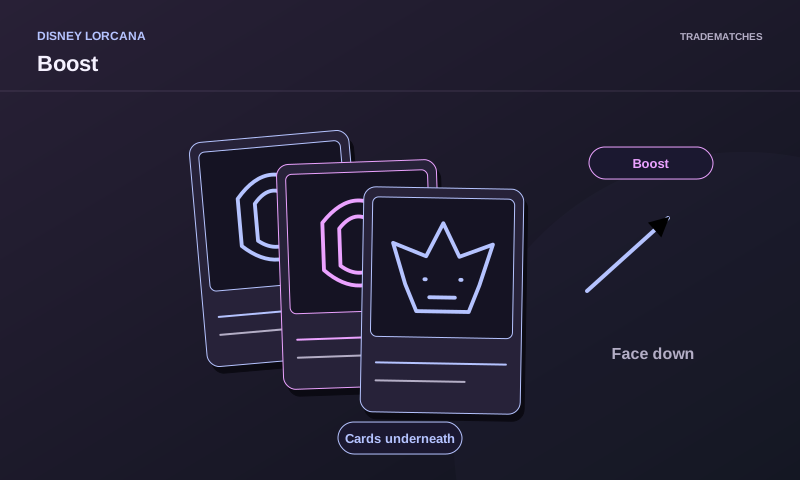
Boost lets you pay the indicated ink, once during your turn, to put the top card of your deck facedown under the card with Boost. You do not draw it, play it or add it to your inkwell. No player may look at its front while it remains facedown underneath, including its owner.
The benefit depends on the other abilities of the card using Boost. The keyword does not independently grant a universal amount of strength, willpower or lore. Before paying, read how that particular card uses the cards placed beneath it.
Understanding Boost N
The number specifies the ink payment. If a card has Boost 2, the action requires paying two ink. Its basic result is still one top-deck card placed underneath. The number does not mean putting two cards there or automatically receiving a bonus of two.
Rule 8.4 of the comprehensive rules version 2.2.0 defines the procedure and allows it at a time when you could use an activated ability. The limit is once during your turn for that card, rather than unlimited repetition whenever you have spare ink.
Using Boost is optional. Having the keyword does not oblige you to pay. Sometimes the ink would be better spent playing another card or using another ability; sometimes the effect associated with cards underneath justifies the investment. Evaluate the actual consequence before committing resources.
If you control two different cards with Boost, check each separately. Using one does not mean every card you control becomes boosted. Keep track of which object received an underlying card and which has not used its option during that turn.
Performing the action clearly
Identify the card with Boost and its payment. Check that it is your turn and that the action is permitted at that point. Pay the ink, then move the top card of your deck facedown underneath the appropriate card without looking at its front.
Do not choose a card from your hand or search the deck for a particular card. The procedure uses the top card. You also cannot inspect it first to decide whether you want it underneath: Boost does not contain permission to look at or select its identity.
Arrange the underlying card so the number underneath can be understood without revealing the front. Keep the stack distinct from your hand and inkwell. A disorganised area mixing those groups makes it unnecessarily difficult to establish the correct game state.
The basic Boost payment does not include exerting the character. Do not add that cost by intuition. Still read all relevant conditions and distinguish Boost from another ability that may require exertion or removing an underlying card as part of its own cost.
Not drawing, playing or inking
Drawing moves a deck card into your hand. Boost puts it facedown under another card. You therefore do not gain a new hand option you can freely play. A draw-related effect should not be applied merely because Boost used the top card of your deck.
Playing a card has its own procedure and can cause play-related effects. A card moved underneath through Boost has not been played. If it later proves to be a character or action, that identity does not generate the entry or resolution effects it would have produced through being played.
Inking puts a card into the inkwell. A Boost card is not there and does not provide another ink resource to exert for payment. You already paid to put it underneath; that payment is not automatically refunded by treating the underlying card as ink.
| Action | Card destination | Distinction to preserve |
|---|---|---|
| Draw | Hand | Adds a hand card |
| Ink | Inkwell | Creates an ink resource under its rules |
| Play | The card's appropriate destination and resolution | Applies playing procedures |
| Boost | Facedown under the card with Boost | Does not substitute for the other three actions |
This separation matters when abilities observe particular actions. An effect asking for a card underneath does not necessarily require that Boost put it there. Conversely, an effect specifically observing Boost does not automatically apply to every different effect that moves a card underneath.
Who may look at the underlying card?
The restriction applies to everyone, including the player who used Boost. Ownership does not grant permission to lift it. You cannot check whether it is a valuable card, action or character before deciding how to proceed with the rest of your turn.
If an earlier effect told you the top card's identity, Boost does not require you to forget that knowledge. However, remembered information does not permit a new inspection while the card remains underneath. Distinguish what you remember from an action of looking that the rules do not allow.
Faceup cards underneath another card have different information rules: players can inspect them. Stacks created through Shift or other effects can contain such cards. Do not transfer that permission to the facedown card placed underneath through Boost.
If someone reveals it accidentally during a tournament, call a Lore Guide for the appropriate procedure. Do not secretly exchange cards or reconstruct the deck yourselves. Correcting revealed information requires event policy rather than a private agreement to pretend nobody saw it.
Underlying cards are not in play
The rules distinguish physically being in the Play zone from being considered in play. A card underneath another card is not in play for these purposes. It is not a second independent character that can quest, challenge or use its own abilities.
Boost consequently does not put whatever was on top of the deck into play for free. You do not receive an active item, location or character merely because its identity is later established. The underlying card serves the role recognised by other abilities, rather than its ordinary role as a played card.
Imagine a hypothetical ability increasing strength while there is a card underneath. That improvement depends on the stated condition. Another ability could count the number underneath. These are different effects: Boost supplies the initial movement but does not let you exchange their results or invent a shared bonus.
Read whether a benefit lasts for the turn or applies while a condition remains true. Putting a card underneath does not make a temporary ability permanent. The Boost payment and an associated effect's duration are separate parts of the card's operation.
When evaluating a deck, record the benefit beside the keyword rather than counting every Boost card as equivalent. One may reward a single underlying card, while another may support a different plan. The word alone does not establish the card's strategic purpose.
When the top card leaves play
Stacked cards follow the general stack rule. When the top card leaves play, the cards underneath move to the same zone and stop forming that stack. Do not leave Boost cards on the table as if an invisible character remains above them.
If the character is normally banished, the underlying cards also move to the discard. If it returns to hand, the stack separates and those cards move there. Follow the actual effect and the appropriate states for the destination instead of assuming Boost always sends everything to the discard.
The restriction against looking concerns the card while facedown underneath. After a zone change, follow the information rules of the new zone. It is not eternally inaccessible merely because Boost once placed it in a hidden underlying position.
Read special effects moving particular cards in full. An ability may remove an underlying card or give another explicit instruction. General stack rules explain ordinary departures, but they do not replace card text that expressly changes what happens.
Deciding whether to pay
First identify what Boost enables now. If the associated benefit improves a challenge, verify that the character can challenge and that the improvement changes the result. For a newly played character, Boost does not automatically remove the ordinary drying limitations.
Count the ink remaining afterwards. Paying may prevent another play or ability during your turn. You do not need an invented numerical rating for Boost: compare the concrete actions available with the payment against those available without it.
You also consume the top deck card without adding it to your hand. That can matter in a long game. Boost is not a free draw; the possible benefit belongs to the upper card and its associated abilities, while the underlying card is no longer available as the next draw.
For clear play, announce both the payment and the receiving card. If several stacks exist, physically indicate the one receiving the top card. The visible arrangement should support your opponent's understanding without requiring disclosure of the hidden front.
Frequently asked questions
Does Boost 2 put two cards underneath?
No. The number describes the ink payment. The basic procedure moves one top-deck card underneath the card with Boost. Any additional movement allowed by another ability must be read separately rather than inferred from the Boost value.
Can I inspect my own card after putting it underneath?
Not while it remains facedown underneath another card. The restriction includes its owner. Remembering what was on top of the deck does not permit lifting the card to confirm its identity again.
Can Boost make a newly played character challenge immediately?
Not by itself. Paying Boost and receiving an associated benefit does not remove drying rules or automatically grant Rush. Check the character's permitted actions and its actual abilities independently.