Empty deck in Lorcana: when do you lose in 2026?
On this page
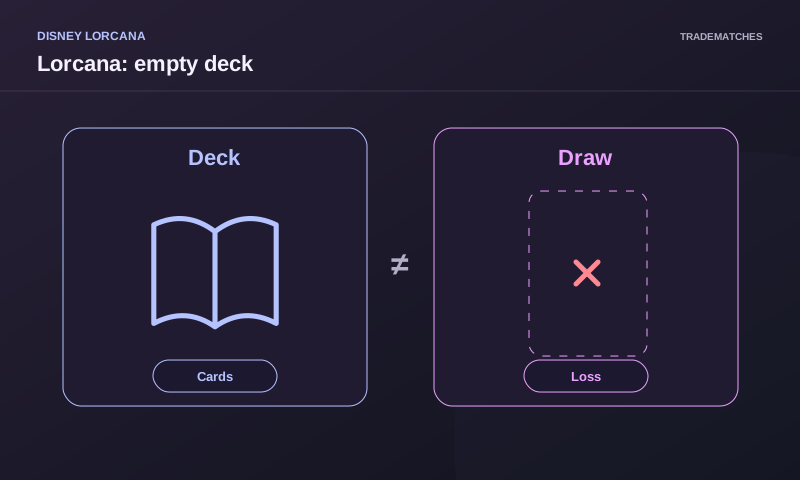
With Lorcana's rules in effect in 2026, you lose if your turn ends without cards in your deck. The check should no longer be summed up as 'loses as soon as you cannot draw'. Having the deck empty during the turn may leave a chance to win or return cards, but if you end up like this, the defeat condition applies.
The rule you must consult
The comprehensive rules version 2.2.0, linked from the official resource page, place the condition in the check of the state of the game at the end of your turn. The formulation matters because it determines how long you have to act. An old explanation can maintain a condition of failed draw and lead to incorrect decisions in a current game.
This guide is revised on October 1, 2026. If you play with a previous product, document or video, compare your rule to the current text before you start. It is not enough for two people to remember the same old version. For an organized event, use the applicable rules and the judge's guidance.
Running out of cards during your turn
Imagine you start a turn with a card in the deck and draw it. Now the deck is empty, but you still have to run the rest of the turn according to the rules. The fact that you've withdrawn the last card alone does not trigger an immediate defeat at that time. You can have legal actions that change the situation.
The practical question is what you can achieve before the turn ends. Perhaps you can reach the lore needed to win; perhaps an effect will allow you to return cards to the deck. You may also not have any of those options. Do not extend the turn indefinitely: use the available actions and respect the rhythm and policies of the event.
Drawing the last card isn't the same as failing a draw.
If an effect allows you to draw and there are fewer cards than the amount indicated, apply the appropriate instructions and draw rules. Do not invent cards to complete the amount or finish the game automatically using the old formulation. The empty deck remains a condition that you must evaluate at the current loss-check timing.
To learn the difference, compare two states. In the first you draw the last available card. In the second the deck is already empty and another draw is being attempted. The chances of adding cards to the hand are different, but you should not replace the current condition with an immediate defeat sentence on both. When a card has additional instructions linked to drawing, read its full text.
You can win before you finish the turn.
Reaching 20 lore causes victory in the corresponding check. If during a turn with an empty deck you get that total and there is no effect that changes the situation, you can win before you reach the end of the turn. The condition of future defeat does not automatically cancel out a victory that has already taken place.
Suppose you're at 18 lore and you have a character ready to quest for two lore. If the action is legal and resolved, you would reach 20 before the end. The example does not allow you to quest with a character who is still unable to act or ignore other restrictions. Opportunity exists, but the sequence must be legal.
Returning cards can change the final state
An effect that really puts cards in your deck can prevent you from ending up with zero. Check the zone of origin, destination and quantity. Returning a card to hand does not fill the deck. Shuffle also does not generate content if you are not incorporating cards: rearrange zero cards still leaves zero.
If you have an action that returns cards from the discard to the deck, check that you can play it and that the chosen cards meet its requirements. Then apply any subsequent draw instructions. An effect that incorporates several and then draws the same amount could leave it empty again. What matters for the condition is the actual state at the end, not having had cards briefly during the resolution.
Empty deck during an opponent’s turn
The above rule refers to the end of the turn of the player whose deck is empty. If you run out of cards during an opponent's turn, you should not automatically move the defeat to the end of that other person's turn. You will have to continue applying the effects and, when your turn comes, evaluate what actions you can take before its end.
This difference can matter with cards that force someone else to draw. Don't announce an instant victory just because the rival has exhausted the deck. Read if the card contains another specific condition and check the time of the checks. The ordinary condition and a particular effect are not the same mechanism.
Multiplayer and players leaving
In a game of several people, who loses by this condition must leave according to the rules of multiplayer. Their cards and effects are withdrawn according to the procedure, with the exceptions indicated for certain effects generated with duration. The game can continue among others; it does not necessarily end for the entire table when the first player exhausts his deck.
If only one person is left in the game, the rules contemplate his victory. Keep track of turn order clearly after an exit. For an interaction with pending effects of the player removed, check the multiplayer section instead of leaving your cards in play or dealing them for convenience.
How to plan when few cards are left
Count the available cards without looking at information that is not allowed and observe the draw actions you might use. Distinguish mandatory draws from optional draws. A drawing ability can be excellent for many turns and be dangerous when your goal is to reach the next one without emptying the deck.
As a strategic exercise, compare the lore you need with the one you can generate now. Then see if your recovery cards change the deck or just the hand. Don't try to solve the problem by adding out-of-game cards. If you notice that your construction is running out repeatedly, check the closure plan and draw management before increasing the size for no specific reason.
No need to inflate the deck out of fear
A larger deck may take longer to run out, but it also reduces the frequency with which certain pieces appear. Such an exchange of consistency should be assessed in real terms. The rule of defeat does not automatically make a deck much larger than its format minimum the better choice.
Record how exhaustion occurred: mandatory draws, chosen actions or rival pressure. The construction response may be different in each case. If you never get on an empty deck turn and lose due to lack of development, increasing size for a hypothetical threat will probably not solve your main problem.
Correct an old explanation
If in a game someone uses the previous formulation, stop the sequence and open the current rules. Do not continue to make decisions based on two different conditions. In a tournament, inform the judge of what happened and when the alleged defeat was applied. Any correction depends on policies and on the specific state; do not reconstruct the game unilaterally.
Count the deck before choosing a draw effect
When few cards remain, confirm the count before choosing an action that draws cards. With two cards left and an effect asking for three, do not assume a third card exists or that failing to draw it causes the same immediate loss you remember from another game. Resolve the effect under its instructions, then assess the actual state using the end-of-your-turn rule.
Ask two separate planning questions: can you reach 20 lore before ending the turn, and can a legal action leave a card in your deck? A favourable answer does not make an otherwise illegal action permissible. If neither route is available, accumulating cards in hand does not prevent the loss condition when your turn ends with an empty deck. This calculation helps identify when drawing supplies a necessary tool and when it merely consumes your remaining margin.
Frequently asked questions
Do I lose as soon as I draw the last card?
Not by the ordinary condition described here. The 2026 rules checks to see if your turn ends without cards in the deck.
Can I win with 20 lore before I finish?
Yes, if you legally achieve the win condition before your turn ends. An empty deck does not nullify that possibility on its own.
Does returning a card to hand avoid this loss?
Not if the deck is still empty when it's finished. The destination must actually be the deck for that recovery to change this condition.