Ready, Set, Draw in Lorcana
On this page
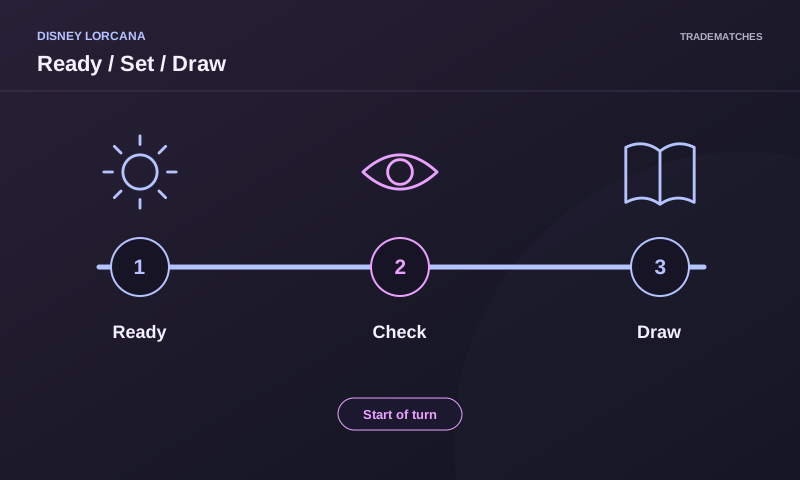
The beginning of each turn in Lorcana follows this order: Ready, Set and Draw. In Ready, you prepare all cards that have been exhausted in play and in your inkwell; in Set, your characters stop drying, you gain lore from Locations, and pending start-of-turn abilities resolve; in Draw, you draw a card. There is an important exception: the player who starts the game skips Draw on their first turn. Respecting the order prevents using characters too early or losing lore points.
A turn has three phases
The rules divide a turn into a beginning phase, a main phase, and an end phase. Ready, Set, and Draw are the three steps of the beginning phase. They are not optional actions during the main phase that you can reorder to gain advantage. After completing these steps and resolving any pending abilities from the bag, you enter the main phase, where you can entwine a card if conditions are met, play cards, make quests, challenge, move characters, and use permitted abilities.
This distinction helps determine when you can act. If a card says "at the start of your turn", its effect belongs to the beginning phase as specified by the rules, not to a free moment during your main phase. If you wanted to play an Item before gaining lore from a Location during Set, you would be too late: you don’t have a main phase until after Draw. If you wanted to use an ability that requires ink ready, first check whether Ready already prepared the inkwell and whether the activation moment allows using it.
Ready: prepare cards in play and in the inkwell
During Ready, the active player prepares all cards that have been exhausted in play and in their inkwell. Preparing means returning them to a vertical, ready position. A character that completed a quest during your previous turn, an Item that was exhausted to fulfill an ability, and a card used to pay costs all become ready again—except when a specific effect changes the rule. This step does not add new cards to the inkwell nor does it draw from the deck.
Example: you end your turn with two exhausted characters, one exhausted Item, and three exhausted ink cards. After your opponent’s turn, at the start of yours, Ready prepares those six cards according to the general rule. You can visually identify which resources will become available later in the main phase. However, a character becoming ready does not automatically mean it has stopped drying or that it can make a quest; those checks happen during Set and depend on when it entered play.
What effects begin or end during Ready
During Ready, effects described as active "during your turn" begin, and effects that last "until the start of your turn" or "until the start of your next turn" end, according to the rules. Additionally, abilities that trigger at the start of the turn or during this step are placed into the bag, but usually wait until the Set step to resolve. They do not resolve mid-way while preparing the first card before preparing the second.
The duration of the text matters. A bonus that ends at the start of your turn is not unavailable for a main phase action simply because you forgot to remove it physically. An ability that triggers at the start does not disappear if you don’t resolve it immediately in Ready; it is placed in the appropriate sequence and waits for its moment. If multiple cards have similar text, note which are continuous effects that end and which are triggered abilities that generate something new. The same colloquial expression "at the start" can hide different rule processes.
Set: characters stop drying
During Set, the active player’s characters in play stop drying. From the main phase onward, a character that survived from the previous turn can make a quest, challenge, or exhaust itself to pay costs when its other requirements are met. This does not automatically make a character "dry" if you haven’t played it yet: a character you place into play later during the main phase will begin drying until your next Set, except for a specific exception.
Example: you played a character during your previous turn. Your opponent did not banish it. At the start of your new turn, Ready may prepare it if it was exhausted; during Set, it stops drying; after Draw, in your main phase, you can choose a legal action with it. If the character has Rush, it might have challenged before this Set under the specific permission granted by that keyword, but Rush does not change the general rule for making quests. The guide on newly played characters explains that exception in detail; here, the key point is the place of Set in the sequence.
Set: gain lore from Locations
During Set, you also gain the value of lore from Locations you control in play and that show that value. This gain is not a triggered ability and does not go into the bag. It occurs as part of the step. If you control several relevant Locations, add the corresponding values and visibly update your lore counter. Do not wait until the main phase to gain it, nor do you advance it to Ready because a Location was already ready.
Imagine you start with eighteen lore and control two Locations each with a value of one. During Set, you gain two and reach twenty. A check of the game state may give you victory before you even reach Draw or a possible quest action. If your opponent banished one of the Locations during their turn, only one remains for Set and you would reach nineteen. The guide on Location lore details this source of points; this page specifies exactly when it integrates into the turn.
Set: resolve pending start-of-turn abilities
Abilities triggered during Ready or during Set are managed in the bag according to Lorcana rules. The active player resolves those that apply during this step before moving on to Draw. A card ability that says "at the start of your turn" does not get confused with the basic lore gain from a Location: the first can go into the bag, while the second forms part of Set without being used. If a Location has both, treat each source separately.
When multiple abilities are pending, identify their source and applicable order before moving cards. One may draw, another modify characters, and another gain lore. The game state is checked at the moments established by the rules, so a victory at twenty lore may make continuing with later actions pointless. Do not move to Draw while pending start-of-turn abilities remain unresolved. And do not use the bag as a stack: Lorcana has its own resolution procedure.
Draw: draw a card
After Set comes Draw. The active player takes the top card from their own deck and places it into their hand. Drawing does not mean looking at cards nor placing a card into hand due to another instruction. If a previous effect already drew a card during Set, that does not automatically replace the normal Draw, unless the text specifically says otherwise. The order can change which card you have available when entering the main phase.
Example: during Set, you resolve an ability that places a card on top of the deck. During Draw, the normal draw could take that card, if the effect and the deck state allow it. If you incorrectly reverse the steps, you would end up with a different hand. The rules also have specific rules about an empty deck and the end of the turn, so do not assume a Pokémon-style draw impossibility condition. Each TCG sets its own moment and consequence for running out of cards.
The exception of the first turn of the game
The first player skips Draw on the first turn of the entire game. This does not mean they skip Ready or Set, nor that all players skip drawing on their first turns. The second player draws normally on their first turn according to the sequence. The exception applies to the first turn of the game, not to "each player’s first time playing".
Your initial hand already contains seven cards and the first player could alter it before the game began. If they chose to return some to the bottom and draw replacements, they ended up with seven cards again before entering their first turn. After passing through Ready and Set, they skip Draw. This precision matters when evaluating your hand: do not count on an extra card to pay the cost of the first character. The Lorcana mulligan guide explains how to decide which seven cards to keep before this exception.
What happens after Draw
When all effects have resolved and no start-of-turn abilities remain in the bag, the game enters the main phase. Here you can decide the order of many legal actions: place an entwined card into the inkwell, play cards by paying ink, make quests with dry characters, challenge, move characters to Locations, or use activated abilities. Ready, Set, and Draw prepare the resources and game state for this choice, but do not perform these actions for you.
This separation prevents "reserving" a beginning-of-turn action for later. You cannot decide to draw the Draw card at the end of the main phase to see if a play will work out well. You also cannot go back to Ready because you exhausted an ink card to play an Item. The turn has a sequence. A card effect may create specific exceptions, but you must identify it by its text. The flexibility of the main phase begins after completing the three steps, not within them.
Example of a complete turn leading into the main phase
Paula ends her turn with one exhausted character, two exhausted ink cards, and one Location with one lore value. Her opponent plays and returns the turn. Paula enters Ready: she prepares the character and the ink cards. A "at the start of your turn" ability triggers and waits in the bag. During Set, a character that played in her previous turn stops drying; Paula gains one lore from her Location and resolves any pending start-of-turn abilities according to the rules.
After that, Paula reaches Draw and draws a card, unless this was the first turn of the entire game and she was the initial player. After resolving what is due, she enters the main phase. Now she can choose whether to use the character to make a quest, whether to pay ink for another card, or whether to attack a rival Location with a legal character. The example shows why saying "I prepare and draw" is not sufficient: between these two actions, drying, lore, and possible abilities occur.
Common mistakes and quick check
Common mistakes include drawing before gaining lore from Locations, resolving start-of-turn abilities during Ready, forgetting that a character stops drying in Set, gaining lore from a Location that was already banished, or causing the second player to skip their first draw. Players also attempt to play a card from hand before completing the beginning phase. These confusions often cause more errors than complex abilities, because they alter basic turn resources.
Use an audible routine: "Ready: I prepare game and inkwell; Set: characters dry, lore from Locations, abilities from the bag; Draw: I draw if it’s my turn". Check the game state at the end of each step when relevant, especially if lore reaches twenty. Then announce entry into the main phase. If a specific card changes the order or adds an effect, read its text and apply it at the indicated point. The basic sequence remains the reference for any exception.
Frequently Asked Questions
Do I gain lore from Locations before drawing?
Yes. The normal gain occurs during Set, and the draw occurs afterward, during Draw.
When can a character played in my previous turn make a quest?
It stops drying during your next turn’s Set, if it remains in play. During the main phase, it can make a quest if it is dry and there are no other restrictions.
Does the second player also skip Draw on their first turn?
No. The exception applies only to the first player on the first turn of the entire game.