How to build your first Lorcana deck: inks, inkable count and curve, by the numbers
On this page
For your first Lorcana deck, build for Core Constructed: exactly 60 cards from sets 9 to 14 (Fabled through Hyperia City), two inks, four copies of your key cards, 47 to 49 inkable cards and a curve weighted towards costs 1 to 3. Since 3 November 2026 there is also one banned card in Core: My Adventure Book. This guide shows how to choose your ink pair using data from the 1,227 cards that are legal in Core, how many inkables you need based on the actual odds of drawing them and how to spread your costs. It finishes with a deck published by Ravensburger, broken down card by card, with a rough Cardmarket price.
The construction rules in detail (full names, dual-ink cards, the inkwell) live in our Lorcana keywords and rules guide. This page is about the decisions and the numbers behind them, all checked on 9 November 2026.
The four rules your list has to meet
Under rule 1.10.1.1 of the Comprehensive Rules 2.3.0, a Constructed deck needs at least 60 cards (no maximum, as long as you can shuffle it yourself), one or two inks, no more than four copies of any full name (name plus version, in English) and no banned cards for the format. That last one is this month's news.
Which format to pick: Core, Infinity and the rest
The Tournament Rules recognise two Constructed formats, Core and Infinity, and four Limited ones (Preconstructed, Sealed, Pack Rush and Draft). For a first deck of your own, Core is the one that matters. It is the rotating format, and in the two weeks of events we counted in Madrid, Barcelona, Valencia and Seville for our collector guide, it was the most common one.
| Format | Which cards are legal | Banned as of 9/11/2026 | Who it suits |
|---|---|---|---|
| Core Constructed | Sets 9 to 14: Fabled, Whispers in the Well, Winterspell, Wilds Unknown, Attack of the Vine! and Hyperia City, plus older cards that were reprinted in them | My Adventure Book (since 3/11/2026) | Your first deck and most weekly tournaments |
| Infinity Constructed | Every set | Hiram Flaversham – Toymaker | Players who already own cards from sets 1 to 8 |
| Limited (Sealed, Draft, Pack Rush, Preconstructed) | Whatever you open at the event | Not applicable | Prereleases and events where you don't bring a deck |
| [Format Coconut] (beta) | Anything, built around a "Coconut" card | Bend to My Will (this format only) | Games with 3 or 4 friends, not tournaments |
The November ban. On 3 November 2026 Ravensburger banned the item My Adventure Book, from Attack of the Vine!, in Core. The stated reason: it gave too much consistency to decks running very few characters, or none. The Tournament Rules PDF, dated 14 July, doesn't list it yet; the official card database already does.
Rotation. Once a year the four oldest sets leave Core (official article of 4 August 2026), and the next rotation hasn't been published yet. If that rhythm holds, Fabled, Whispers in the Well, Winterspell and Wilds Unknown will be the first to go, so a Hyperia City card will stay in Core longer. Upcoming sets are in the release calendar.
What about "Coconut"? It is a multiplayer format in open beta since August 2026, still under a placeholder name: up to three inks, one copy of each card (except up to four of the card tied to your "Coconut"), and you win at 25 lore. Great for an evening with friends, not for tournament practice.
Choosing your two inks with data
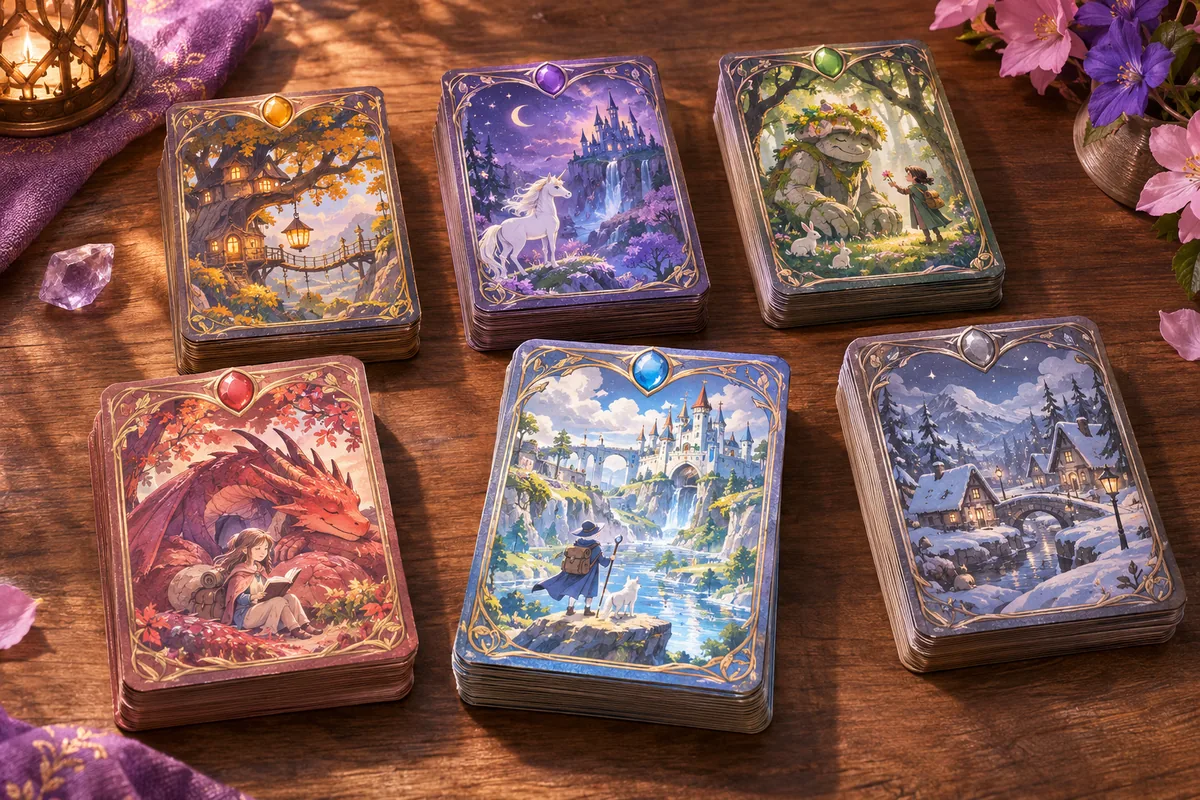
Ravensburger says each ink has its own personality but doesn't publish an official profile of what each one does. So we measured it. On 9 November 2026 we downloaded the official card database (cards.disneylorcana.com), which records whether each card is Core-legal, and counted the 1,227 distinct cards legal in that format today. The 16 dual-ink cards count towards both inks.
| Ink | Cards in Core | Inkable | Characters: average Strength / Willpower / Lore | What shows up most |
|---|---|---|---|---|
| Amber | 207 | 81% | 2.52 / 4.03 / 1.47 | Bodyguard (14), Singer (14), Support (12); 20 songs, the most of any ink |
| Amethyst | 208 | 78% | 2.99 / 3.66 / 1.43 | Evasive (20), Rush (12), Challenger (10); 36 cards with draw text |
| Emerald | 206 | 80% | 3.04 / 3.49 / 1.65 | Evasive (20), Ward (14); the highest average lore |
| Ruby | 207 | 77% | 3.73 / 3.55 / 1.36 | Evasive (17), Singer (11), Rush (10), Reckless (9); the highest average Strength |
| Sapphire | 208 | 82% | 2.86 / 4.00 / 1.61 | Support (11), Ward (10); 25 items and 46 cards that put cards into the inkwell |
| Steel | 207 | 81% | 3.35 / 3.94 / 1.49 | Resist (15), Bodyguard (10), Challenger (9); 37 cards that damage or banish a chosen character |
Average character cost runs from 3.50 (Amber) to 3.81 (Sapphire), so the averages compare fairly. The "draw" and "damage or banish" counts come from searching card text for those phrases, so treat them as a guide. Shift appears in all six inks, so it won't help you choose. If a keyword is new to you, look it up in the keyword glossary.
Decision table by play style
This is how to get from "what do I enjoy doing at the table?" to an ink pair. Use it as a starting point, not a final answer.
| If you want to… | Look for cards with… | Most common in Core in | Pair to start exploring |
|---|---|---|---|
| Apply early pressure and challenge a lot | High Strength for their cost, Rush, Challenger, Reckless | Ruby and Amethyst | Ruby–Amethyst |
| Win the lore race without being touched | Lore 2 or more, Evasive, Ward | Emerald and Sapphire | Emerald–Sapphire |
| Hold the board and win late | High Willpower, Bodyguard, Resist, banish effects | Steel and Amber | Amber–Steel |
| Play songs for free | Songs, Singer, Sing Together | Amber and Ruby | Amber–Ruby (like the example deck) |
| Have more ink than your opponent | Effects that put cards into the inkwell | Sapphire | Sapphire plus the ink of your expensive cards |
| Never run out of cards in hand | Draw effects | Amethyst and Steel | Amethyst–Steel |
Before you commit, check that each ink brings something the other lacks (if both only attack, nothing deals with the evasive character that beats you) and that the cards you already own fall into that pair. All 15 possible pairs have at least one dual-ink card in Core.
How many inkable cards to run
The most specific official advice comes from Frank Karsten's article on disneylorcana.com (September 2025): 11 to 13 uninkable cards, which means 47 to 49 inkables in a 60-card deck. According to the article, that range comes from data on successful tournament decks. The reason behind it isn't the obvious one.
Missing an ink drop is rare. If you go first, by your turn T you have seen 6 + T cards, because the starting player skips the first draw (CR 3.2.3.1). You will have inked on every turn up to T if at least T of those cards are inkable, which is the same as having seen no more than 6 uninkables. Here are those odds, before any mulligan:
| Inkables in 60 | Turn 4, on the play | Turn 4, on the draw | Turn 6, on the play | Turn 6, on the draw | Turn 7, on the play |
|---|---|---|---|---|---|
| 49 | 100% | 100% | 100% | 100% | 99.9% |
| 47 | 100% | 100% | 99.8% | 100% | 99.6% |
| 44 | 99.8% | 99.9% | 99.0% | 99.7% | 98.1% |
| 40 | 98.8% | 99.6% | 95.4% | 98.1% | 92.3% |
| 36 | 96.0% | 98.2% | 86.8% | 92.8% | 79.8% |
| 32 | 89.9% | 94.4% | 72.0% | 81.6% | 60.8% |
You can reproduce any cell with the opening hand probability calculator: pick Lorcana (60 · 7), enter your inkables in "Copies of the card", the turn number in "At least this many", and in "Extra cards drawn" the turn minus 1 on the play, or the turn itself on the draw. For example, 36 copies, at least 6 and 5 extra cards gives 86.8%.
If 40 inkables almost never leave you short, why aim for 47–49? Because of two costs this table can't see:
- Clunky hands. With 13 uninkables, a 7-card opening hand holds 3 or more of them 16.6% of the time. With 16 that rises to 27.1%, and with 20 to 42.9%. Hands like that force a mulligan or leave you with fewer options.
- Inking what you wanted to play. Your ink comes out of your hand. If nearly all your inkables are important cards, you give one up every turn. Spare inkables are what let you keep the good ones.
That is why the article saves the uninkable slots for cards that are strong in every matchup. A mediocre uninkable takes up a slot and can't even be used as ink.
The cost curve: a starting split
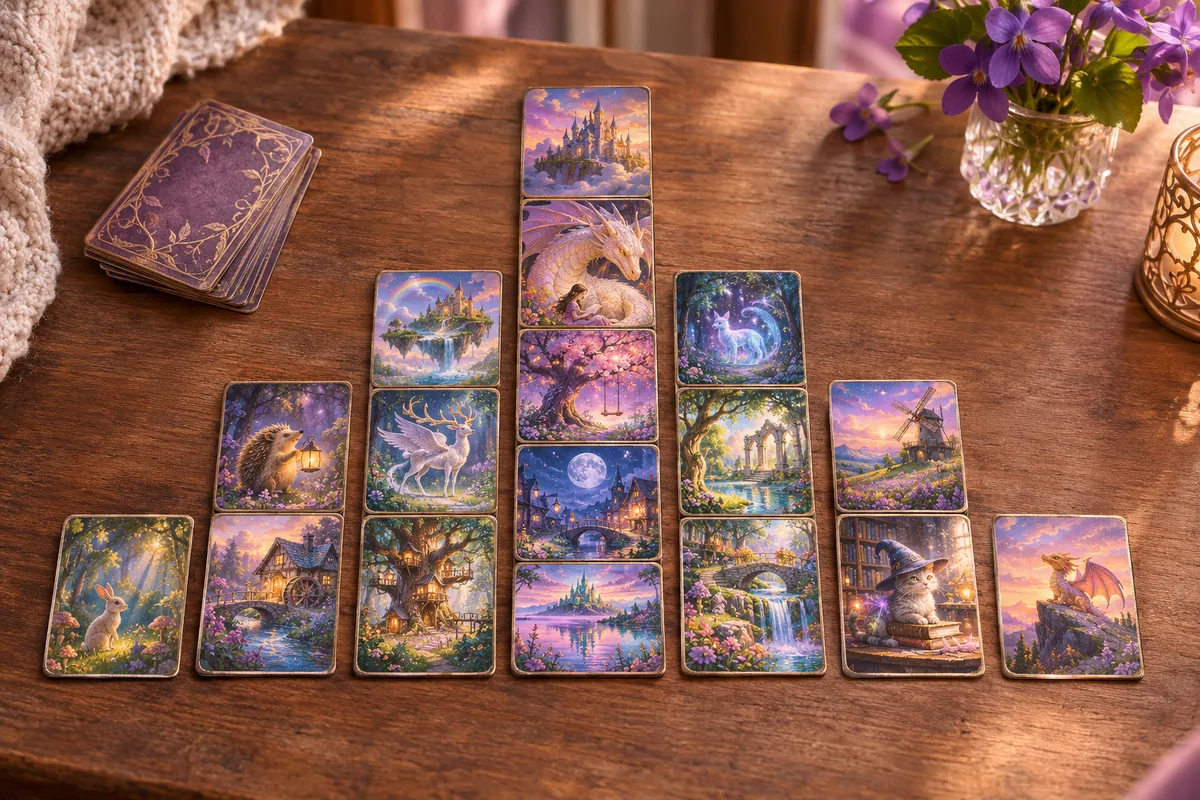
The same official article suggests a skeleton for a midrange deck, counted by the turn you plan to play each card rather than its printed cost:
| Planned turn | Cards | Chance of having at least one in time, on the play |
|---|---|---|
| Turn 1 | 8 | 65.4% in the opening hand |
| Turn 2 | 8 | 70.6% (8 cards seen); 93.1% of having one of the 16 turn-1 or turn-2 plays |
| Turn 3 | 12 | 88.7% (9 cards seen) |
| Turn 4 | 8 | 79.0% (10 cards seen) |
| Turn 5 | 8 | — |
| Turn 6 | 4 | — |
| Flexible actions and songs | 12 | Played when needed |
The percentages are ours, using the calculator's formula and no mulligan. The skeleton adds up to 60 and leaves 48 cards to play on curve, which is what keeps a deck from stumbling early. Aggressive decks lean harder on 1- and 2-drops and may top out at 4; control decks go up to 7- or 8-cost cards.
The article's other useful idea is the "rule of eight". With 4 copies of a card you see it in your opening hand 39.9% of the time, or 66.5% if you send all 7 back when it isn't there. With 8 cards that do the same job (say, 4 and 4 of two similar cards) that becomes 65.4% and 89.8%. If your plan relies on one effect, look for eight pieces, not four. According to the article, a typical deck runs around 15 cards at four copies, with 3, 2 or 1 copies reserved for expensive or uninkable cards. Add at least four cards that draw and four that remove opposing characters, and stay at 60: every extra card lowers your odds of drawing the best ones.
Worked example: Ravensburger's "Coco" deck, card by card
On 15 October 2026, Brennan DeCandio from Ravensburger's design team published a Coco-themed deck with Hyperia City cards on disneylorcana.com. The article doesn't say which inks it uses, so we looked up its 18 different cards in the official database. The answer: it is a 60-card Amber–Ruby deck, 30 cards of each ink, and every card is Core-legal as of 9 November.
| Cost | Cards | Inkable | Uninkable | What's there |
|---|---|---|---|---|
| 1 | 12 | 12 | 0 | 4 Héctor Rivera – Street Musician, 4 Miguel Rivera – Street Musician, 4 Pepita – Sweet Kitty |
| 2 | 12 | 11 | 1 | 4 Angel – Siren Singer, 1 Hercules – Young Rescuer, 4 Della's Moon Lullaby (song), 3 Ancestral Guitar (item) |
| 3 | 8 | 4 | 4 | 4 Meilin Lee – Losing Control, 4 Akood et Emuti (song) |
| 4 | 6 | 6 | 0 | 3 Ariel – Ethereal Voice, 3 Héctor Rivera – Gone to Pieces |
| 5 | 10 | 4 | 6 | 4 Pepita – Imelda's Right Hand, 2 Miguel Rivera – Accomplished Musician, 4 Grab Your Bow (song) |
| 6 | 9 | 9 | 0 | 3 Ernesto de la Cruz – Ruthless Musician, 4 Héctor Rivera – Worldwide Sensation, 2 Remember Me (song) |
| 7 | 3 | 0 | 3 | 3 Red Moon Ritual (song) |
| Total | 60 | 46 | 14 | 40 characters, 17 songs, 3 items |
What the numbers tell us:
- 46 inkables, one below the recommended range. Missing ink is still almost impossible: on the play you reach 6 ink on turn 6 99.6% of the time. The cost shows up in your hand: with 14 uninkables, the opening hand holds 3 or more of them 19.9% of the time, against 16.6% with 13.
- The uninkables sit at the top of the curve. 9 of the 14 cost 5 or 7, and 7 of those 9 are songs. A song can be sung by exerting one of your characters with equal or higher cost instead of paying ink. That is a sensible use of uninkable slots: you don't need those cards early, and with the right singer on the board they don't even cost ink.
- A very solid start. With 12 one-cost cards, 80.9% of opening hands contain at least one. And with 17 characters costing 1 or 2, 64.8% of hands hold two or more.
- Average cost: 3.48. The curve is 12-12-8-6-10-9-3: heavy early, a dip at 3 and 4, then weight again at 5 and 6.
What it costs to put together. If you buy in Spain or elsewhere in Europe, Cardmarket is the usual reference. Using its price guide generated on 9 November 2026 at 02:50 and the cheapest version of each card, the 60 cards come to about €38 at trend price, or about €16 if you add up the lowest listing for each. These are examples, not a budget: shipping isn't included and the lowest listing can be any language or condition. What stands out is the split: the 4 Akood et Emuti account for €17.56 of the €38, and almost every other card is under €1. Trading for the few expensive cards is where you save the most, and the trade calculator helps you balance a trade with prices entered by hand.
Your first deck in six steps
- Pick a play style and an ink pair using the decision table.
- Choose 4 or 5 core cards and look for eight pieces for every effect you depend on.
- Fill the curve with the 8-8-12-8-8-4 skeleton plus 12 actions or songs.
- Keep 11 to 13 uninkables, and at least four cards that draw and four that remove characters.
- Cut down to exactly 60 and check nothing is banned in Core.
- Play ten games and note the turn where you get stuck: if you stumble early, lower the curve.
To play it, find events on the Ravensburger Play Hub; if you live in Spain, our TCG store directory also lists shops. At competitive events you register your list with each card's full name (TR 3.8), and your sleeves must all match and have opaque backs (TR 3.11). Before your first tournament, read how to prepare for your first TCG event and our guide to sleeves, binders and storage. Add any cards you're missing to your Lorcana "want" list in TradeMatches to see who has them nearby and agree the trade over chat.
Common mistakes
- Building a Core deck with cards from sets 1 to 8. They are only legal if the same card, with the same name and version, was reprinted in Fabled or later.
- Still running My Adventure Book. Banned in Core since 3 November 2026.
- Running 20 uninkables because they're "the good ones". Almost half your opening hands will hold 3 or more.
- Counting copies by character instead of full name. Four Héctor Rivera – Street Musician and four Héctor Rivera – Worldwide Sensation are legal together, just as the example deck runs them.
FAQ
Which inks are best for a beginner in Lorcana?
There is no official beginner pair. Amber and Steel have the highest average Willpower on their characters, so mistakes cost you less, and Amber–Ruby is the pair behind the deck Ravensburger published in October. Pick by play style using the decision table and make sure the two inks complement each other.
Can I play The First Chapter cards in Core?
Only if that exact card, with the same name and version, was reprinted in Fabled or a later set. In that case any printing is legal, the old one included (TR 1.6). Otherwise it is Infinity only.
How many 1-cost cards should I run?
About 8 cards meant for turn 1 in a midrange deck, so you have one in your opening hand two times out of three. The Coco deck runs 12; a control deck can run fewer.
How do I check whether a card is legal in Core?
Look at its set: set 9 onwards is legal, except My Adventure Book. For an older card, search its full name in the official card gallery and check whether it has a printing in sets 9 to 14.
Sources and checks
On 9 November 2026 we reread the deck construction and format rules, went through the official news published since (which is where the 3 November ban comes from), downloaded the official card database for the ink counts and the deck breakdown, and took prices from Cardmarket's daily price file. All probabilities and counts are our own calculations.
- Disney Lorcana Comprehensive Rules 2.3.0 (PDF)
- Tournament Rules, effective 14/07/2026 (PDF)
- My Adventure Book banned in Core (03/11/2026)
- Official rotation explainer (04/08/2026)
- Frank Karsten's deckbuilding tips on disneylorcana.com (September 2025)
- Coco-themed deck by Brennan DeCandio (15/10/2026)
- [Format Coconut] multiplayer beta (08/08/2026) and its rules (PDF)
- Official Disney Lorcana card database
- Quick Start Rules, updated 19/02/2026 (PDF)
- Cardmarket: Lorcana price guide (JSON, 09/11/2026)