Lorcana ink drops: temporary ink from Hyperia City
On this page
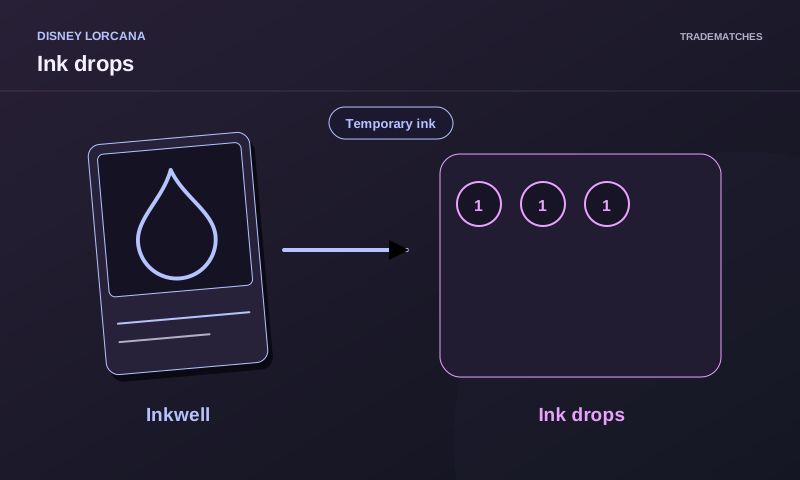
Ink drops are temporary ink resources announced for Disney Lorcana's Hyperia City. Each drop is worth one ink, and a spent drop is removed from the game rather than becoming reusable ink in your inkwell. Cards create them through their effects, and Ravensburger says every ink color combination can access the mechanic.
This explanation was checked on October 6, 2026, before Hyperia City's announced October 16 prerelease and October 23 wider release. It uses the publisher's preview; consult the final set notes and updated comprehensive rules for tournament interactions as those are published.
A drop is not another card in your inkwell
Ordinary ink in your inkwell provides a recurring resource through the game's readying and spending procedures. An ink drop represents a consumable resource. Spending it removes that drop, so a payment made from drops should not be recorded as though you had added permanent cards to your inkwell.
For example, suppose your available ordinary ink can provide four ink and you also have three drops. Those resources can support a payment of seven if the play and payment are otherwise legal. After consuming the three drops, you have not gained a permanent seven-card inkwell for later turns.
Keep two counts on the table: ordinary available ink and unspent drops. A single combined number can help calculate one payment, but it hides how much of that number survives as a recurring resource afterward.
Effects create drops; the normal ink action does not
The announcement describes cards creating ink drops in different ways. This is not a replacement for the normal action of adding an eligible card from your hand to the inkwell. Do not turn every inkable card into a drop merely because the set introduces that resource.
Read the specific generating effect. Some may depend on a Character being banished, a song being played or another condition. The resource arrives when that effect legally resolves, not whenever you would prefer to begin a large payment.
This distinction matters when planning a turn. A card that will create drops only after a future event cannot fund an earlier play in the same sequence unless you can actually cause and resolve that event first. Write the resource sequence in order instead of treating all potential drops as immediately available.
The published examples show different generating routes
Ravensburger's September preview names Tadashi Hamada — Making Waves as creating two drops when the card is banished. The announcement also describes the song Higitus Figitus generating three drops. These examples illustrate different triggers and costs, not a universal rule that every generating card gives the same amount.
Inspect the full published card before using either example in a deck. A preview paragraph can explain a mechanic without displaying every condition, cost or other ability relevant to a particular play. The card gallery and eventual release notes should resolve those details.
For a beginner's demonstration, label the source of each batch of drops. If two effects create resources at different points, resolve them separately before combining the available count. This keeps both players able to verify how the total arose.
Newly created drops can be useful immediately
The official article says you can use ink drops in the same turn you make them. You do not infer the ordinary drying restriction of a newly played Character and apply it to this different resource. Once the generating effect has resolved, use the drops according to the mechanic's permissions.
However, immediate usefulness is not permission to interrupt the middle of an unresolved effect with an unrelated play. Finish the generating instruction and follow the game's action and triggered-ability procedure. A resource available this turn still needs to be spent in a legal sequence.
Imagine a legal generating effect resolves and leaves you with two drops. You can then plan a subsequent play using those drops and ordinary ink. The same plan fails if the proposed play must happen before the generating condition or if another restriction prevents playing that card.
Track the exact drops used in a payment
Some previewed cards care whether ink drops were used to play them. That means the composition of a payment can matter, not only the final total. Announce how much comes from ordinary ink and how many drops you consume before moving the resources.
The publisher highlights Madam Mim — Resourceful Trickster and The Jousting Match as examples that benefit from spending drops to play them. Read each card's precise condition rather than assuming all such cards need the same number of drops or receive the same additional effect.
A clear announcement might be “three ordinary ink and one drop.” The opponent can then assess a drop-dependent instruction while the payment is still visible. Do not decide afterward that a different resource funded the play because another payment composition would have produced a better result.
| Resource question | Ordinary inkwell ink | Ink drops |
|---|---|---|
| Where does it come from? | The inkwell and relevant effects | Effects that create drops |
| What is being represented? | Reusable ink resources | Consumable one-ink resources |
| What happens to a spent drop? | Not applicable | It is removed from the game |
| Can a payment care about its source? | Read the card | Some announced cards specifically care |
| Does the source card always need to be inkable? | Normal ink action has eligibility rules | Follow the generating effect instead |
Separate spending from permanently increasing resources
Drops can bring a play forward without permanently accelerating every later turn. A large Character played with temporary resources still remains subject to its own ordinary entry and action rules. The fact that you paid early does not inherently ready it or let it quest immediately.
When evaluating a turn, calculate two results: what you can play now and what resource capacity you expect afterward. A turn funded by three drops may produce a valuable board, but the next turn's available ordinary ink should be estimated from the actual inkwell and applicable effects.
This prevents a misleading deck test in which spent drops quietly reappear during readying. Remove consumed markers completely from the active drop area. If the generating effect later creates new drops, record that as a new event rather than as automatic refreshing of the old ones.
Temporary resources still have an opportunity cost
Consuming drops on one play means those same drops are unavailable for another payment. A small play can be correct if it develops the board or answers a threat, but it may delay a larger drop-dependent play you intended to make. Compare actual card options rather than treating drops as free value with no decision attached.
For example, you may have enough total resources for either a useful Character now or a different card whose bonus requires a drop payment. Look at hand quality, the opponent's next possible action and the condition you need to satisfy. There is no verified universal opening sequence that every deck should follow.
The preview says drops can be used quickly for smaller plays or saved toward a later large play. For precise duration, storage and special interactions, use the final rules rather than inventing an automatic end-of-turn expiry or a persistence rule unsupported by the card and rules documents.
Use distinct physical markers
A drop reminder should not be confused with lore, damage or ordinary ink cards. Keep unspent drops in a labeled area and remove spent markers from that area. The publisher's announced resource value is one ink per drop, so a die displaying three should clearly mean three drops rather than three lore.
If your reminder uses a die, announce its change after every generating effect and payment. A large shared resource total can become unreliable if the table remembers some drops as already spent and others as merely exhausted. The physical display should reflect consumption.
For a practice session, rehearse creating two drops, adding a further three and consuming four. The remaining count is one, while ordinary inkwell cards are tracked separately. This arithmetic exercise does not require guessing the text of unrevealed cards.
Read the preview with its publication date
The September 29 deep dive explains the mechanic and selected cards. It is not a complete rules reference for every possible interaction. As of this article's October 6 review, Hyperia City is still ahead of its announced prerelease.
Before an event, check the official resources page for updated comprehensive rules and the set's release notes. Pay attention to restrictions on generating, spending and identifying a payment source. If a preview example and a final card differ, use the current authoritative card text and rules.
Do not buy an entire deck solely because a preview says a mechanic may influence competitive play. Establish which cards have been officially revealed, what your deck actually needs and which format you intend to play. Predictions of dominance are different from verified rules explanations.
Frequently asked questions
Does a spent ink drop ready again next turn?
The announced mechanic removes a spent drop from the game. It is not an ordinary inkwell card waiting to ready. New drops require their own generating effects.
Can only Sapphire decks make ink drops?
No. Ravensburger says every ink color combination can access them. The actual generating cards and their requirements determine which options fit a particular deck.
Can I spend a drop during the turn it was created?
Yes, the official preview expressly describes same-turn use. Resolve the generating effect first and follow the normal legal sequence for the subsequent play.