Landfall in Magic: when does it trigger?
On this page
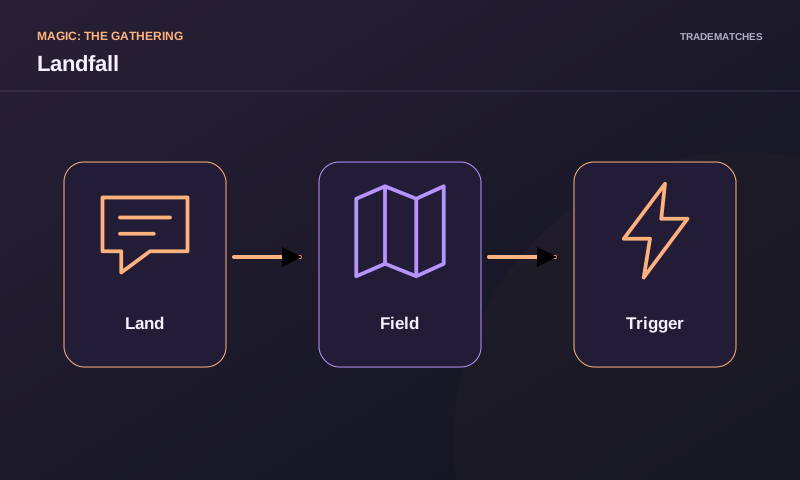
Landfall in Magic refers to abilities that trigger when a land enters your battlefield under your control. It doesn't matter whether you played the land during your turn or whether a spell or ability placed it there. Each relevant entry can trigger all of your applicable Landfall abilities. The word "Landfall" by itself does not define the reward—you must read the text that follows to determine whether it creates creatures, deals damage, adds counters, or offers another benefit.
Landfall is a keyword ability
The full rules classify Landfall as a "keyword ability." It groups cards with similar themes, but the italicized word does not have an independent mechanical definition that replaces the full text. On a card, you might see "Landfall — Whenever a land enters your battlefield under your control, ...". The part beginning with "whenever" expresses the event that triggers the ability, and what follows after the comma establishes its specific result.
This prevents a common error when comparing two cards: not all cards with Landfall do the same thing or offer the same number of counters. One might reward each land with a creature, another might grant a bonus until the end of the turn, and another might impose an additional condition. If a card uses different wording, it will state its exact text. Landfall helps you recognize the type of deck strategy, but the actual resolution of the game depends on the full ability text.
The event is the entry of a land under your control
The key point is not having many lands, but rather having a land enter your battlefield under your control while the relevant ability is active. A land that was already on the battlefield does not re-enter each turn. Tapping a land to produce mana is not an entry. If a permanent already on the battlefield becomes a land due to an effect, it has not entered again, and Landfall does not trigger solely from that type change.
Example: You control a creature with a Landfall ability that triggers when a land enters. You play a land from your hand legally. The land enters and the ability triggers. Later, you tap that same land to produce mana: no second trigger occurs from the tap. If an enchantment turns an artifact already on the battlefield into a land, no new entry occurs. The number of lands you control may matter for other text, but it does not replace the Landfall event.
Playing a land and putting a land are different actions
During your turn, you can play lands following normal rules and available permissions. That play is not casting a spell, but the land enters the battlefield and can trigger Landfall. There are also spells and abilities that place a land directly from your hand, library, or graveyard onto the battlefield. When the result is a land entering under your control, the ability can trigger just as effectively. It does not require you to have used your normal land play.
Imagine you already played your turn land and then resolve an effect that places another land onto the battlefield under your control. The second entry can trigger Landfall even if you don’t have another normal land play left. Conversely, a card that only searches for a land and puts it into your hand does not trigger Landfall at that moment: the land has not yet entered the battlefield. The word "land" in the text is not sufficient; you must follow the physical destination of the card.
A land that enters tapped also counts
Many lands enter tapped due to their own text or an effect. This limits what you can do with their mana abilities at that moment, but it does not change the fact that they entered. If the Landfall condition is limited to "a land enters under your control," a tapped entry can trigger it. Do not confuse being tapped with a delay in entry: the card is already on the battlefield.
Example: An effect places a basic land tapped onto the battlefield under your control. That land will not be available to tap again immediately to produce mana, but the Landfall ability observes its entry. If the Landfall text has an additional condition, check it separately. The example illustrates two independent questions: "Can I use this land as a resource now?" and "Did a Landfall ability trigger upon its entry?" The answer to one does not determine the answer to the other.
Multiple lands produce multiple triggers
If two lands enter under your control, each one is a relevant entry event for your Landfall abilities. If a card with Landfall triggers once per land and two lands enter simultaneously, there are typically two triggers for that ability. Do not reduce it to "once because only one spell occurred." The spell might have placed two permanents onto the battlefield, and the ability looks at entries, not how many spells caused them.
Suppose you control a creature whose Landfall ability adds a +1/+1 counter to itself each time a land enters. An effect places two lands onto the battlefield under your control. Two triggers occur, which resolve in stack order; if nothing changes, the creature receives the result of both. If you also control another Landfall card, that ability can also trigger for each land. Count "lands that entered × abilities that observed the entry," not "cards that cast the effect."
Multiple Landfall abilities and stack order
When different Landfall abilities you control trigger simultaneously due to a single entry, you can order your abilities in the stack according to applicable rules. The last one you place resolves first. Order matters if one ability creates a creature and another boosts creatures, or if one steals a card and another depends on the state afterward. Do not choose the order after seeing the result of the first; announce it when placing the abilities in the stack.
Example: One Landfall ability creates a creature, and another grants +1/+1 to all creatures you control until the end of the turn when it resolves. If both trigger due to the same land, the resolution order may determine whether the creature exists when the boost applies, depending on the exact wording of the effect. Place the ability you want to resolve first on top and explain the order to your opponent. This exercise connects Landfall with stack and priority rules: the triggers do not resolve instantly at the moment of entry.
A land with two functions in the sequence
Some lands can sacrifice themselves to search for another land and place it onto the battlefield. The first entry of the land you played can trigger Landfall. If you then activate the ability, you sacrifice that land as a cost and a second land enters under your control—this second entry can trigger Landfall again. These are two distinct events, not an arbitrary duplication of the same one. The timing of sacrifice, search, and entry must follow the specific text of the land.
This type of sequence explains why a Landfall deck may value cards that allow placing additional lands into play. Simply searching for many lands is not sufficient if you can only play one per turn and lack effects that allow other entries. When building your deck, distinguish between cards that place lands directly onto the battlefield and those that only search for lands in hand. The former can trigger the ability immediately; the latter prepare a future entry, unless another legal action causes it to enter now.
Your opponent can also respond to the trigger
Playing a land through normal gameplay does not use the stack as if it were a spell, but the Landfall ability triggered by its entry is managed as a triggered ability. When it's on the stack and players receive priority, your opponent can respond with legal actions. Do not assume the effect has already occurred at the moment you placed the land on the battlefield. First, recognize the triggers, place them in the correct order, and let the priority sequence determine when they resolve.
Suppose your Landfall ability deals damage to a creature target. The target is chosen when the ability is placed on the stack according to rules. Your opponent can respond before resolution if they have a legal action. A response that changes or removes the target can alter the result. However, they cannot "undo" the historical fact that the land entered without an effect that interacts with it. The difference between triggering and resolving is crucial in decks that generate many effects from a single land play.
Control, zones, and permanents that become land
A typical Landfall ability observes lands that enter under your control. If your opponent plays a land under their own control, it does not trigger your abilities designed that way. If a land leaves the battlefield and later re-enters under your control through a legal action, that new entry can create another trigger. The important point is that a new entry occurred, not that the card has a different name.
The reverse case is a permanent you already controlled that becomes a land without leaving the battlefield. It did not enter as a result of that transformation; therefore, a Landfall ability requiring "when a land enters" does not observe a new event. This nuance prevents counting the same card twice. Also remember that some abilities have additional conditions regarding land type, the number of lands you control, or the source's state. Review those phrases before generalizing all cards with the Landfall label.
How to plan a Landfall turn
Before playing a land, identify which Landfall abilities are active and what result each one provides. If an ability requires a target, consider legal targets and possible responses. If you can play multiple lands, decide the order of your spells and actions: perhaps it's better to play a permanent with Landfall first so it observes subsequent entries. Perhaps you need to save mana to protect it before activating a card that places lands. The text of your cards, not the abstract Landfall label, determines the best order.
In Commander or on a table with many abilities, use tokens or notes to keep track of pending triggers. If three lands enter and you control two applicable Landfall abilities, announce each source's trigger and its order separately. Do not resolve all triggers in an informal block if they can receive responses or if one changes the next one's target. A clear table makes your deck plan understandable to everyone and avoids accidental advantages from overcounting.
Common mistakes and quick check
Common mistakes include believing that Landfall triggers when tapping a land, only when a land is played from hand, once per spell that places multiple lands, or when an existing permanent becomes a land. It's also common to assume the effect is complete before priority passes. Each mistake is avoided by asking a specific question: "Did a land enter under my control now?" If yes, identify which abilities were in condition to see it and place them in the stack accordingly.
Afterward, read the consequence of each card. One might require choosing a target; another might grant a bonus lasting until the end of the turn; another might depend on land type. Do not assume all triggers are the same just because they share the Landfall keyword. If a card uses modern wording such as "when a land you control enters," apply that wording and consult official set notes if a specific interaction remains unclear.
Frequently Asked Questions
Does Landfall trigger when a land enters tapped?
Yes, if it enters under your control and all other conditions of the ability are met. Being tapped does not prevent an entry from occurring.
Do two lands entering at the same time trigger twice?
A standard Landfall ability triggers once for each land that enters. With two relevant entries, two triggers of that ability occur.
Does converting an artifact already on the battlefield into land trigger Landfall?
No, due to that type change. The permanent was already on the battlefield; it did not enter again.