Reality Fracture: how to collect echoed pairs
On this page
Reality Fracture echoed pairs connect two different cards: one from the familiar Multiverse and its Echoverse counterpart. Track both identities and the versions you want. Two identical copies or two arbitrary legendary cards do not necessarily form a pair.
Source · Reality Fracture: how to collect echoed pairs.
Start with the official product information
Wizards says physical Reality Fracture Play Boosters and Collector Boosters contain echoed pairs. The set released on 2 October 2026. Official examples contrast counterparts of characters including Chandra, Ajani and Karn.
Reality Echoes documentation distinguishes three pair-sheet cards in a Play Booster: two forming a true pair and an unpaired legendary in that pack. Do not call all three a single pair or assume any two form a valid combination.
This guide concerns physical collecting. Physical booster contents do not guarantee identical digital-product distribution or another box's contents. Identify the product before applying its description.
Define completion before buying
You may want one copy of each identity, matching finishes or only selected characters. Those goals differ. A card that fills a slot under one approach may fail your criteria if you later decide to accept only another version.
Record accepted languages, finish, presentation and minimum condition before shopping. You do not need every variant for a coherent collection. A small, testable goal makes missing cards easier to identify.
| Personal goal | When you count a pair as complete |
|---|---|
| Both identities in any accepted version | You own the two correct cards |
| Matching finish | Both have your chosen finish |
| Specific presentation | Both match the selected variants |
| Selected characters | Only pairs on your chosen list matter |
These are organising suggestions, not official deckbuilding rules or manufacturer requirements.
One pair record, separate copy records
Assign your own pair reference and record both exact card names. Then add each physical copy's number, set code, language, finish, condition and location. Recognising a pair should not erase copy-level identity.
Use separate states for missing, located, agreed and received. An offered card is not yet in your binder. Payment does not verify its arrival condition. Distinct states prevent counting an outstanding slot as closed twice.
If mismatched languages meet your goal, record that preference. Do not later describe an agreed language as the seller's error. A personal completion rule clarifies the transaction without changing official identities.
A pack does not guarantee your desired pair
Containing pairs does not prove that a particular pair will appear after a fixed number of openings. This guide supplies no unverified pull rate or probability-based budget.
Separate opening enjoyment from completing a particular list. For an exact identity, compare offers that identify it. If opening for entertainment, inventory what arrives without treating expenditure as a completion guarantee.
Suppose you have one member of three pairs and two duplicates of another card. You have three missing counterparts, not three complete pairs. Duplicates may support another transaction but cannot replace different missing identities.
Verify versions before trading
Request photos showing name, number and set code. Confirm finish, language and condition for each copy. “The Reality Fracture Chandra” may not sufficiently identify the presentation you want.
A photographic reflection alone does not establish a finish. If finish is decisive, obtain an explicit confirmation and suitable image, retaining the agreed description.
Before offering a duplicate, confirm it is available under your actual plan. One copy may belong to a pair and another to a deck. Ownership, use and trade availability are separate fields.
A thematic pair is not a universal game permission
Magic Presents: Reality Echoes uses special event rules for pairs. Do not transfer its exile permissions to ordinary games or every format simply because you own both cards.
For play, check the format, individual legality and actual event instructions. For collecting, use the official identity relationship. A binder goal does not modify card text or deck rules.
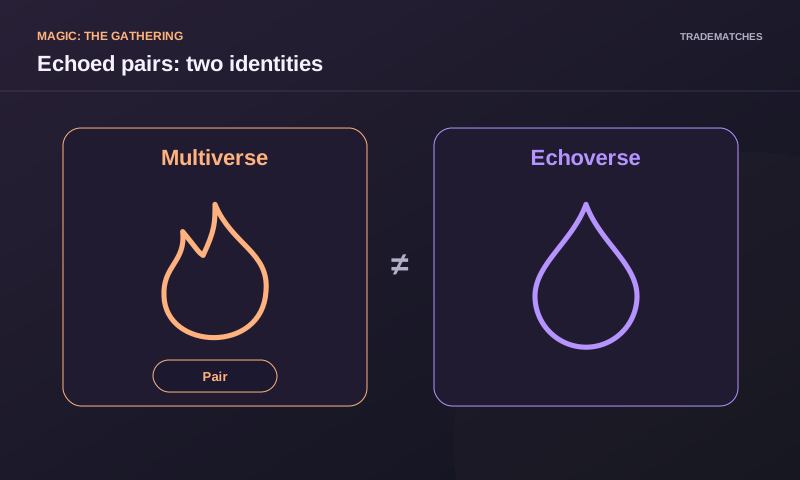
The cover is an original diagram of the contrast between realities. It does not reproduce official cards or authenticate a number, finish or another person's offered copy.
Keep the collection auditable
Pair-based organisation works best when both references remain visible in the inventory even if stored separately. Avoid layouts that squeeze cards or mix unidentified copies.
On receiving a counterpart, confirm identity and condition before marking completion. Retain a pair photo and each copy's reference. If you later change finish criteria, these records let you recalculate missing cards without rebuilding the catalogue.
Frequently asked questions
Do two copies of the same legendary form an echoed pair?
No. Identify the two different members of the actual pair.
Must I collect every variant?
No. Define your own goal and accepted versions, separately from official product rules.
Does owning a pair always grant a gameplay advantage?
No. Special-event permissions are not universal rules for every format.
Sources and checks
Find other collectors on TradeMatches to complete your pairs; confirm names, versions and condition before agreeing a trade.