One Piece attributes: Slash, Strike and card types
On this page
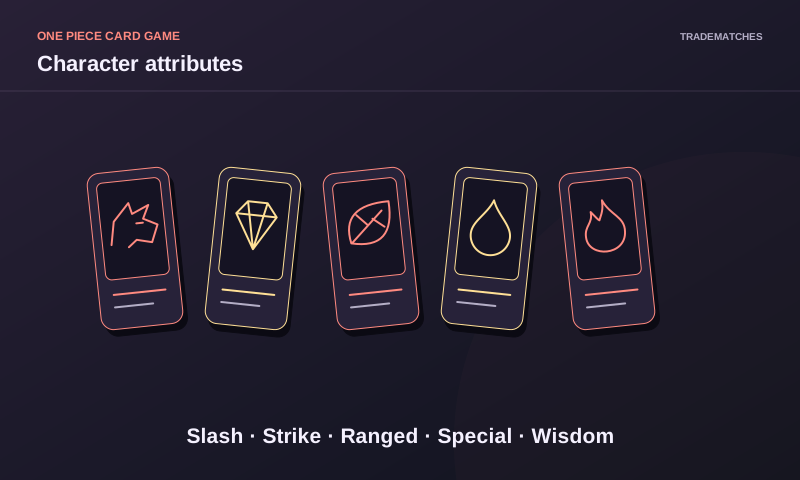
One Piece attributes such as Slash, Strike, Ranged, Special and Wisdom are card characteristics, not automatic attack bonuses. They matter when an effect refers to an attribute. Keep them separate from the card's colour, card category, name and printed types when checking a search or other restriction.
A Character with the attribute Slash is not therefore a Swordsman for every effect, and a familiar pirate's name does not supply every crew type from the story. The game uses the fields printed on the card and any effect currently changing them.
Locate the attribute beside the power information
The official rule manual shows where to find the card's attribute. On relevant cards, it is displayed as a distinct icon and label in the upper area alongside other identifying information. Use the label rather than guessing from whether the artwork shows a fist, a sword or a firearm.
Artwork is particularly unreliable on alternate illustrations. Two visually different printings of the same rules card do not acquire different attributes because the artist emphasised a different weapon. Start with the card number and current official text, then use the artwork to identify the physical variant.
When learning the layout, compare several cards from the official list with different attributes. Point to the attribute, then separately identify the power and cost. That physical reading exercise is more useful than memorising a story-based rule such as “everyone who uses a sword must count as Slash.”
Attribute is separate from card category
Leader, Character, Event, Stage and DON!! identify different card categories. An attribute on a Leader or Character does not convert that card into another category. An effect searching for a Character is not generally satisfied by finding a Leader with a matching attribute.
This matters because many effects combine requirements. A hypothetical instruction finding a Slash Character needs an eligible Character with the relevant attribute. A Slash Leader may meet one descriptive field but fail the category requirement. A non-Slash Character can fail the attribute requirement despite belonging to the correct card category.
Read such a filter as a set of conditions attached to one candidate. Do not satisfy “Character” with one card and “Slash” with another, or use a card's possible future role to bypass its current category. The text determines which object is eligible in the zone being searched.
| Field | Example of what it identifies | What it does not automatically establish |
|---|---|---|
| Category | Leader or Character | Crew or combat attribute |
| Attribute | Slash or Strike | A damage multiplier or a printed type |
| Colour | A card's colour information | Every card featuring the same character |
| Type | A printed crew or other classification | All groups the character joins in the story |
| Name | The complete printed card name | Every nickname or related character |
| Card number | The particular rules card | One unique illustration or finish |
Printed types are their own text field
The card's printed types describe classifications such as crews, affiliations or other groups. They are not inferred from the character's biography. If an effect refers to a particular type, inspect that field on the actual card and any relevant effect modifying its characteristics.
Two cards depicting the same person can have different types because they represent different versions. A collection organised by character may deliberately place them together, but a deck search for a specified crew must check each candidate individually. Shared artwork subject is not shared rules eligibility.
For a hypothetical search, compare a Character with the required crew type and the wrong attribute against another with the correct attribute and no required crew type. If the effect requires both, neither candidate qualifies. This example reveals why shortening a filter to “find a matching pirate” can change the answer.
Attributes do not form a universal advantage chart
There is no general rule that Slash automatically defeats Strike, that Wisdom avoids Ranged damage or that Special receives a bonus against a particular category. Ordinary battle resolution follows power and the applicable effects. Attributes matter when the actual rules text makes them matter.
Consider a simple battle with an attacker at 6000 power and a defender at 5000, with no relevant modifiers or protections. The printed attributes do not supply an extra unseen number to add before comparing those values. An attribute-specific effect can change the scenario, but it needs to exist and apply.
This distinction is helpful for players arriving from games with element or weapon advantage systems. Rather than building an imagined chart, learn how actual One Piece effects refer to attributes. A card can restrict attacks, searches or other actions by attribute without creating a universal interaction for the whole game.
Read exclusions before selecting the candidate
Effects can include several requirements and exclusions: a category, cost limit, colour, type, attribute or prohibition on a particular name. Matching the most visible condition is insufficient if the card fails another. Read the entire sentence before choosing a card from a searched group.
Use a small practice grid with hypothetical candidates. Candidate A has the correct type but costs too much. B has the right cost and attribute but is an Event when a Character is required. C meets every positive condition but has a specifically excluded name. Only a candidate satisfying the complete instruction can be selected.
The exercise need not involve expensive cards or a competitive deck. Its purpose is to turn filtering into a repeatable reading process. When testing an actual list, replace the hypothetical rows with exact card numbers and official text so that the practice remains connected to the cards you own.
Multiple characteristics need the actual wording
A card can carry more than one relevant characteristic, and effects can modify information during a game. Do not reduce a multi-field card to a single label because a collection app displays only one convenient tag. Use the card's complete current information for the interaction you are resolving.
Pay particular attention to whether an effect asks for a card that includes a stated type or uses a more restrictive formulation. A translated summary can accidentally drop an exclusion or a condition. When two readings disagree, compare the official card text and FAQ for the exact card number.
Also distinguish the zone in which an effect applies. A modification affecting Characters in play is not automatically a change to every physical copy in your deck or trash. Before searching, establish whether the instruction refers to printed characteristics or characteristics altered by an effect that is actually active in that zone.
Catalogue attributes without misidentifying variants
For collection records, store name, number, language, physical version, condition and finish as identity fields. Attribute and types can be additional searchable information. They help you find themes or deck candidates, but they do not replace the details needed to match an exact physical printing.
If two copies share a card number but have different illustrations, keep the variant distinction alongside their shared rules identity. Do not assume the attribute marks a new parallel edition. The alternate-art question and the eligibility-for-an-effect question are separate searches that happen to concern the same card.
A useful wanted-list note might specify the exact card number and desired variant, then add the gameplay reason in a separate sentence. This gives a trading partner enough information to locate the right copy without requiring them to reconstruct your entire deck plan from a crew or attribute keyword.
A short procedure for an uncertain card
Read the full effect you want to use, underline each required field and identify its exclusions. Check the candidate's category first, then its relevant colour, cost, name, types and attribute. Finally, account for applicable effects and consult the current official entry if the printed wording is unclear.
For an event in Spain, use the regional language and legality rules as an additional check before including the card in your registered deck. Correctly reading Slash or a crew type does not by itself establish that the physical language version is permitted at that event.
Frequently asked questions
Does Slash automatically deal more damage to another attribute?
No. Attributes do not create a general advantage chart. Apply any actual attribute-dependent effects, then resolve the battle through the ordinary rules and current power values.
Can I identify a card's crew from the anime?
Use its printed types and applicable effects instead. Different cards showing the same person can carry different classifications, and story membership is not an independent game rule.
Does an alternate illustration change the attribute?
An alternate illustration of the same rules card does not change its characteristics merely because the artwork differs. Confirm the card number and official text, while recording the physical variant separately for collection purposes.