One Piece cost vs power: what do effects reduce?
On this page
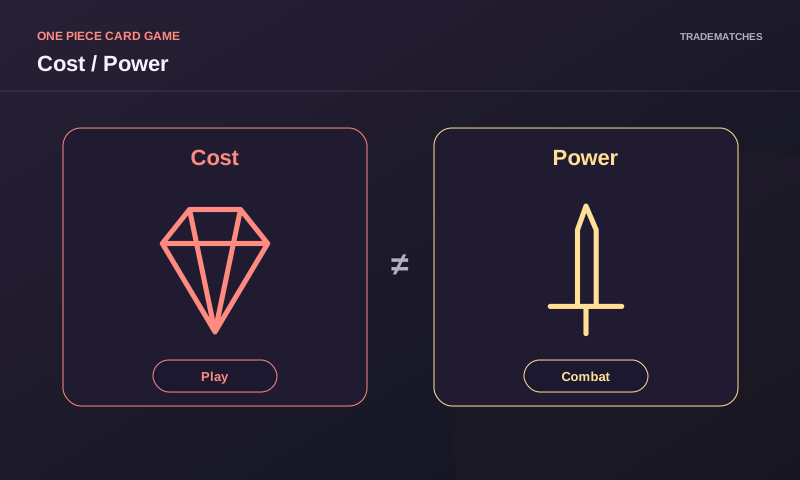
In One Piece Card Game, cost and power are different values. Reducing the cost of a Character may allow an effect to choose it as a target, but it does not automatically reduce its power. Reducing power can help win a battle, but it does not by itself change whether the card meets a cost threshold. See what value each effect mentions before reresolving it.
| When an effect checks… | Use… | Do not substitute… |
|---|---|---|
| Cost 4 or less | Current cost with applicable modifiers | Power or attached DON!! count |
| Power 4000 or less | Current power with applicable modifiers | The cost to play the card |
| Battle outcome | Card power and battle rules | A cost-based removal threshold |
Where to find each value
The printed cost of a Character indicates the requirement to play it through the ordinary procedure. Its power is the value involved in battle comparisons, with applicable modifiers. A card may have high cost and relatively low power, or the opposite. The number you saw first is not necessarily the one that an ability is testing.
Before announcing a removal effect, read its criterion: "cost of X or less" and "power of X or less" select different sets. Add zone, status and card type requirements. If the instruction says Character, a Leader with the same power does not become a valid target. If you require a rested Character, having the right cost does not allow you to choose an active Character.
Reducing cost serves to cross a threshold
Imagine a Character with cost 6 and power 7000. One effect reduces its cost by 2 during the indicated period. As long as it is applied, its cost goes to 4 for checks using that modified value. An effect that removes a Character with cost 4 or less could now select it, provided that it also meets the other conditions.
Power remains 7,000 if no instruction changes it. Don't write 5000 because you've subtracted "two" from the cost or assume that you can now beat him with a 4000 power attacker. Cost reduction and battle use different scales. Keeping the numbers separate helps especially when you place markers on the card: identify what each marker represents.
Reducing power changes battle comparison
If the same Character receives a reduction of 2000 power, it becomes 5000 for the duration of the effect. Its cost is still 6, except for another modifier. Now an attack that reaches the required power could win the comparison, but a limited effect at cost 4 or less cannot choose it solely for that reduction of power.
Nor is an automatic K.O. produced just because the power is small or zero. Do not apply a rule of other games where a reduced defensive value involves destruction. In One Piece you must solve what really indicates the effect and conditions of the game. If an additional ability eliminates the Character after reducing it, these are instructions that you need to check separately.
Two reductions can serve different plans
Suppose you want to remove a large Character by means of a card with a cost-based removal threshold. Your sequence may require a prior cost reduction. If instead you want an attacker to overcome his defense, it may be more useful to reduce the defender’s power or increase your attacker’s power. No option is universally better: it responds to a different type of problem.
When building a deck, check that the pieces in the combination use the same criterion. A card that reduces power does not prepare a cost elimination if there is no other written interaction. A card that reduces cost does not itself change battle power. Reading both instructions together before purchasing copies can avoid mounting a set that only seems compatible because the two "reduce something".
The cost to play and the cost to be checked
A reduction applied to a particular card or area does not automatically modify all copies with that name. If an effect affects a Character in the field, don't suppose that it also lowers another specimen in your hand. To find out how much you pay when playing a card, check out what instructions modify your cost in that situation and what procedure you are using.
There are also effects that play a card without following the full ordinary payment. That does not allow you to treat your cost as zero for any subsequent verification. Distinguish the value of the card from the amount that an instruction allowed you to pay. When the interaction is specific, check the Q&A of the exact number and don't replace that reference with an intuitive discount rule.
Duration determines when the change disappears
A modifier can last until the end of a turn, during a battle, or while a condition is maintained. They do not all expire at the same time. If a reduction effect is over, you must reassess the threshold with the corresponding value now. Having selected a legal character in a previous action does not prove that it remains valid for the next one.
Announce the duration when placing a marker: "cost minus 2 until the end of the turn" is clearer than "minus 2". With two simultaneous effects, retain a separate reference for each. At the end of the corresponding period, remove the expired marker and recalculate. An orderly table prevents a battle modification from being accidentally preserved during later turns.
attached DON!! affects power according to its rules
Attaching DON!! and reducing cost are different mechanics. The power increase of attached DON!! is applied according to the corresponding rule and turn time; it does not convert each DON!! into a cost discount. If an effect checks the current power, you have to include the increases and reductions that are actually active at that time, not those that will be applicable on another turn.
To pay a card, check the usable DON!! and the cost of the procedure. To declare an attack, review power and legal target. To resolve a removal effect, check the threshold that mentions that deletion. This separation into three questions avoids using the same pile of DON!! as an argument for decisions that check different data.
Example with a removal card
Imagine an ability that eliminates a rival character of cost 4 or less. The rival has A, cost 5 and power 3000, and B, cost 3 and power 6000. Without other effects, B meets the cost criterion and A does not. That A has less power doesn't make him a target. If you reduce the cost of A by 1 for the right period, you could now meet it.
Change the instruction to one that removes a Character with 4000 or less power. In that case A could be valid and B could not, even if B has lower cost. If B receives a 2000 reduction in active power, it could enter the new threshold. The sample numbers are hypothetical and serve to practice reading; they do not describe a specific card or a guaranteed combination.
What to check before looking for a copy
Check the card number, updated text, formatting restrictions, and the role it will play on your list. A parallel illustration changes the collectible item, but does not correct an incompatible combination. If you need a piece to reduce cost, describing it as "card that lowers statistics" is too vague for another player to understand what you're looking for.
A turn with both values modified
Consider a Character with cost 6 and power 7000 that receives a cost reduction of 2 and a power reduction of 2000 for the relevant period. You may now need to read it as cost 4 and power 5000. An effect allowing cost 4 or less checks the first value. An effect allowing power 4000 or less still cannot select it on that basis. The reductions do not combine with each other, and you cannot choose whichever statistic gives your preferred result.
Before continuing, identify the effect responsible for each change and its duration. If only the cost reduction expires, that does not automatically restore power to 7000. If the power reduction ends, a separate cost reduction is not undone. Use distinct markers or a short note when several modifiers are active, particularly when their durations differ. When checking a removal play, announce the relevant value clearly: cost 4 or power 5000. This avoids a marker reading −2 being mistaken for a change to the wrong statistic, and makes the sequence easier for both players to verify.
Frequently asked questions
Does reducing power to zero cause an automatic K.O.?
No, not from the power reduction alone. You need the instruction or condition that causes the K.O.; do not import that rule from another TCG.
Can power satisfy a cost-based removal threshold?
No. You must use the data that mentions the effect, including its applicable modifiers and all other requirements.
Does a reduction also affect the hand copies?
Only if the applicable text or rule so provides. An effect on a Character on the field should not be extended to other areas by assumption.