Character Counter vs Event Counter in One Piece
On this page
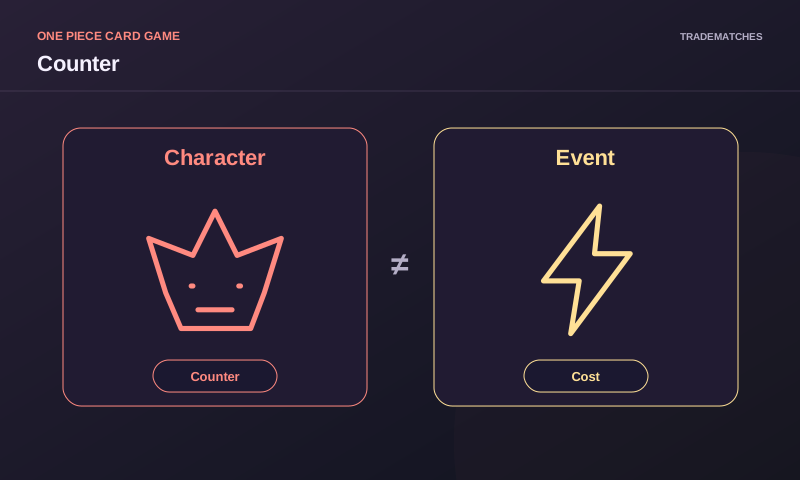
In One Piece Card Game, defense occurs in the Counter Step. A Character with a Counter value and an Event with a Counter effect are not used the same way: the first provides power from the hand and the second resolves the text of an Event.
Character: discard it for its Counter value
If the Character card shows +1000 or +2000 in the Counter area, you can discard it from the hand to increase the power of your Leader or defended Character during that battle. You do not play that Character on the field. A card without a Counter value is not useful for this action simply because it is a Character.
Event: pay and resolve the effect
An Event marked Counter can be activated in the Counter Step of the opponent. Pay its cost of DON!!, discard it according to the rules, and apply the effect described; do not assume that all grant the same power. If you need to reserve DON!!, activate it to defend, plan the previous turn instead of joining all to attackers.
Example of defense
Your Leader has 5000 power and receives an attack of 7000. A Character Counter +2000 raises the defense to 7000 for that battle, but it is not enough to avoid damage: with equality, the attacker wins. You would need to exceed 7000 power. Review this comparison before deciding how many cards to spend.
Locate the Counter Step within the attack
The battle does not compare powers as soon as the opponent turns his card to attack. First, the attack is declared and its target, then comes the Block Step, and then the Counter Step. It is at this last moment that the defender can defend with Counter cards from his hand. Only after that does it move to the Damage Step and the final power comparison is made. Remembering this order avoids spending a card before knowing if a Blocker will change the battle's target.
The window also explains why a Character with Counter does not "go to the field" to defend. It is in your hand and you use its Counter value by discarding it. A Counter Event is played according to its text during that window, with the corresponding cost. The official manual allows the defender to perform these actions multiple times and in the order they choose during the Counter Step. You can combine two Characters, an Event, and then another Character if you have resources and the cards allow it; there is no mandatory choice between "one type or the other."
Character Counter: immediate power for the cost of a card
Look for the Counter value printed on the Character card. A +1000 adds 1000 points of power to the Leader or defended Character during that battle; a +2000 adds 2000. To use it, the card leaves your hand to the discard. You do not pay the game cost you would use to summon it as a Character, nor do you need a free slot in your Character area. The cost number and the Counter number have different functions. If the card does not show a usable Counter value, do not convert it into +1000 simply because it is a Character from your deck.
The real cost of this defense is strategic: you lose a card that you might have wanted to play in your next turn. A high-value Character on the field can be a correct Counter if it protects your last Life or prevents losing an essential Character, but it is not always worth spending two cards to avoid a minor damage. Do the power calculation first and then evaluate the hand you will have left. In a game with few resources, defending everything can leave you without a way to develop the table.
Counter Event: read the text and reserve resources
An Event with the Counter label can be activated in the indicated Counter Step. To play it, pay its printed cost, usually by resting the corresponding amount of DON!! available in your cost area, and resolve the instructions of the Event. Some Events increase the power of a card; others incorporate conditions or additional effects. That is why it is not enough to say "use an Event as if it were a Counter +2000." Indicate the target, pay the cost, and apply each part of the text in the order established by the card.
A DON!! joined to an attacker and a DON!! rested to pay a cost are not available in the same way. If you want to threaten with a Counter Event during the opponent's turn, keep enough DON!! in the appropriate area after your plays. Planning the defense begins in your own turn: spending everything to attack can leave an Event in your hand that you cannot pay when you need it. Do not assume that every Event card has Counter; a Main label corresponds to another window, and the specific text may impose additional requirements.
The equality of power favors the attacker
This detail decides many card exchange situations. In the Damage Step, the attack wins if the attacker's power is greater or equal to the defender's. If your Leader has 5000 and receives 6000, a Counter +1000 only places it at 6000: the attack still wins. You need to reach 7000 or more for the attacker to have less power. If it receives 7000, a +2000 also produces equality; you will need to exceed 7000 with another card or effect. Do not spend a defense that leaves the comparison tied if your only goal was to avoid damage.
Do the subtraction before showing the first card. With an attacker of 8000 and a defender of 5000, the difference is 3000, but you need at least 4000 of increase to be above. Two cards +2000 can achieve this; a +2000 and a +1000 only tie. If an Event modifies the power in another way, calculate the result it produces with its text instead of assigning it an approximate number. This arithmetic allows you to decide if it is worth defending or accepting the result and preserving resources.
Complete examples of defensive decisions
Attack on the Leader with available Life
Your Leader of 5000 receives an attack of 6000. You have a +2000 card in your hand and several cards you want to play in the next turn. The +2000 would raise the defense to 7000 and avoid that damage. But, if you have enough Life and the Life card you would receive gives you options, accepting the damage may be reasonable. Counter responds to a rule question - how much power you need - and a resource question - what hand you want to keep. The second depends on your game, not a universal formula.
Attack on a rested Character
The opponent attacks one of your rested Characters. During the Counter Step you can increase the power of the Character defending, not just your Leader. If you manage to exceed the attacker's power, that Character will not be KO for that battle. Calculate how much it would cost to play it again and if it supports your table plan. Saving a key Character can justify two Counter cards, while a non-essential Character may be better to let it fall.
A Blocker changes the target
The opponent declares an attack on your Leader; in the Block Step you activate a valid Blocker and the attack shifts to him. Now, in the Counter Step, calculate the defense of the current target. Do not continue adding power to the Leader by habit if the Blocker is the one receiving the comparison. The decision to block and the decision to spend Counter are separate: you can block to absorb the attack and still keep the Counter cards if saving the Blocker does not compensate.
An Event that costs DON!!
You saved a Counter Event that can increase the power enough, but at the start of the opponent's turn you don't have DON!! available to pay its cost. The card does not become free because you need it urgently. Resolve with other Counters you can use or accept the battle. In the next game, review your previous turn: did joining an additional DON!! to the attacker give more than keeping it to defend? This analysis teaches you to play around your own Events without turning each turn into passive defense.
When it is advantageous to combine Characters and Events
The defender chooses the order of their actions in the Counter Step. If an Event steals cards, changes a permitted objective, or depends on a battle condition, it may be interesting to resolve it before deciding how many Characters to discard. If you only need +1000 and have a Character of that value, you may not want to pay for a more flexible Event. On the other hand, an Event that saves a key Character and provides another benefit may be the best option. Read each card separately; the manual establishes the general window, while the Event defines its specific result.
A prudent sequence consists of announcing the attacked objective, confirming if there will be a Blocker, adding the attacker's and defender's power, calculating the minimum increase needed, and only then choosing cards. If the opponent has relevant effects already applied, include them before deciding. After each Counter, update the number aloud. The bonus of Character Counter lasts for that battle: do not carry it into the next attack of that turn. Returning to 5000 for the next battle may require another defense, although the first ends without damage.
Common mistakes on the table and when building the deck
The most common error is treating the game cost of a Character as if it needs to be paid when using its Counter. Another is forgetting to pay the cost of an Event. The third is spending exactly the power difference and ending in a tie, which favors the attacker. It is also common to confuse the windows: Blocker is decided before the Counter Step, while a card without a Counter label cannot be played from the hand in that window simply because it would be useful. Correct each error by indicating the card's zone, the key word, and the battle phase.
When building the deck, observe how many Characters have Counter and how many do not, as well as the cost of your Counter Events. This review does not impose a universal proportion; it allows you to anticipate if your hand can defend itself without abandoning your game plan. A deck with many powerful Characters but no Counter value may end up with difficult-to-use cards when facing attacks. A deck full of defenses without own threats may survive one more turn but still lose the game. Test real hands and note when you lacked power, DON!!, or playable cards.
Common Questions
Can I use multiple Character Counters?
Yes, during the Counter Step you can use more than one if you have them in your hand.
Does a Counter Event need active DON!!?
Usually yes: pay the indicated cost, except if its text specifies another form of activation.