How to build a One Piece deck: Leader, 50 cards and 10 DON!!
On this page
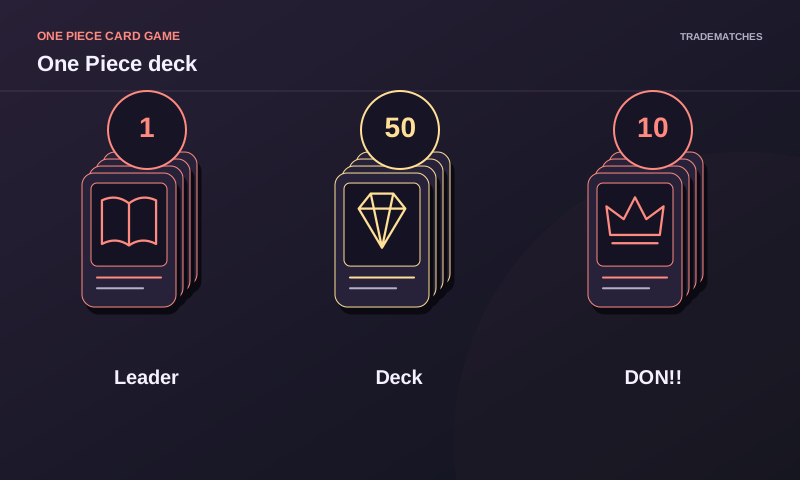
A constructed One Piece Card Game deck needs one Leader, exactly 50 cards in the main deck and a separate 10-card DON!! deck. Your Leader determines which colours you may use. DON!! cards do not belong among the 50 main-deck cards.
Choose the Leader before expensive singles
Pick the Leader you intend to play first. Its colour or colour pair limits the Character, Event and Stage cards in your main deck. A red-green Leader permits those colours, but not a blue card merely because it features the same character. Read the Leader ability too: it may reward a different strategy from the artwork you like.
Count by card number
The official manual sets a general maximum of four cards with the same card number. A parallel and regular version sharing a number count together: three regular copies plus two parallels of that code make five, so one must leave. Artwork, language and finish matter to collectors but do not create a new card number.
Write a list with codes and quantities before trading. For example, “OPXX-000 × 3” is more precise than “three Luffy cards”, because one character appears on many different cards.
Final check before an event
- Count one Leader, 50 main-deck cards and 10 DON!!.
- Match every main-deck card’s colour to the Leader.
- Group copies by number, not just name.
- Check the official restrictions and event rules on products and languages.
If you need two more copies of a particular card, record its code and quantity. That makes a trade request much easier to fulfil than an unspecific request for “cards for my Leader”.
Three separate sets
The structure of a One Piece Card Game deck is concrete: a Leader, 50 cards in the main deck, and 10 DON!! in their own deck. The 10 DON!! do not complete the 50 main cards, and the Leader is not one of them. If a published list says "50 + Leader + DON!!", it is describing three groups. Physically organizing them before playing prevents mixing resources between the cards you will draw. A box with 61 cards in total can be fine if distributed in those quantities; one with 60 because you forgot the Leader or a DON!! is missing.
To start, place the Leader face up and make two piles. Count the main cards in groups of ten and then the DON!! one by one. If you buy a Starter Deck, check its actual content and any cards you have replaced. Do not assume that a modified deck automatically retains the original numbers. A card left out for exchange does not count, but a forgotten extra card inside does alter the deck you present.
The Leader decides the available colors
Choose the Leader before acquiring the rest. Its colors define which cards you can include in the main deck according to the construction rules. A two-color Leader offers access to those two, but not a third simply because the card features a character from the same series. The printed color, not the narrative relationship, determines compatibility. A Character, Event, or Scenario card that seems perfect may be excluded if its color does not belong to the chosen Leader.
Imagine your Leader is red and green. A green card serves by color; a blue card is not compatible because its effect supports the same strategy. If you change to a Leader of another color, review the entire list before playing. A single card of incorrect color can ruin a tournament inscription. When buying a set, separate the cards by color first and check how many you can actually use; paying for a large package does not mean obtaining many pieces for that Leader.
The number of card controls copies
The general rule allows up to four copies of the same numbered card in the main deck. This number is a more precise reference than a character's name. A parallel card and the normal version with the same number count together. You cannot carry four of the normal and four of the parallel to get eight. If two cards have similar names but different numbers, review each entry by its number and the corresponding restrictions. Appearance is not a substitute for the code.
Example: you have two normal copies and three parallel copies of a card with the same number. The total is five; you must remove one. If you buy an illustrated version to improve the deck's appearance, it usually replaces one of the four existing places. When registering or exchanging cards, note the number and finish separately: the first helps count legality, the second identifies the print you want to receive.
Check prohibited or restricted cards
The four-card rule is a general maximum, but Bandai publishes restrictions for certain numbers. A list valid when a video was recorded may need changes afterward. Before buying four copies of a popular card, consult the official restrictions page for your region and the tournament date. Do not use cards without a date. Also, do not think that a restricted card becomes free when placed as a parallel: the restriction applies to the card identified by the policy, not the shine you choose.
The event format also matters. A store may organize a tournament with specific conditions or a different learning activity than the standard built. Read the call for participation. For a casual game, you can agree on something else, but if the goal is an official competition, the Leader, card numbers, restriction list, and date must match. A legal deck today is not considered legal forever without reviewing future announcements.
What goes into the 50 cards
The main deck includes the types of cards allowed to be built around the Leader, such as Characters, Events, and Scenarios. There is no universal quota for each type you must fulfill. The proportion depends on the Leader's ability, the cost curve, and the attack and defense plan. A new player can start with a simple list, play several games, and note when they lack early Characters or responses. Adding cards just because a character is liked can leave a difficult hand to use.
When modifying a 50-card list, apply "one in, one out." If you add a high-cost Event, identify which card you removed and what problem the change solves. Check afterward that the total remains 50 and that you haven't accidentally increased a card number to five copies. A table with columns for number, color, type, and quantity allows review without depending on a specific application.
The DON!! are a resource deck
The DON!! are used to pay costs and support attacks according to the game rules, but they are not stolen as if they were Characters or Events from the main deck. Keeping them separate prevents an initial hand from including cards not belonging there. If you buy DON!! versions with different art, continue counting exactly ten physical cards in that deck. Visual customization does not alter the necessary number. If you lend a DON!! to someone for a game, remember to retrieve it before the next tournament.
During the game, distinguish available, rested, and linked DON!! according to the situation. The deck construction only responds to how many you carry and where you start; using each DON!! correctly is a later game rule. Do not confuse both questions. You can have a legal resource deck and make a payment error, or understand the payment perfectly but have carried nine cards. Review each level separately.
Example of a list check
A list contains a two-color Leader, 48 main cards, and 10 DON!!. It fails to reach 50 main cards: the DON!! do not fill the gaps. You add two cards of an allowed color, but you already had four with the same number of one of them. You need to choose another number or substitute, not just add. Afterward, you check if any card is restricted. This example shows why simply counting the total once is insufficient. Each change can solve one problem and create another.
Another list has 50 main cards, ten DON!! and a blue card that does not match a red and green Leader. The quantities are correct, but the color is wrong. Replacing the blue card with a permitted card maintains the total and fixes the compatibility. Effective review follows an order: Leader and colors, total main, repeated numbers and restrictions, total DON!!. This way, you know exactly what to correct instead of rebuilding the deck from scratch.
Before buying or trading
Define the Leader you want to play and note the specific cards missing by number, quantity, and color. An ad that says simply "Luffy card" or "Zoro parallel" may refer to several prints and not necessarily the one you want. Request an image showing the number and condition. If the purchase is for a nearby tournament, check the current legality and shipping deadline. Do not buy the fourth expensive copy of a card until you confirm your list allows that quantity.
If you change the Leader after gathering half a deck, filter everything by color and synergy again. Some pieces will still be useful and others not. This does not make the extra cards useless: they may interest for another deck or trade. Correctly registering what you own and what you want reduces duplicate purchases. A legal deck is built with specific numbers, not a collection of favorite characters without review.
More common preparation errors
One: putting the DON!! among the 50. Two: counting the Leader as one of those 50. Three: including a color foreign to the Leader. Four: treating a parallel as a different number and exceeding four copies. Five: copying an old list without checking restrictions. These are corrected by separating the three piles and verifying color, number, and date. When a friend reviews your deck, show them the complete list and not just a general photo of the cases.
Frequently asked questions
Do DON!! cards count toward the 50?
No. The manual places exactly 10 in a separate DON!! deck.
Can I use four regular and four parallel copies?
Not if they share the same card number: the general four-copy limit applies to that number together.