One Piece mulligan and the five-card opening hand
On this page
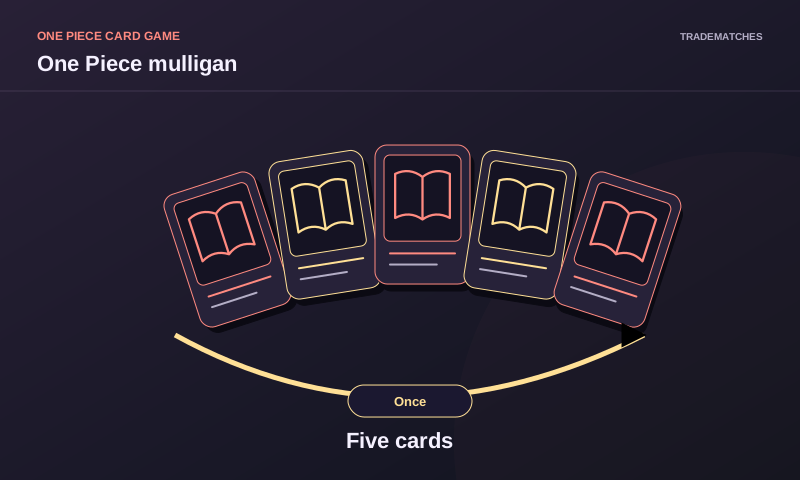
In One Piece Card Game, your opening hand contains five cards and you may replace the whole hand once during setup. To mulligan, return all five cards to your deck, shuffle and draw five again. You cannot keep the best cards while replacing the others, or repeat the process because the second hand is worse.
The exact opening-hand rule
Bandai's comprehensive rules, sections 5-2-1-6 and 5-2-1-6-1, define the procedure. Each player first draws five cards. Starting with the player going first, each player may redraw their hand once. The redraw requires returning every card in that hand to the deck and reshuffling before drawing the new five.
Players commonly call this replacement a mulligan. It does not require a particular defect in the hand, such as lacking a certain card type. You can keep a weak hand or replace one containing legal early plays. The rule offers a choice; assessing that hand depends on your deck's plan and the particular game.
There is also no card-count penalty for choosing to redraw. Your replacement hand still has five cards. If you come from a game that reduces hand size or allows selective replacement, do not import those procedures into One Piece. Using the same word for an opening-hand decision does not make every game's mulligan rules identical.
What you know when deciding
Whether you go first or second is determined before drawing the opening hand. Leaders have also been placed face up. You therefore know your position in turn order and the opposing Leader when evaluating the five cards. Looking at your hand does not let you unilaterally reverse the earlier decision about who starts.
After the mulligan decisions, players place Life cards according to their Leaders' Life values and begin the game. You do not inspect Life cards to decide whether to keep. Nor can you take already placed Life cards and use them as an informal replacement for opening-hand cards you dislike.
For each new game, follow the applicable setup procedure again. The previous game's remaining hand does not become the next game's starting point. Make it clear when a new game begins and communicate whether you are keeping or redrawing before progressing to Life placement or the first turn's actions.
Carrying out the replacement clearly
If keeping, say that you are keeping your five cards. If redrawing, return the entire hand to the main deck, shuffle and draw five new cards. Your Leader and DON!! cards do not join this exchange. The returned cards do not go to the trash or remain set aside while you draw the replacement.
That order matters. Because the original five are back in the deck before the second draw, you can draw a card you just returned, or several of them. The procedure does not guarantee five different names or prevent an unwanted card from appearing again. A disappointing outcome does not itself establish that the mulligan was performed incorrectly.
At a tournament, follow the organiser's instructions for shuffling and presenting the deck as well. If you notice that you drew the wrong quantity or put a card in the wrong zone, call a judge before improvising a repair. A seemingly simple correction can expose information or change the deck's order inappropriately.
| Choice or question | Ordinary procedure |
|---|---|
| Keep the hand | Retain the original five cards |
| Replace the hand | Return all cards, shuffle and draw five |
| Keep two favourite cards | Selective replacement is not permitted |
| Receive another awkward hand | That does not grant a second redraw |
| Draw a returned card again | Possible because it rejoined the deck before drawing |
Assess a sequence rather than five isolated cards
A useful opening hand lets you explain what you can do with the early resources available. Examine costs, conditions and the actions each card enables. Five individually appealing cards may still create a poor opening if all need many DON!! or requirements you cannot yet satisfy. Card quality and opening-hand functionality are related without being identical.
Going first or second changes that assessment. The DON!! Phase rules give the starting player one DON!! on their first turn, while the other player receives two on their own first turn. This affects which cards can be used early. It does not make one particular cost curve the best choice for every Leader.
Before keeping, ask what you can legally do on your first turn and what you can do next if you do not draw the perfect missing piece. The second question catches hands that only look strong because you are imagining a favourable draw. Evaluate the cards actually present before assigning value to a sequence you do not yet have.
An example of an opening that needs too much
Imagine a deck whose plan is to deploy an early piece and benefit from it later. Your hand contains two expensive cards that reward that piece, an Event also requiring it and two defensive cards, but neither the piece itself nor an available way to find it. The eventual payoff exists; the immediate route to it does not.
Compare that hand with the risks of replacing everything. A redraw could produce a functional opening, but it also gives up the defensive cards already available. This does not establish a rule that every hand missing the key piece must be replaced. Check whether your Leader supplies another route and how long the plan takes to begin without that requirement.
Now consider a hand with a usable early card, a way to advance your plan and enough defence to avoid spending everything on the first opposing attack. It might lack your favourite finisher while still offering a coherent sequence. Keeping it can be reasonable even though it is not the most spectacular combination your deck could produce.
Distinguish cards to deploy from cards to defend with
When assessing the hand, separate cards you intend to play from those you can use defensively. A Character's Counter and an Event's Counter do not operate identically; the Event has its own cost and instructions. Counting every defensive symbol as available without resources or conditions can make an opening seem safer than it really is.
Also decide what you would actually be willing to spend. If one card is both your only early play and your best defensive option, planning to use it for both roles ignores the trade-off. Using the physical card one way usually means it is no longer in hand for the other use. Five cards do not supply unlimited copies of each possible function.
Avoid assigning a universal Counter quota that supposedly makes every hand good. The opposing Leader, your plan and the costs of your answers matter. A more useful check is identifying a real development or defensive sequence and understanding its compromises, rather than approving a hand just because several cards display familiar numbers.
Use the opposing Leader as relevant information
Because the opposing Leader is visible during setup, you can evaluate whether your hand supplies tools for that matchup. You still do not know the opponent's five cards. Look for reasonable needs such as early board access, an answer to an expected threat or the ability to preserve an important part of your own plan.
A powerful answer may be awkward when its condition or target will not become available for several turns. Conversely, replacing a balanced hand to chase one specialised card could leave you without a playable opening. Consider when each card can perform its role, rather than treating a good matchup label as proof of immediate usefulness.
Practise with written scenarios. Record your Leader, the opposing Leader, turn order and the five cards, then write “keep” or “redraw” with a reason. Exclude the next draw from that explanation. Its identity was unknown when you made the decision, so it cannot retrospectively become the reason for an earlier choice.
Learn from the decision, not only the outcome
A well-reasoned mulligan can produce a worse second hand. Keeping a questionable hand can also end in a win thanks to later draws. Judge the process using information available at the time, rather than only the match result. This separates a preparation mistake from an unfavourable random outcome.
With repeated games using the same deck, record which kinds of opening leave you without useful actions and which let your plan develop. That observation can improve your decisions and your list, but it is not a statistical guarantee. A handful of practice hands cannot justify a universal success percentage or a claim that one card must always be kept.
When considering a deck change, distinguish executing the mulligan legally from building a list that supplies functional openings. Replacing five cards cannot fully repair a deck dependent on too many incompatible conditions. Setup and construction interact, but each deserves its own check. Treat the redraw as one opportunity to improve an opening, not as permission to redesign it after seeing the result.
Frequently asked questions
Can I replace only the expensive Characters?
The ordinary redraw replaces the entire hand. Choosing it means returning all five cards, including any you liked, before shuffling and drawing five again.
Do I need a hand without Characters to mulligan?
No such condition is required by the setup rule. You may use the one replacement even when your five cards include Characters and possible plays.
Can I decide after placing Life cards?
The opening-hand decision comes before Life placement. If setup has advanced by mistake or players disagree about an announced choice, stop and consult the event's judge.