When can you use Blocker in One Piece?
On this page
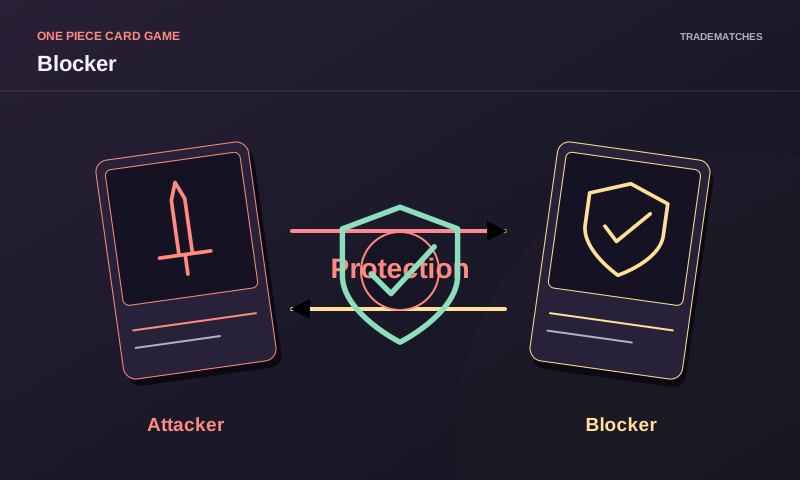
Blocker allows an active Character to become the new target of an attack directed at another of your Characters or your Leader. It is declared during the Block Step, before spending Counter.
First the attack, then the block
The attacker rests his card and announces a legal target. In the Block Step, the defender can rest one of his Characters with Blocker to substitute that target. It is not mandatory to block just because the ability is available. The Blocker becomes the attacked card during the battle.
Check the status of the Character
A Blocker Character that is already rested cannot activate the normal ability, because it must rest to block. It also cannot block itself when it is the initial target of the attack, according to official questions. Announcing it in time matters: the next step is Counter and it is no longer the same window.
Counter after Blocker
After redirecting the attack, the defender can use Character Counter or Event Counter during the Counter Step to improve the defense of the new target. For example, if the Blocker has low power, you might prefer to sacrifice it or spend an additional card; that decision depends on the table, not the name of the ability.
The exact sequence of a battle with Blocker
The active player announces an attack with his Leader or a Character that can attack and designates a legal target: the rival Leader or a rested rival Character, except if an effect changes those options. After applying the effects that correspond to the announcement, the Block Step comes. The defender can activate the ability of one of his Characters with Blocker, resting it so that that Character becomes the new target of the battle. Following that comes the Counter Step, in which you can increase the power of the card that now defends. Finally, powers are compared in the Damage Step.
Think of Blocker as a decision about who receives the battle, not as a cancellation of the attack. The attacker remains the same and the attack continues. If the new target is defeated, that Character can end up in the Trash; the originally attacked Leader or Character remains out of that comparison. It also does not open a second ordinary Block Step window because then you change your mind. Announce the block before the Counter Step begins and keep visible which card is rested and which is the current target.
Conditions for activating the ability
The Character that blocks must be on your field and in active status to be able to rest when activating Blocker. One that is already rested cannot pay for that action of resting again. If the opponent attacks directly at that same Character when it is rested, it cannot "block itself" to change the target to the same Character. Check official questions when a special effect modifies the status or the target; the normal rule is better understood on a field without other effects.
It is not enough for the word Blocker to appear on a card in your hand. First, it must be in play as a Character. It also is not used as a hand Counter: they are different abilities and occur in different steps of the battle. A card that has both possibilities can serve as defense from the hand or as a future presence on the field, but the choice of one or the other depends on where the card is at that moment. When you play a Character with Blocker, think if you want to leave it active for the rival's turn instead of spending another ability that rests it.
What changes when redirecting an attack
If the attack was directed at your Leader and you block, the final comparison is made against the power of the Blocker. In a normal battle, if the Blocker loses it does not mean the Leader loses Life as well: the attack was directed at the Character. If the attack was directed at another rested Character, the Blocker can protect it from being K.O. in that battle. The utility is different in each case: against the Leader, it is often about buying time; against a Character, you can keep a key piece for your next turn.
Blocking does not automatically reduce the attacker's power. If the Blocker has 4000 and receives an attack of 7000, it will lose the battle unless a Counter or effect changes the comparison. The attacker wins if his power is equal or greater than the defender's; a draw also does not save the Blocker. That is why the correct question is not "Do I have Blocker?" but "What happens after the block and is that exchange worth it?" Sometimes it is correct to let a small Blocker fall to preserve the last Life; other times it is better to accept damage now and keep it for a larger attack later.
Blocker and Counter are consecutive decisions
The Counter window comes after deciding whether to block. This order allows you to see who is defending before spending cards from your hand. If the 5000 Leader received an attack of 7000 and you block with a 6000 Character, calculate the Counter relative to the 6000 Blocker. A +1000 would leave it at 7000 and the attacker would still win by equality; you would need to exceed 7000 to save it. If your intention was only to prevent the Leader from losing Life, you might be able to accept the Blocker's K.O. and save the Counter card.
If you do not block, you can still use Counter to protect the original target when it comes its turn. Blocking is not mandatory, even if the attack seems dangerous. Before declaring, compare three costs: losing Life, losing the attacked Character, or spending a Blocker —and perhaps additional Counter. Also consider if the opponent has more attacks prepared that turn. A Blocker that rests to cover the first is usually no longer active to block the next; preserving its use for a later threat may be more valuable.
Six examples of the field
1. Protecting the last Life
Your Leader has one Life card and the opponent announces an attack that will surely win. An active Blocker can redirect it and avoid that battle taking away the last Life. If the Blocker is K.O., you still have a Life card and the opponent has used an attack. Before celebrating, check how many attacks are left and if any can ignore the Blocker due to their text. The block resolves a battle, not guarantees survival for the rest of the turn.
2. Saving a rested Character
Your key Character is rested because it attacked during your turn. The opponent chooses it as the target. If you block with another active Character, the attack is directed at the Blocker and the key Character is no longer the target of this battle. It can be an excellent move if the protected Character allows your next combination, but do not forget to calculate the value of the Blocker you are risking. Swapping a valuable piece for another valuable piece may not improve your position.
3. Low-power Blocker against a large attack
A 3000 Character blocks an 8000 attack against the Leader. Defending it until exceeding 8000 would require many cards. If there is no other effect, you can accept that the Blocker loses and keep your hand for the next turn. The block has deflected the attack even if it did not save the Character. Spending Counter only to bring it to 7000 would be useless if it still falls below; do not confuse "I have increased power" with "I have changed the result."
4. Rested Blocker
Your only Blocker was rested by a previous ability. The opponent announces an attack against your Leader. Although the word Blocker remains visible on the card, you cannot activate the normal ability because the Character is not active to rest. In the Counter Step, you can still use cards from your hand if they are legal. This situation shows why the active status of a Blocker is a defensive resource that is worth protecting during your turn.
5. Multiple Blockers for multiple attacks
You have two distinct Characters with Blocker active and the opponent has several attacks. The choice of the first does not imply that the second automatically activates. For each battle, the opponent announces the target and you decide in your Block Step whether to use an available Blocker. It may be useful to cover the strong attack with the Character of higher power and save the smaller one for another attack, or do the opposite if protecting a specific card is urgent. The sequence is decided battle by battle.
6. DON!! combined with a Blocker
The manual indicates that the general power bonus of DON!! combined is applied during your turn. Do not automatically calculate the defensive power of a Blocker during the opponent's turn by adding the DON!! you received in your previous turn. Check the text of the cards and the specific duration of the effects before comparing powers. This detail can turn a seemingly safe block into an avoidable K.O. if you had reserved a Counter or chosen another defender.
How to evaluate a Blocker when building and playing the deck
A Character with Blocker offers defensive flexibility while remaining active on the field, but it occupies space, costs DON!! to play it, and can be removed by effects before the attack you wanted to cover. Look at its power, cost, and any additional abilities, not just the word Blocker. A cheap card that covers an attack can be excellent for gaining time; a more expensive card may need to provide additional value to compensate for the risk of losing it in a battle. The comparison depends on your strategy and the current format.
During the game, identify the specific threat each Blocker is reserved for. If the opponent still can attack with a Leader and two Characters, do not mechanically block the first minor attack. Check the number of Life cards, the Characters you need to keep, and the Counter in your hand. Also read if the opponent's attack or card restricts the block; a ability can change the ordinary rules. The text of the card and the official sequence are more reliable than a habit learned from previous games.
Frequently Asked Questions
Should I block whenever I can?
No. Blocker is an option during the block window.
Can I use Counter on the Blocker?
Yes, the Counter Step comes after the Block Step and can increase its power.