Pokémon damage versus counters: different protections
On this page
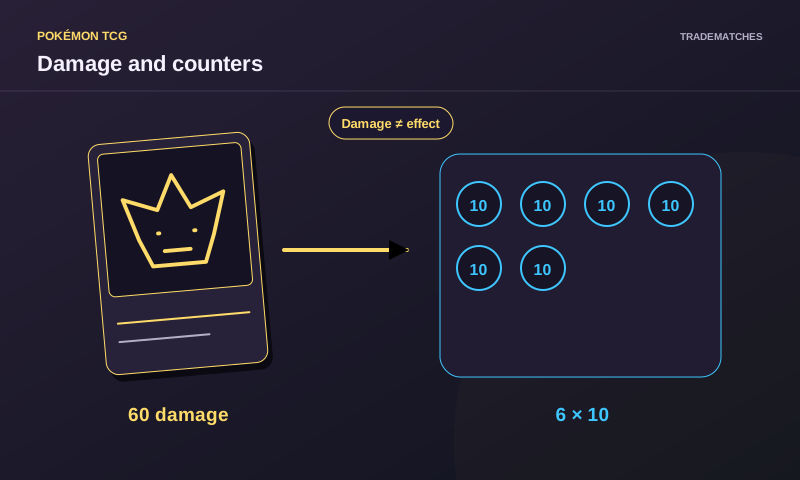
Damage and placing damage counters can leave the same amount of damage on a Pokémon, but they are different instructions. Protection against damage does not automatically prevent an effect that places counters. Start with the verb on the attacking card, then read exactly what the defending card prevents. One ordinary damage counter represents 10 damage; that recording unit does not turn every counter-placement effect into attack damage.
Read the instruction before calculating the result
A hypothetical attack that deals 60 damage and an effect that places six damage counters both leave 60 damage recorded if nothing changes their results. The route matters. Weakness and Resistance belong to the attack-damage calculation. You do not apply them simply because counters will end up on the Pokémon. Likewise, an effect protecting a Pokémon from attack damage does not acquire a broader meaning because the counters would knock it out.
The official Pokémon glossary distinguishes the damage counter used to record damage from damage itself. The rulebook provides the damage procedure. For a particular interaction, the complete text of both cards is essential: protection may concern damage, effects, a particular opposing category, or only a Pokémon in a specified position. These qualifications decide the interaction before you compare remaining HP.
| Hypothetical instruction | Starting amount | Question to check |
|---|---|---|
| Deal 60 damage | 60 attack damage | What modifies or prevents this damage? |
| Place six damage counters | Six counters, representing 60 damage | What prevents this particular effect? |
| Move three damage counters | Three existing counters | Are the source and destination legal? |
| Remove three damage counters | Up to the permitted existing damage | Does the instruction allow removal here? |
These are teaching examples, not the text of an unidentified real card. Do not use the table to override a restriction printed on a card.
Separate damage protection from effect protection
Imagine a defending Pokémon with 100 HP remaining and protection only against damage from a particular category of attacker. An eligible attack tries to deal 120 damage: its damage protection matters. Now suppose that attacker instead has an instruction placing twelve counters. The protection must actually cover that effect to stop it. The shared total of 120 is not enough to make the two instructions interchangeable.
Reverse the wording. An effect might stop effects of attacks while another clause allows ordinary damage through. It would be equally wrong to conclude that preventing counter placement also prevents the attack's printed damage. Check each component separately when an attack both deals damage and has additional instructions. A single attack can produce two differently protected events.
Write the relevant clauses in two short columns when learning: “damage clause” and “effect clause.” Put the defender's prevention below the column it actually addresses. This is a useful practice exercise because it reveals missing words. If you need to add “all” or “every” to make your interpretation work, that interpretation probably asks the protection to do more than it says.
Weakness and Resistance do not multiply counters
Take a hypothetical defender weak to the attacker's type. An attack dealing 40 damage may have a different final damage amount after the normal damage procedure. An instruction placing four damage counters still places four, unless a separate applicable effect changes that instruction. A multiplier in the Weakness area is not a multiplier on everything the attacker does.
The same distinction applies to the Bench. The rulebook's treatment of Weakness and Resistance for Benched Pokémon and a card's protection for its Bench are separate checks. “It is on the Bench” does not by itself answer whether counter placement is permitted. Identify the destination, the actual instruction and the applicable prevention. Only then count damage.
For practice, use an imaginary 90-HP Pokémon with 20 damage already recorded. Four newly placed counters bring the total to 60, leaving 30 HP. Do not start from 90 and subtract only the new 40 while forgetting existing damage. Also do not double that 40 merely because the Pokémon is weak to the attacking type. Both mistakes arise from skipping a different stage of the calculation.
Counters, dice and the ten-damage unit
A die is a reminder device. A die displaying six might mean six ordinary counters, or your table might use it differently. Agree on the convention before play. A physical 50-damage marker records five ordinary ten-damage units; it is not one counter when an effect asks you to count damage counters in the rules sense.
Suppose you have a 50 marker and two 10 markers on a Pokémon. Its recorded damage is 70, corresponding to seven ordinary counters. An instruction to move three counters concerns 30 damage, not “three physical objects,” which would incorrectly remove all 70. Replace markers as necessary so the record continues to represent the correct total.
Use separate reminders for conditions, temporary effects and damage. A coloured die indicating that an ability was used should not resemble a damage die. In a crowded board, a clear record is part of understanding the interaction; arithmetic cannot recover whether an ambiguous marker was meant as poison, an ability reminder or 20 damage.
A complete check before a knockout
Here is a worked sequence with hypothetical cards. The defender has 150 HP and 80 damage. The instruction places eight counters on that defender. First verify that the destination can be chosen and that no applicable effect prevents the placement. If it succeeds in full, add 80 to the existing 80: the Pokémon has 160 damage, meeting its HP for a knockout check. The prevention question occurs before that arithmetic.
Now change only the instruction to “move up to eight damage counters from another Pokémon.” You must examine how many counters exist on the source and what choices the effect permits. Having selected a destination with 70 HP remaining does not create eight counters on an empty source. “Place,” “move” and “remove” solve different bookkeeping problems.
At an event, present the two exact cards and the current damage record to a judge. Ask whether the protection applies to the instruction, rather than whether “this does damage.” That precise question avoids arguing about everyday language. Preserve the board while the interaction is checked instead of removing a Pokémon prematurely.
Frequently asked questions
Does one six-sided die always mean six damage counters?
No. A die records whatever clear convention the players have established. When resolving a card, translate that record back into ten-damage units; do not count the number of physical markers as the number of rules counters.
Can placing counters knock out a Pokémon without dealing attack damage?
Yes. If the placement legally produces enough recorded damage for a knockout, the absence of ordinary attack damage does not save the Pokémon. Check any relevant protection against that effect first.
Should I apply Weakness to an attack's counter-placement clause?
No. Resolve attack damage through its damage procedure and counter placement through its own instruction. An attack with both parts requires you to distinguish them.