Pokémon Weakness and Resistance: calculate damage
On this page
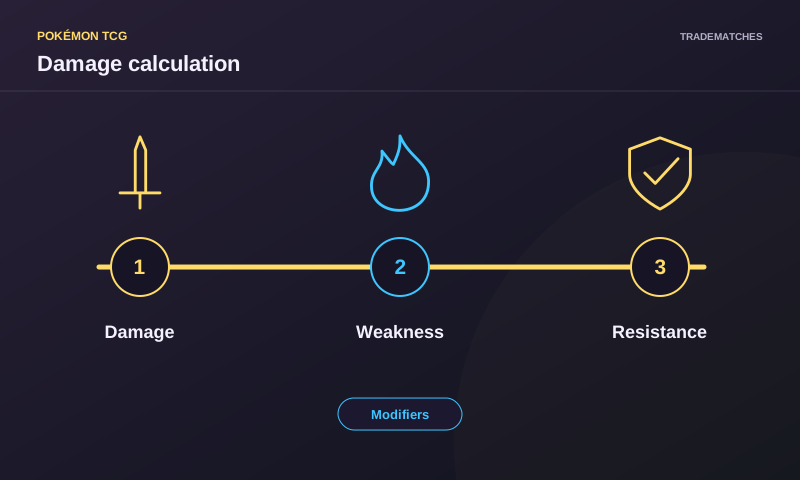
To calculate an attack in Pokémon TCG, look at the type of the attacking Pokémon and any Weakness or Resistance printed on the defending Pokémon. If the type matches a Weakness of ×2, double the attack damage; if it matches a Resistance of −30, subtract 30. This refers to attack damage, not any form of placing damage counters. This distinction avoids most errors. Before applying a modifier, also check the text of the cards in play: a specific effect may change what damage is dealt or indicate that Weakness or Resistance does not apply.
Four things to check on the table
First, identify the type of the attacking Pokémon. It's the type of the Pokémon using the attack, not the color of the Energy used to pay for it. For example, an attack with a Colorless Energy cost does not become a Colorless-type attack. Second, read the damage value and the attack text. A "90" next to the name and an instruction that says "place three damage counters" describe different operations. Third, check the bottom of the defending Pokémon's card to see if it has Weakness or Resistance to the attacker's type and what value is listed. Fourth, review any effects from other cards that alter damage in this situation.
Make these checks with the current card in play. If a Pokémon has evolved, the top card of the stack determines its current stats, including type, HP, Weakness, and Resistance, unless a specific effect states otherwise. Do not rely on memory of the Basic Pokémon below. The expansion or character name alone is not sufficient: different printings of the same Pokémon name may have different stats and Weaknesses. In a game with many cards, physically marking the attacker and defender before calculating reduces misunderstandings.
How a ×2 Weakness works
Suppose an attack deals 90 damage and the defending Pokémon has a ×2 Weakness to the attacker's type. The basic example is 90 × 2 = 180 points. Place counters representing 180 points of damage, in addition to any damage already on that Pokémon. The multiplication does not change the attack's text or the cost paid; it only modifies the damage the defender receives according to the applicable rule. If the attacker deals 0 damage before this check, doubling 0 still results in 0 damage.
To determine if the Weakness actually matters, compare the result to the defender's remaining HP. If the defender has 200 HP and already had 30 damage, an attack that ends with 180 damage brings the total to 210 and Knocks it Out, assuming no other effect intervenes. If the Weakness did not match, the example attack would raise the total to 120 and the Pokémon would survive. That's why it's not enough to just look at the printed attack value when deciding which Pokémon to promote or when to attack.
There is no universal rule stating that "Fire type always beats a certain character." Weakness is printed on the defending card and is compared to the type of the attacking card. Some cards lack Weakness or have a different one from another version of the same Pokémon. A type guide based on the video game can lead to a false result in the card game. To resolve a game, the immediate reference is the card itself, and if there are specific effects or ambiguities in wording, the current official rulebook applies.
How a printed Resistance works
Resistance reduces attack damage when the type matches. If an attack would deal 90 and the defending card shows a −30 Resistance to the attacker's type, the basic example results in 90 − 30 = 60. Do not discard Energy or remove previous counters for this subtraction; simply place counters representing the new 60-point damage. If the Pokémon already had 40 damage, after the attack it will have 100 total damage. Resistance does not erase prior damage nor grants additional HP.
If the attack would deal 20 and the applicable Resistance subtracts 30, the result is 0, not −10. You do not "heal" 10 points nor transfer a Resistance credit to the next attack. Each attack is calculated independently. If another attack comes later, you re-evaluate its data. When a specific card establishes effects that depend on whether damage was dealt, it's important to read its exact text and consult the rule sequence before assuming that a zero result has the same effect as a positive damage attack.
Attack damage and damage counters are distinct concepts
A damage counter represents 10 points of accumulated damage on a Pokémon. After calculating an attack of 60 points, you can indicate that total with six 10-point counters or equivalent pieces. But an attack that says "place three damage counters" does not mean you're announcing a 30-point attack that you must double due to Weakness. Place three counters, which represent 30 points on the target as specified in the text, without applying Weakness or Resistance to that placement. The visible result being the same number of counters as a certain attack does not make both operations the same rule.
The difference matters when reading defensive and offensive effects. A card may reduce "attack damage" without mentioning counters placed by an effect, or it may prevent counters from being placed without altering normal damage. You must respect the verb used: "deals damage," "places counters," "moves counters," and "heals" are not interchangeable. If a play combines several instructions, resolve each one as the card and rules specify. It's better to write a separate calculation for the attack damage and another for counters placed by an effect, rather than summing everything and applying a single ×2 at the end.
What happens when the attack affects the Bench
The general rule of Pokémon TCG is that Weakness and Resistance do not apply to damage received by Pokémon on the Bench. If an attack deals damage to the Active and one or more Pokémon on the Bench, calculate each recipient separately. Do not automatically double the damage to a Bench Pokémon due to a Weakness symbol on its card. Nor do you subtract its Resistance as if it were defending in the Active position. If a specific card's text creates an exception, follow that text and verify its scope: it may specify a target, a type of damage, or a specific moment.
A practical example helps: the attack announces 90 damage to the Active and 20 to a Pokémon on the Bench. The Active has a ×2 Weakness to the attacker and no other effects; the basic calculation for the Active is 180. Even though the Bench Pokémon also has a Weakness to the attacker, it normally receives the 20 indicated for the Bench, not 40. If the attack instead says you place counters on the Bench, the instruction is resolved as placing counters, not as attack damage. These two checks prevent improper damage accumulation in decks that attack multiple targets.
Other modifiers: don't invent an order
A Tool, ability, Stage, or attack text can increase, reduce, or prevent damage. The order of application can change the result when multiple effects coexist, so it's not enough to remember "first multiply, then subtract" as a universal formula. The official rulebook describes the sequence, and each card's text may specify when its modification occurs. Read the full cards, check which Pokémon each effect affects, and distinguish whether it alters the attack damage before it's applied, the damage received, or a subsequent placement of counters.
When you have doubts during an event, ask the judge with exact names and texts. A useful question is: "This attack shows 90, this Tool adds 20, and the defender has a ×2 Weakness; in what step does each effect apply?" A vague question like "how much damage does it do?" forces you to reconstruct the entire table. In casual play, open the rulebook and note the agreed-upon calculation. If an effect explicitly states that the attack does not apply Weakness, do not add it just because the type matches. The card may be specifically designed to override the general rule in that attack.
A quick check before placing counters
Read the attack and decide whether it deals damage, places counters, or combines both. Mark the attacking Pokémon and its type. Mark each target of the attack: the Active and, if applicable, each Pokémon on the Bench. Read the defender's Weakness or Resistance and check if the type matches; do not assume the match based on the character or Energy used. Then review any modifying effects from cards in play and consult the current order if effects interact. Only then express the final damage with counters and add any counters already on the Pokémon.
Afterward, compare the accumulated damage to each affected Pokémon's HP. If one is knocked out, resolve the consequences according to the rulebook and the card text. This final step is different from the Weakness calculation: a correct multiplication is useless if you later forget the prior damage or count new counters twice. Use readable counters and let your opponent see the calculation. Showing "90 times two, 180; had 30, now 210" makes a possible error detectable before continuing to play.
Common mistakes that change a game
The first is looking at the attacker's Weakness instead of the defender's. Weakness tells you which type of attack harms that Pokémon when it takes damage; it does not increase the damage of its own attacks. The second is using the type of Energy used: paying an attack cost with Energy of a certain type does not change the type of the attacking Pokémon. The third is doubling counters placed by an effect because their visible value equals points of damage. Accumulated counters matter for being knocked out, but placing them does not automatically mean "dealing attack damage."
Weakness is sometimes incorrectly applied to damage directed at the Bench, Resistance is sometimes interpreted as healing, or a card from a different printing with an old number is used. To avoid this, review the top card of the current Pokémon and clearly state each target of the attack. If playing with test proxies, copy all relevant stats from the printing they represent, not just the name and attack value. And if a card has an officially corrected text, consult the current version; an outdated guide might describe an interaction that no longer applies to your event.
Two exercises to check it
First exercise: an attacker of type A uses a 90-point attack against an Active defender that has a ×2 Weakness to type A and already had 20 damage. With no other effects, the attack deals 180 damage, and the defender ends with 200 total damage. The result of the multiplication is new damage; the prior damage is not multiplied again. Second exercise: a 20-point attack faces a −30 Resistance to type A. The new damage is 0. If the defender already had 50, it will still have 50; the Resistance does not reduce that prior damage. In both cases, check the printed HP to determine if the Pokémon is knocked out.
A third contrast highlights the central distinction: an effect places three counters on a Pokémon with a ×2 Weakness to the type of the Pokémon that caused the effect. Without a text instruction changing that placement, they remain three counters, equivalent to 30 points of accumulated damage. They do not become six. Repeat the exercise with a card that deals 30 points of attack damage and you'll see why the verb in the text matters: in the second case, if the conditions for Weakness are met and there are no exceptions, the damage could be 60. The same initial visible value, different rule operations.
Frequently Asked Questions
Does the attack's Energy determine Weakness?
No. Compare the type of the attacking Pokémon to the Weakness or Resistance printed on the defender. The Energy pays for the attack, but does not change the type of the attacking Pokémon by itself.
Are the existing counters on the defender doubled?
No. Calculate the new damage from the attack and then add the counters to the damage already on the Pokémon. Do not multiply the prior damage again.
Do I apply Weakness to a Pokémon on the Bench?
Normally not. Check if the specific card's text establishes an exception for that situation.