Pokémon evolution: what happens to damage and status?
On this page
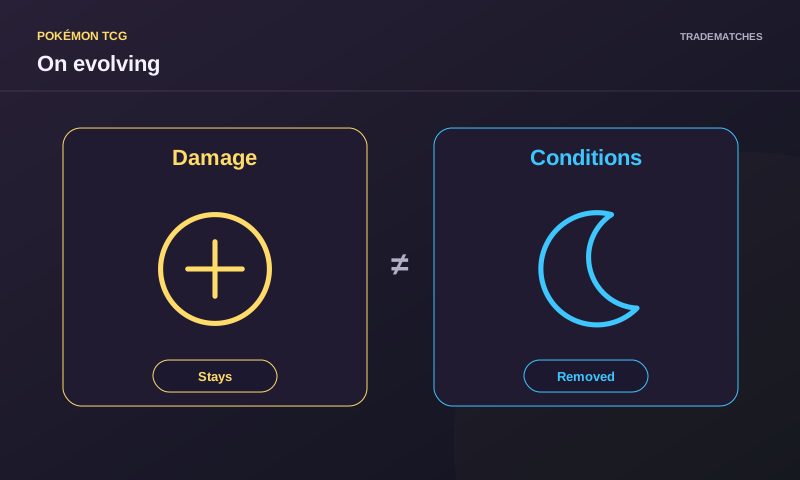
When a Pokémon TCG evolves, the damage counters and attached cards remain. In contrast, the special conditions and effects of attacks that affected the previous Pokémon end.
Damage does not heal by evolving
The new card is placed on top of the previous one. If the Basic had 30 damage counters, the evolution retains those counters; it does not start clean. Check the HP of the new card after placing it, because its maximum can change. The Energy cards and other attached cards also continue with that Pokémon.
Special conditions do end
Asleep, Confused, Paralyzed, Poisoned and Burned are special conditions. The rules indicate that they disappear when the Pokémon evolves. Remove the counter or turn the card back to its normal orientation as appropriate. They also end effects of attacks that were affecting that Pokémon.
Example of the table
Your Active Pokémon is Paralyzed, has two Energy cards and 40 damage points. If you can legally evolve it, the Energy cards and the damage remain, but it no longer is Paralyzed. The evolution does not allow keeping attacks or abilities printed on the lower card unless another card authorizes it.
Separate three things: damage, attached cards and effects
The most reliable way to resolve an evolution is to check the table in layers. First look at the damage counters: they remain on the Pokémon. Then look at the attached cards, such as Energy cards or Tools: they stay attached unless another applicable instruction says otherwise. Finally, check what was affecting the Pokémon, especially Special Conditions and attack effects: those effects end when the Pokémon evolves. This separation avoids the imprecise phrase "the evolution resets everything," which would give an incorrect answer for the damage and the Energy cards.
The Evolution card is placed on top of the previous one, forming a stack. The top determines the name, the HP, the attacks, the abilities and other current data of the Pokémon. The lower cards continue in the stack; they do not return to the hand or go to the discard pile simply because of the evolution. Keep the arrangement of the counters and the attached cards while changing the top card. If you temporarily remove a Tool to organize the table, put it back in the same Pokémon: physically moving it does not mean the game has discarded it.
How to calculate the HP after placing the evolution
Do not transport an abstract number of "remaining life." Transport the damage counters. If a Basic with 70 HP has four counters of 10, it accumulates 40 damage. If it evolves to a card with 120 HP, it still has 40 damage and has 80 HP left before reaching its new maximum. It does not become a fully 120 HP Pokémon or limit itself to keeping the 30 HP that the Basic had left. The method works even when the HP maximum changes a lot between stages.
Always check the result on the new card. If the accumulated damage equals or exceeds its HP, that Pokémon is Knocked Out according to the rules; there is no free healing that saves it. In most evolutionary lines, the evolution increases the HP, but it is not good practice to resolve by intuition. Modifiers and effects that alter the HP can complicate a specific situation. Note the source of the modifier and verify if it still applies to the evolved Pokémon; do not confuse this analysis with the basic rule that the damage counters remain.
The Energy cards and other attached cards do not disappear
An Energy attached to the Basic continues attached to the evolution. This allows preparing an attacker that needs several Energy cards in advance: you can place them in the previous stage and, when it is legal to evolve, use the new card with the already attached resources. The evolution itself does not count as a new Energy attachment from the hand, nor does it replace the ordinary attachment allowed for the turn. They are distinct actions. If an attached card contains special text, read if that text still applies to the current Pokémon; the card is not discarded simply because an evolution is placed on top.
The Tools and other attached cards require the same review. The general rule of keeping attached cards does not mean that all their effects produce the same result after evolving. A Tool may refer to a type of Pokémon, a stage, or another condition that the upper card no longer fulfills. In that case, you have to follow the applicable text of the Tool and the current rule. The questions "Does it remain physically attached?" and "Does it do something useful now?" do not always have the same answer.
Which Special Conditions are cleared
The Special Conditions of a Pokémon TCG are Asleep, Confused, Paralyzed, Poisoned and Burned. When a Pokémon evolves, it no longer suffers them. Remove the Poison or Burn counters and return the card to its normal orientation when you had turned it to indicate Asleep, Confused or Paralyzed. Do this just when placing the evolution so that the table state is readable before taking the next action. Do not wait for the check between turns to eliminate a condition that has already ended.
The clearing of the condition does not eliminate the damage counters that that condition may have caused before. If a Poisoned Pokémon received damage between turns, those counters are already on the Pokémon and will remain after evolving. What disappears is the Poisoned condition for the future. In the same way, if Burned had added damage in a previous check, evolving does not rewind that check. This distinction is essential when a player uses the evolution as a way to remove a condition without using a healing card.
What happens with attack effects
The rules also indicate that the effects of attacks that affected the Pokémon end when it evolves. For example, a previous attack could impose a temporary restriction. If that restriction affected that Pokémon, check if the evolution eliminates it. Do not put all visible rules on the table in the same bag: an effect on a player, a Stadium card, or a condition imposed by another source may require a different reading. Identify the exact source of the effect before removing it.
When there are doubts, reconstruct the phrase that created the effect: Did it say "this Pokémon," "the Defending Pokémon," "your opponent," or refer to a zone? Then identify if the affected Pokémon has evolved and consult the official text if the interaction is unclear. This specific reading avoids two opposite errors: leaving a restriction that has ended or removing a limitation that still exists because it was not an attack effect on that Pokémon. In competitive games, call a judge before taking another action if the resolution changes an important decision.
Five complete examples of the table
1. Paralyzed with prepared Energy cards
Your Active Pokémon is Paralyzed, has two attached Energy cards and 40 damage points. You check that it can evolve this turn and place its Stage 1. The Energy cards and the damage counters remain; Paralyzed ends. Now look at the attacks of the new card and their costs. If it already has the necessary Energy and there is no other impediment, the previous condition no longer blocks attacking. The result would not be the same if you tried to evolve it in the turn it entered the game without an exception.
2. Poisoned that received damage before
A Basic received two damage counters from an attack and two more from Poison between turns. When it evolves, it retains the four counters: 40 damage total. The Poison counter is removed, and if it does not receive that condition again, it will not add damage from poison in the next check. Saying "the poison cures" is an acceptable abbreviation only if you remember that the damage already applied does not cure with it.
3. Tool that depends on the stage
A Basic carries a Tool with a requirement referring to the Pokémon it is attached to. When it evolves, the Tool usually remains physically attached, but you must re-read if the current Pokémon satisfies its condition. If it no longer satisfies it, do not assume the bonus is still active. You also should not discard the Tool on your own initiative unless its text or another rule orders it. The attached card and its effect are two different issues.
4. Evolution with less HP margin than expected
A Pokémon has 90 damage points. Before assuming the evolution saves it, look at the HP of the new card and the modifiers that actually continue to apply. If the damage is equal or greater than the resulting HP, the Pokémon will be Knocked Out. This example is rare in simple lines, but the check is the same as when a card changes the HP through an effect. Keeping a count of the counters avoids discussing "healed life" even though none was ever removed.
5. Previous attack with a restriction
The opponent applied an attack effect that prevented taking an action with your Pokémon. Before evolving, identify if it is an effect on that Pokémon. If so, the evolution can end it along with other attack effects that affected it. If the restriction is written on the player or comes from another source, do not automatically remove it. The exact text is more important than the memory of a word like "blocked."
Common errors when resolving the evolution
The first error is removing all counters when removing a status marker. The status markers and the damage counters represent different things. The second is sending Energy cards to the discard because they were below a new card; they remain attached to the stack. The third is using an attack or ability from the lower card without an effect that allows it. The fourth is forgetting to check the HP of the new card after keeping the damage. Each error can change who is Knocked Out, which attack is available, or how many Prize cards are taken.
A simple procedure avoids all four: announce the evolution, place the new card without moving the attached ones, count the existing damage, remove the Special Conditions, and review the attack effects on that Pokémon. Finally, read the top card to know its HP and current options. If both players can follow this sequence aloud, the resolution is easy to verify even on a table with multiple stacks, Tools, and markers.
Common questions
Does evolving eliminate the damage?
No. The damage counters remain on the evolved Pokémon.
Are the attached Energy cards discarded?
No by normal evolution. They remain attached, unless a specific effect indicates otherwise.