Pokémon GO peelable Ditto: identify before peeling
On this page
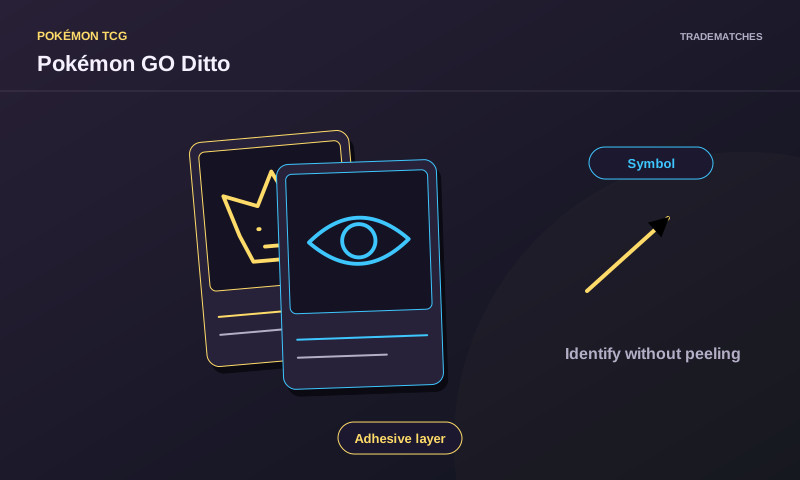
A peelable Ditto from the Pokémon GO expansion has a small Ditto symbol on its covering layer. Do not lift a corner merely to investigate an ordinary card. Identify the expansion, visible Pokémon and symbol first. Peeling changes the physical collectible, so decide whether you want an unpeeled example or the revealed Ditto before handling it.
Identify the special layer without testing every card
The Pokémon GO expansion introduced cards with a removable illustrated covering that reveals Ditto underneath. The official reveal describes the covering as a layer rather than a manufacturing defect. A normal reverse-holo card is not automatically peelable. Neither a glossy surface nor a corner that appears slightly raised is enough to justify pulling it apart.
For the international Pokémon GO set, the disguises collectors look for are Spinarak, Numel and Bidoof. Their ordinary versions also exist. Check for the Ditto icon near the lower-left identification area, rather than treating the Pokémon's name as proof. The set checklist separately identifies Ditto as 053/078; the identity visible on an intact covering and the identity of the revealed underlying card are different information.
| What you are examining | Useful evidence | What it does not prove |
|---|---|---|
| A reverse-holo Spinarak, Numel or Bidoof | Clear lower-left identification area | That every reverse copy conceals Ditto |
| An intact special covering | Ditto symbol and complete original layer | A future sale price or grading result |
| A revealed Ditto | Underlying card identity and its condition | The condition of a removed covering |
| A loose illustrated covering | Its own physical state | That it is a complete playable card |
The table is an inspection framework. If a photograph does not show the symbol, request a closer photograph before making an irreversible decision.
“Unpeeled” is a condition description
An unpeeled example should still have its original covering in place. That does not necessarily mean the corners are perfect, that nobody has lifted an edge or that the underlying card is undamaged. A partially lifted covering requires its own description. “Never fully peeled” is weaker than “original covering intact and not lifted.”
Ask a seller for front, back and lower-left close-ups. If the listing shows a stock image, it cannot establish the state of the offered example. Photograph any raised edge without pressing it flat. Do not ask someone to peel the card as proof if the item you intend to buy is specifically an unpeeled collectible.
A useful listing might say: “Pokémon GO Numel disguise, Ditto symbol visible, original covering present; front and back shown; slight lift at the upper edge.” This communicates an observable state. A listing saying “perfect secret Ditto, guaranteed investment” tells you little about the actual surface and adds promises the identification cannot support.
Choose a collection goal before removing anything
There are several reasonable goals: one revealed Ditto for the normal numbered checklist, one intact example of each disguise, or both. They require different acquisitions. A collector who wants three intact disguises cannot replace a missing one with another revealed Ditto merely because the underlying card number matches.
Make that distinction in your inventory. Use separate fields for the visible disguise, underlying identity, language and covering state. Avoid recording an unpeeled Numel disguise only as “Ditto, one copy.” That entry may cause you to offer something another collector expects to receive already revealed, or to buy an unnecessary duplicate of a disguise you already own.
Suppose your folder has intact Spinarak and Bidoof examples plus one peeled Ditto. Your next missing item is an intact Numel disguise, if your goal is all three coverings. Buying any third peeled Ditto does not complete that goal. This example concerns completeness, not a claim that one collecting goal is more valuable than another.
Peeling is a deliberate alteration of the collectible
The intended removable layer is part of the product feature, but removing it still changes what you own. A revealed card cannot be described later as never peeled. Reattaching a covering does not recreate reliable evidence that the original layer was untouched. The appropriate choice depends on your purpose, not on a promise that peeling always increases or decreases value.
If your priority is preserving an intact disguise, store it without lifting its layer. If you intend to reveal it, work on a clean surface with clean, dry hands and support the card. Do not introduce solvents, heat or blades to deal with an edge that resists. Stop if the action begins damaging the underlying card or if you are unsure that the item is genuinely the special version.
This guide does not prescribe a restoration treatment or predict long-term adhesive chemistry. There is no universal storage experiment here demonstrating that all intact examples will age identically. Protect the collectible against abrasion and inappropriate handling, and describe changes you can actually observe.
Separate a covering from a card
A removed illustrated layer is not interchangeable with an intact ordinary Spinarak, Numel or Bidoof card. The official announcement warns that the special covering should not be used as a card in official play. A piece of adhesive illustration does not acquire a normal card back and full card identity just because it displays attack information.
When buying a mixed lot, count complete physical cards separately from loose coverings. A lot advertised as “four Ditto items” might contain one revealed Ditto and three coverings. That is not the same purchase as four complete Ditto cards. Ask for an itemised description instead of relying on a photograph where several pieces overlap.
For play, consult the current format's eligibility separately. A genuine card can be outside the legal set pool. Authenticity, physical completeness, covering state and format legality are four different checks. None should be inferred from the others.
Inspect a received example before filing it
Compare the delivered disguise with the agreed listing. Check the visible icon, language, edges and back under normal light. Keep the covering attached while checking an unpeeled purchase. If the edge is lifted more than the seller described, photograph that state before attempting to smooth or reveal it.
For a trade, a short confirmation such as “one intact Bidoof disguise with Ditto icon, not a peeled Ditto” prevents a misunderstanding about identity. On a collection platform, record that distinction in the description rather than expecting a generic card name to carry it. The important information is the physical form the other collector will receive.
Frequently asked questions
Does every Pokémon GO reverse-holo Bidoof conceal Ditto?
No. Look for the specific Ditto symbol. The Pokémon name and reverse-holo finish alone are insufficient evidence that a card has the special removable layer.
Can I put the layer back and call the card unpeeled?
No. If it has been removed or lifted, disclose that handling. Reattaching it does not establish that the original covering was untouched.
Does peeling guarantee a more valuable card?
No. It changes the collectible's form. Compare purchases by the form and observable condition you want; do not infer a guaranteed price change from the mechanism.