Pokémon holo vs reverse holo: how to tell them apart
On this page
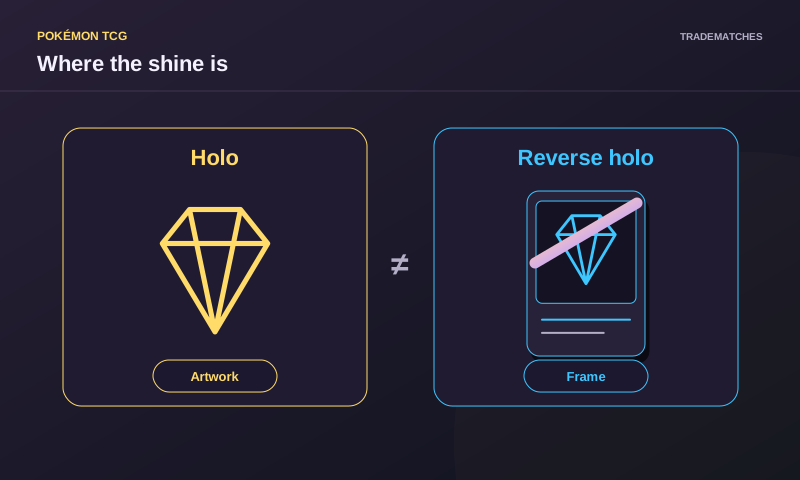
Pokémon holo and reverse holo cards differ in their finish, not simply in their rarity symbol. In many printings, a regular holo concentrates its shine in the artwork, while a reverse shows foil elsewhere. That is a useful starting point, but appearances change across eras and products. Confirm the expansion and variant before buying a card or marking it complete in your collection.
Rarity, finish, and number answer different questions
Rarity identifies a category within a set. Finish describes the physical treatment of a printing. The card number helps locate it in the checklist. Combining those details into one vague description can leave you with the right card for playing but the wrong version for collecting.
Imagine you want the reverse version of a card you already own without foil. Both copies may have the same name, artwork, and number. The finish is the difference you need to communicate. Asking only for “number 42” can result in another copy of the card already in your binder, even though the other collector supplied the requested number.
A star alone does not settle the question either. “Rare” does not identify every specific holo treatment, while “shiny” can describe several finishes. Record the expansion, number, language, finish, and product origin separately when the product distinguishes the variant. That gives another collector the information needed to check a possible trade.
Where to look for the foil
Begin with the complete card under soft lighting. Tilt it slowly and watch which surfaces reflect. On a conventional holo, the artwork window commonly contains the holographic pattern. On many reverses, the treatment appears outside that window, such as around the text or across the background of the card's body.
Do not treat this observation as a universal definition. Pokémon has used different layouts and foil patterns over time, and some special cards do not follow a traditional framed-artwork design. “Foil outside the picture, therefore reverse” is an initial hypothesis. Confirmation depends on the product that produced the card.
Also look for stamps, repeated patterns, or a treatment associated with that set. Note them as visible characteristics before deciding they represent an exceptional rarity. Something unusual beside your recent cards may be standard on an older printing. Compare with the same card and product rather than any shiny Pokémon card.
What official checklists can establish
Set checklists help establish which variants are documented. EX Delta Species provides a useful example: its official list states that cards 1–18 have two foil versions, cards 19–107 have foil and non-holo versions, and cards 108–113 have one holo version. Applying “normal plus reverse for every number” would create collection slots that do not match that product.
Read the checklist legend as well. Holo, foil, parallel, and reverse can appear in product documentation and collector descriptions at different levels of detail. Do not automatically label every foil checkbox as a modern-style reverse. Establish which printings that particular checklist distinguishes.
If two sellers use different names, return to observable details. Ask which part of the card is foiled, whether there is a particular stamp, and which product the copy comes from. Photographs and an official product reference can clear up an ambiguous listing. You do not need to settle the entire history of foil terminology to identify one specific copy.
Four checks for a specific card
1. Identify the card and expansion
Read the number and expansion identifier, and check the language and artwork. Make sure you are comparing the same card before comparing finishes. Two pictures of the same Pokémon can belong to different numbers or products, with treatments that are not equivalent variants.
2. Find the documented product variants
Look for an official checklist or product description that documents the relevant treatments. For older cards, also check whether a promotional or deck printing has its own finish. The question is “Does this version exist in this product?” rather than “Does Pokémon have reverse cards in general?”
3. Inspect the actual copy
Request a straight-on photograph and an angled image under lighting that shows the finish. A catalog picture identifies the design but does not always show the version the seller owns. A reflection on a sleeve should not be your only evidence that the card itself is foiled.
4. Write an unambiguous description
Combine the number with language and finish. Include a stamp or specific pattern when it distinguishes the version. If a check remains unfinished, mark the finish as unconfirmed in your private inventory. Keeping that uncertainty visible is more useful than ticking a collection slot you will later need to correct.
Helpful and misleading photographs
Direct flash can wash out a section and hide its pattern. Poor lighting can make a reverse look like a non-foil card. Filters and heavily compressed photographs can also change the apparent shine. Ask for straightforward pictures of the actual copy rather than an edited image that looks attractive but conceals the detail you need.
A short video tilting the card can answer a question that several front-facing images leave unresolved. Ask for the whole card first, followed by the relevant detail. There is no need to rub the surface, touch it with bare fingers, or scratch it to test the finish. Inspection should provide information without introducing wear.
Separate finish from damage too. A line visible when tilting the card may be a manufacturing mark or a scratch. It does not by itself establish whether the printing is holo or reverse. Identify the variant first and describe its condition separately. “Reverse” does not mean every visible surface mark is expected or acceptable.
Three situations that lead to the wrong purchase
First, you own a non-foil copy and find the same number advertised as “foil.” Ask for the precise version and an angled picture. If it matches the variant you need, record it separately. If the listing only offers a generic label, its title does not provide enough information to make that decision.
Second, you are buying an older card while expecting the appearance of a recent reverse. The offered copy has a different pattern. Check its product and checklist before dismissing it or calling it counterfeit. One era's appearance should not be imposed on another. However, the existence of a legitimate pattern does not automatically authenticate the photographed card.
Third, a lot contains non-foil, holo, and reverse copies with matching numbers. Count variants separately. If you want one playable copy of each card, you may not need every treatment. If you collect complete finishes, different variants may fill different slots. Your inventory follows the collection goal you chose, rather than the total number of shiny cards in the lot.
What several foil cards in a booster mean
Pokémon Support's general booster information, updated in May 2026, describes three foil cards in current packs using that structure, with at least one rare or higher, and distinguishes packs before Scarlet & Violet. This does not turn the expected reverse count for every older, Japanese, or special product into one universal identification test.
For a loose card, its actual finish and product documentation are more useful than remembering how many shiny cards you opened. Nor does a particular booster position establish that a reverse is worth more than a holo. A meaningful price comparison needs the same variant, language, and condition, together with verified market information.
Recording missing variants and arranging a trade
A practical record might include expansion, number, language, non-foil version, holo version, reverse version, and notes. Adjust those columns when the official list documents different treatments. Do not create a reverse slot for every card number before checking whether that printing exists.
For example, one row might show the regular copy as owned while its reverse slot remains empty. A second row might have only one documented holo printing and no reverse slot at all. Keeping those rows different prevents a spreadsheet from creating artificial missing cards. It also avoids spending time looking for a version that the product never contained.
When looking for a particular reverse on TradeMatches, include its finish, number, and language, then confirm the variant with photographs before exchanging. That lets another collector check their duplicates accurately and avoids meeting with copies that do not fill the agreed collection slot.
Frequently asked questions
Is a reverse holo always a rare card?
No. Finish and rarity are separate details. Consult the symbol and the set checklist to identify both.
Can holo and reverse versions share a number?
Yes. A number can identify the card without distinguishing every finish. Include the variant in a buying or trading description.
Can I identify the finish from one front-facing photograph?
Sometimes, but reflections can hide or imitate shine. A second angled photograph of the actual copy often supplies the missing information.