Pokémon Lost Zone: can you recover cards?
On this page
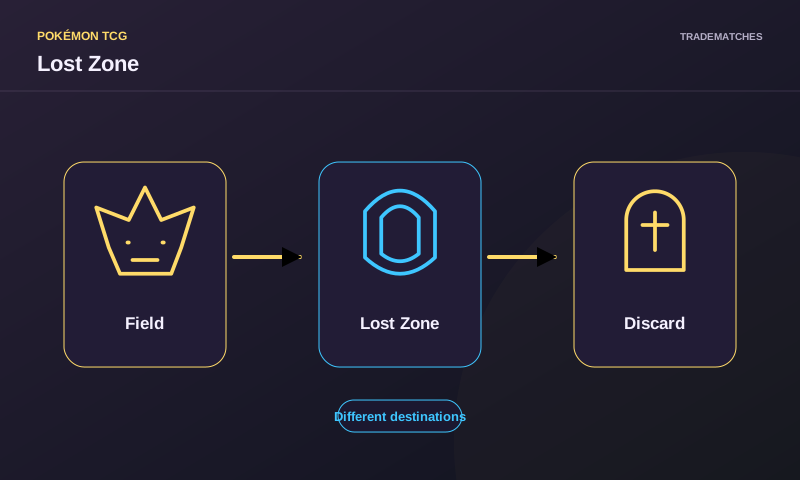
The Pokémon Lost Zone is a separate zone from the discard pile. A card sent there cannot be recovered by effects that look for cards in the discard pile. When you decide what to send to the Lost Zone, you should treat it as giving up that copy for the rest of the game, even if other cards can count how many are there.
Discard and Lost Zone have different functions
Many used or discarded cards accumulate in the discard. Some effects allow to recover certain categories from that zone: Pokémon, Energies or Trainers, as indicated. The Lost Zone has another function. It is not a second discard or a part of the first that you can consult with the same instruction. Mixing the two piles physically turns a resource decision into an information problem.
Put the Lost Zone in a recognizable and separate place from the discard and the Prize cards. Both people should be able to distinguish which cards belong to each area and consult public information in an orderly manner. If you use a playmat that doesn't mark that space, agree to a location before you start. There is no need for a special accessory: a clear layout that stays separate throughout the game is enough.
You can't choose the destination that suits you.
If one card says you send another one to the Lost Zone, you cannot discard it instead because you want it back later. Conversely, discarding a card does not increase the number of cards in the Lost Zone. The verbs indicate different actions and must be executed as stated in the text. A card that counts lost cards doesn't count everything you spent during the game.
Imagine that one effect offers two cards and asks you to keep one and send the other to the Lost Zone. The decision is made between these options according to its instructions. If the card you want to keep is a unique resource, sending it to the discard pile out of habit changes the situation: it would seem recoverable when it is not. Resolve the full effect and places each card in its destination before continuing with another action.
What recovery from the discard pile means
A recovery must identify the zone of origin and the type of card it can take. Even if a card is Basic Energy, it is not enough for an effect to recover Basic Energies: if the effect says "from your discard pile", it only works from that stack. The same logic applies to a recovery of Pokémon. The right category doesn't make up for the wrong area.
Suppose you have two Energies of one type left in the deck, one on the discard and two on the Lost Zone. To plan an ordinary recovery, count the discard; to plan a draw or a search in the deck, count those that remain there. The two cards in the Lost Zone are not an emergency reserve. That bookkeeping lets you know if you can still pay for the attack you want to use several turns later.
Cards counting the Lost Zone do not empty it
There are effects that check how many cards you have in this area to enable an action or modify its result. Getting to a threshold doesn't mean you can return those cards to hand. Nor should you remove them from the area as if you were paying a cost, unless the text of the card expressly indicates it. Counting resources and spending them are different operations.
When announcing an effect that depends on the number of cards lost, it shows a verifiable count. If the text asks for a minimum, reaching that minimum meets that part of the condition, but you still have to review the rest: Pokémon using the action, cost, time and targets. Not all cards associated with this strategy have the same threshold or instructions. Avoid applying the requirement from one to the other from memory.
How to Decide Which Copy to Lose
Before selecting, look at three things: the cards you need for your next turn, the ones you need to close the game, and the copies that are still available. An unhelpful card now may be your only response to a later threat. A repeated copy may be more expendable, but only if the others are no longer among the Prize cards or in another inaccessible area.
For example, do not judge an Energy only by the current attack. If your second attacker requires that type and you only have a few copies, losing one can prevent you from using it later. Similarly, a switching card may seem unnecessary while your Active Pokémon is well positioned and become necessary after a rival effect. These examples do not set a universal choice; they show what information you must gather so that the choice makes sense.
A quick check during the first games is to note which resources you missed after a practice game. If you repeatedly lose a card and then need it, check the choice or the initial number of copies. Don't change the whole list for a single game. The difference between a selection error and a construction weakness is best seen by comparing several similar situations.
Prizes and unique resources
A copy that is among the Prize cards is not available in the hand or in the deck for an ordinary search. If you send the other copy to the Lost Zone, you may temporarily run out of access to the resource. Therefore, when reviewing the deck with a legal search, pay attention to scarce resources. You don't need to memorize every card, but you do need to recognize when your strategy depends on a single accessible copy.
You cannot freely consult the Prize cards to confirm a suspicion. Use the information that the game allows you to know and any effect that authorizes you to look or move those cards. A suspicion that it “must be among the Prize cards” does not change the rules of access. The plan must operate with uncertainty, or consciously assume the risk of losing the visible copy.
Old cards and current formats
The Lost Zone appears in cards from different eras. Knowing how the area works doesn't show that all those cards are legal at a current event. Check the exact format and card before purchasing components for a deck. An old strategic guide can describe a correct performance and still use cards that no longer belong to the format you are going to play.
If you prepare a casual game with old cards, first agree which set of cards and rules you are going to use. Do not turn a casual combination into a claim of legality for a tournament in Spain. For collection, you can gather historical versions without having to form a legal deck; for organized play, you will need to review the list with the rules of the event.
Correcting a confusion between piles
If you detect that you have mixed a lost card with the discard, stop before doing another search or recovery. In an organized game, explain what happened and calls the judge. Do not try to secretly reconstruct the sequence or choose which card "must have been". The solution depends on known information, time of error and applicable policies.
In a learning game, rebuild the effect together and place the cards where they apply. Then change the table layout so that the same error does not happen again. The best prevention is visual: separate areas, announced instructions and complete resolution before starting another action.
Review one Lost Zone decision after the game
To practise choosing, reconstruct a specific decision that sent a card to the Lost Zone. Write down the two options, the copies still available and the action you hoped to take next. Do not judge the decision solely using information revealed at the end of the game. Separate what you knew at the time from what you learned through later draws or Prize cards. This helps distinguish a planning mistake from a reasonable choice followed by an unlucky outcome.
A resource may be expendable when other accessible copies remain and no planned action depends exclusively on it. The same card may be essential in another game if its remaining copies are Prized or already lost. Practise making that count for an Energy, a switching card and an Evolution piece. Ask which options disappear permanently when you lose the card, rather than merely identifying the least useful card in your current hand. Keep a few examples from practice. A recurring pattern may suggest a deck adjustment or a different priority when resolving the effect.
Frequently asked questions
Is the Lost Zone a part of the discard?
No. It's an independent area. An effect that mentions the discard pile does not access the cards in the Lost Zone.
Do Lost Zone cards return when you shuffle in the discard pile?
Not for that instruction. Only the set of cards specified by the effect is moved; those of the Lost Zone do not belong to the discard.
Can I count the cards from the Lost Zone?
Yes. The cards there are public information. Keep the cards identifiable and separate so that the count and any checks are clear.