Pokémon retreat cost, Energy and Special Conditions
On this page
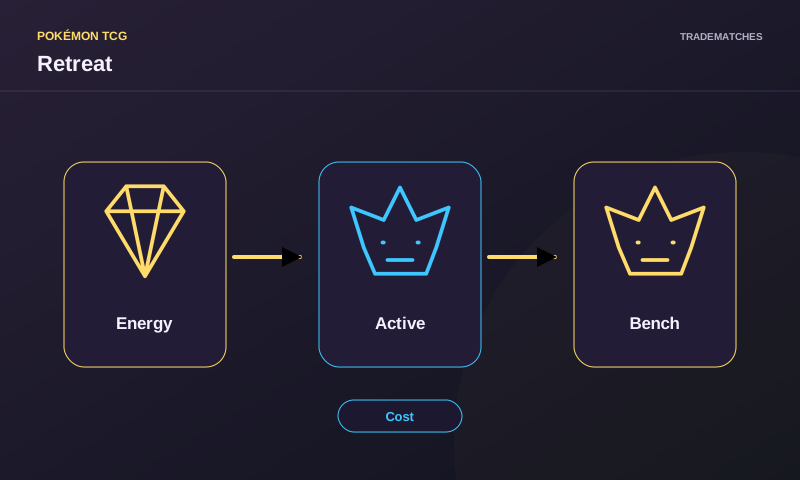
Retiring consists of replacing your Active Pokémon with one from the Bench during your turn. As a normal action, it is allowed once per turn and requires discarding Energy equal to the cost of the retirement printed on the card.
Pay before making the change
Look at the symbols of the cost of retirement on the Active card. If it shows two, discard two attached Energy cards to that Pokémon; if it shows none, the retirement is free. After that, choose a Pokémon from your Bench and switch them. If you don't have any Pokémon on the Bench, there is no substitute for this normal action.
Asleep and Paralyzed block the retirement
An Asleep or Paralyzed Pokémon cannot be retired by the normal action. Other states, such as Confused, do not prohibit it by themselves. When a Pokémon moves to the Bench, it loses its Special Conditions and the effects of attacks that affected it; the damage and attached cards remain.
Retiring is not any change
A card that orders changing Pokémon can function differently from the retirement action and has its own text. Do not automatically add its effect to the limit of a retirement per turn. For example, if you change via a card, check if you still can use your normal retirement and if the effect requires any payment.
The normal retirement step by step
Start by looking at the Active Pokémon, not the one you want to bring from the Bench. Its retirement cost appears at the bottom of the card and can be modified by other cards or abilities in play. Determine the applicable cost before discarding anything. Check afterward if the Active can be retired: Asleep and Paralyzed block it by default, and a card can add another restriction. You also need at least one Pokémon on the Bench to occupy the Active Spot. If any of these conditions are missing, do not announce the change as a normal retirement yet.
If the action is legal, discard the necessary Energy from the Active Pokémon to pay the cost. Then choose a Pokémon from your Bench and switch it with the Active. The unused Energy cards for paying, the Evolution cards, the Tools, and the damage counters remain with each Pokémon. Pay and the switch as a clear sequence; do not switch the cards first and then look for which Energy you wanted to discard. This visible order helps your opponent check that the cost was paid from the correct Pokémon.
How to read and pay the cost of retirement
The symbols of the cost indicate how much Energy you must discard from the Pokémon being retired. A cost of two requires discarding enough Energy to cover two units; it is not paid with Energy from the Pokémon entering from the Bench. If the effective cost is zero, you do not discard Energy, but you still perform your normal retirement of the turn. This last precision is important: a free retirement does not allow an unlimited number of normal retirements. The resource saved is Energy, not the limit of the action.
Special Energy cards can contribute more than one unit of Energy while attached, and their own texts can modify how they count. Do not assume that "two symbols" always equals "two physical cards" without reading the specific Energy. When discarding a card to pay, that card is completely removed; you cannot discard just half of a card that provides multiple units. If a ability reduces the cost, apply the effective cost first and then check what Energy you need to discard. When the result is zero, you do not need to have attached Energy just to announce the retirement.
Special conditions: who can retire
An Asleep or Paralyzed Pokémon cannot use the normal retirement. The prohibition applies to the affected Active Pokémon. Confused, Poisoned, or Burned do not block retirement by themselves, although their consequences may make it urgent to remove the Pokémon from the Active Spot. If a card adds an independent prohibition, read it in addition to the state. For example, removing Paralysis through an evolution can change the legality of a later retirement, as long as the evolution itself was legal and you still have available the retirement of the turn.
When the Active Pokémon moves to the Bench, its Special Conditions end. Remove the corresponding markers or right the card if it was face down to indicate a state. The damage counters do not disappear. If a Poisoned Pokémon already received damage between turns, it will still have that damage on the Bench even if the poison ends. The distinction avoids treating the retirement as a complete healing. The effects of attacks that affected that Pokémon also end according to the rules; for other effects, consult their source and exact text.
Retirement, card change, and other ways of moving
A card that says "change your Active Pokémon" produces a movement, but not necessarily using the normal retirement action. Follow the text of that card: it can choose differently, not require the cost of retirement, or function even when the Pokémon cannot retire normally. The word "change" does not automatically mean "retire." Therefore, if a card changed the Active, check if you still have your normal retirement available for later in the same turn. Conversely, having used the normal retirement does not necessarily prevent playing a change card later, as long as its text and other rules allow it.
The difference is especially important against Asleep, Paralyzed, or an effect that says the Pokémon cannot retire. That phrase blocks the retirement action; do not assume it prohibits all effects that remove the Pokémon from the Active Spot. Nor assume that any change card cancels all the table's restrictions. Read what specific action prohibits the effect and what exactly the card you want to play does. If there is no Pokémon on the Bench when the effect requires one, check how that instruction is resolved before choosing targets.
Practical cases to decide in a game
1. Cost two and exact Energy
Your Active Pokémon shows a retirement cost of two and has two basic attached Energy cards that provide one unit each. If there are no modifiers, you must discard both to use the normal retirement. The Energy of the Pokémon from the Bench does not help to pay. Once the change is made, the new Active can attack if it has the appropriate Energy and meets other requirements. The attack, if you do it, ends your turn; therefore, it is advisable to calculate beforehand if the change leaves a prepared attacker.
2. Cost zero
The Active does not show any retirement symbols or an effect reduces its effective cost to zero. You can retire without discarding Energy, if you have a substitute and there is no other prohibition. Nevertheless, you have used your normal retirement of the turn. If you want to change again later, you will need an effect that allows it; you cannot chain free normal retirements. This situation appears in strategies that frequently move Pokémon, so keeping track of the action used is as important as keeping track of Energy cards.
3. Paralyzed with a change card
The Paralyzed Pokémon cannot retire normally. If you have a card whose effect changes the Active, resolve it according to its own text and check if any additional restriction affects it. Do not pay the retirement cost by habit if the card does not require it. When moving to the Bench, Paralyzed ends, but the damage and attached cards remain. The play can temporarily save an attacker without spending retirement Energy, although it consumes the change card.
4. Poisoned with a lot of damage
The poison itself does not block the normal retirement. You can pay the cost, move the Pokémon to the Bench, and retire the Poison marker. However, you will keep all the damage that was already marked. If it is near its maximum HP, you will still need to heal or protect it before exposing it again. Retiring avoids future consequences of the condition while it is out of the Active Spot, but it does not erase what happened in previous checks between turns.
5. Empty Bench
Although the cost is zero and the Active has no conditions, you cannot use the normal retirement if there are no Pokémon on the Bench that can occupy its place. Before spending cards to reduce the retirement cost, check that there is a real destination. In a deck with few Basics, preparing a second Pokémon may be more important than finding a way to reduce the cost. The movement always implies that another Pokémon takes the Active Spot.
What to check before choosing the new Active
Retiring is not just escaping damage. Look at the attack cost of the Pokémon entering, the Energy it already has, its weakness against the opponent, and if it has a ability that requires it to be Active. Also check if the previous Active needs to keep its Energy to attack again later: paying the retirement can delay its next attack. A free retirement leaves more resources available, but it can still be a bad decision if the substitute does not threaten the opponent or is easily knocked out.
In a learning game, explicitly announce "using my turn retirement," show the cost, indicate which Energy you discard, and name the substitute. In a complex table, this communication avoids confusing a change card with the normal retirement. When multiple cards modify the cost or block actions, stop to read them before moving the cards. If you are playing in an event and the interaction is still doubtful, call a judge with the table in its original state; it is easier to resolve before discarding Energy or attacking.
FAQ
Can I attack after retiring?
Yes. The new Active Pokémon can attack if it meets the other attack requirements.
Does the damage get healed when moving to the Bench?
No. The damage remains even if the special conditions disappear.