PSA Reholder vs Review: which service do you need?
On this page
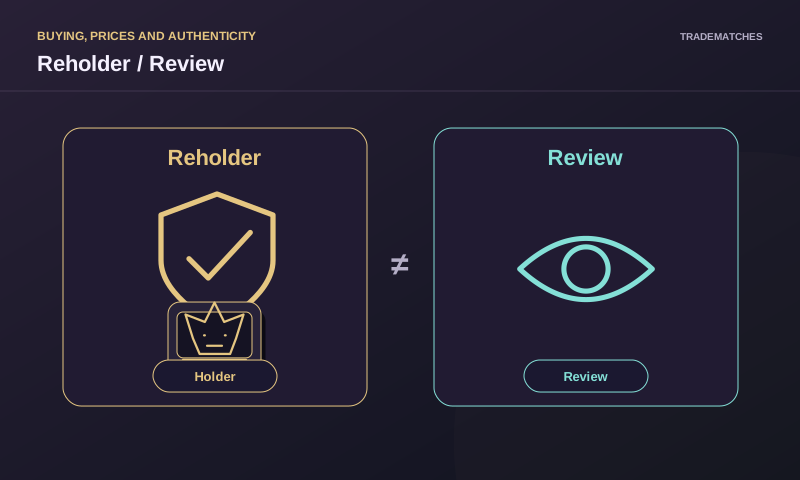
PSA Reholder primarily replaces the case and updates the label of a card already encapsulated by PSA. Review lets you request a reassessment of a grade you believe should be higher. Choose according to the problem you want to solve: scratched plastic and a disputed grade are different issues. Keep the card in its existing holder and read the current service conditions before submitting it.
The distinction that determines your choice
A worn holder can make a good card less pleasant to display. A grade you consider too low raises another question: you want PSA to consider whether the card deserves a higher assessment. Purchasing the wrong service does not turn one request into the other. Before preparing a submission, write down the result you want and compare it with the official description.
| Your objective | Service or route to investigate | Outcome you should not assume |
|---|---|---|
| Replace an old or superficially worn case | Reholder | A higher card grade |
| Request consideration for a grade increase | Review | A guaranteed upgrade |
| Resolve incorrect label information | PSA’s label correction route | That any paid service fixes the discrepancy |
| Address a broken holder or serious incident | Contact PSA and document its condition | Treatment as ordinary superficial wear |
This comparison uses PSA’s published service descriptions at the date checked. The eventual choice still depends on the item and its condition being eligible. If a shop uses “regrade” for every submission, ask which official service it means. An informal name can obscure whether the card stays encapsulated or someone intends to remove it before sending it onwards.
What Reholder covers
The official Reholder page describes replacement with PSA’s current holder and label. Generally, the grade, authentication result and certification number stay the same. Examples of suitable superficial wear include exterior scuffs and label fading. The service is not, by definition, a request for another point on the grading scale.
“Generally” is significant. PSA inspects the holder and label, checks their integrity and accuracy, and considers obvious errors or changes in the item’s condition. Reholder should not be advertised as an unconditional promise to preserve every grade. Its specific conditions address circumstances where damage, tampering or new information prevent an ordinary replacement on the previous basis.
For your collection, distinguish a mark on the plastic from a mark on the card. A scratch on the exterior can create a bright line across the artwork. Changing your viewing angle may help locate it, but a photograph does not always establish its depth. If the mark appears to be on the card itself, do not expect a new holder to make it disappear.
Reholder can make sense for presentation or consistency across stored items. That does not mean every older case needs replacing. A holder that serves its purpose and suits your collection can remain as it is. Consider the specific improvement you would obtain, whether your photographs explain the issue, and how much handling and transport the process entails from your location.
What Review offers
PSA’s Review description requires the card to be submitted in its current PSA holder. If it does not upgrade, the original label and grade are retained; the certification number remains the same. That is the useful distinction from cracking the case and submitting the item as an ungraded card.
The protection described for an ordinary review does not remove the general conditions covering tampered items, opened holders or authenticity problems. It also does not guarantee that PSA will share your visual assessment. Consult the relevant documentation if the card or case has suffered an incident. A request for a grade increase and an investigation into a damaged holder should be described accurately.
Before choosing Review, state your reason. Saying that a card looks attractive does not explain why its grade may be insufficient. Examine centring, edges, corners and surface through clear photographs without manipulating the item. If you cannot distinguish glare from a mark, acknowledge that limitation. An incomplete assessment does not become evidence simply because you repeatedly call the card a ten.
Comparison with another graded card cannot prove an error either. Different photography, reflections and less visible defects complicate the contrast. Use comparisons to identify what to examine, rather than calculate an upgrade probability you do not know. If personal satisfaction is your objective, you can recognise that without presenting the submission as a transaction with assured profit.
Three common situations
Imagine a card with the grade you wanted and a holder carrying superficial storage scuffs. Your aim is better presentation rather than a different card assessment. Reholder is the service to investigate. Photograph the wear and check for a fracture close to the item. If there is a more serious problem, contact PSA before treating it as a straightforward case refresh.
Now imagine an eight that you believe could deserve a nine, inside an intact holder. The objective fits Review. The outcome may still be an eight, so you need to be comfortable with paying without an upgrade. A flattering sales photograph is not a substitute for an honest inspection of the features that may have determined the existing grade.
Finally, suppose the set number or variant on the label does not match the card. Your problem is identification. Gather readable photographs and the certification number, then follow PSA’s applicable correction route. Do not request a grade review to resolve an incorrect description. Establish which detail is wrong and which procedure applies before arranging transport or purchasing another service.
Keep the existing holder intact
For Review, retaining the current holder is part of the stated eligibility. Opening it changes the situation. Do not remove the card to clean its surface, improve a corner or inspect a defect that is hard to see. Apart from changing the condition, you would lose the submission context of the previous assessment you intended to have reviewed.
Avoid aggressive polishing, solvents or homemade repairs to the plastic before documenting an issue. If the case has broken, photograph both sides and the affected area and ask PSA for instructions. Keep the item protected while waiting. The priority is to describe and preserve its received condition, rather than make the holder appear to have had no incident.
PSA’s Authenticity and Grade Guarantee has its own scope and exclusions. It is not universal cover for handling, transport or an expected resale value. If you believe an issue falls within that guarantee, consult its specific process. Explain whether your enquiry is about a claim or a routine purchase of services instead of treating the two as interchangeable.
Calculate the full submission cost
Compare the service charge with the complete journey. Include outward and return shipping, coverage for the item, applicable additional costs and any intermediary’s charge. Request a quotation separating those components. A per-card fee in US dollars does not establish the total you will pay in another currency to have the item delivered back to you.
Check the service level and maximum insured value appropriate for your card. Prices and estimated turnaround times can change, making the current page more useful than an old forum table. Do not arrange a sale with a fixed delivery date on the assumption that an estimated processing period is a guaranteed date for receiving the card at home.
For a collector submitting from Spain, the same calculation needs to cover the actual international route being offered. Ask the provider to identify any applicable charges rather than inserting a generic percentage into your estimate. Local availability of an intermediary does not, on its own, explain the transport coverage or which company takes responsibility at each stage of the journey.
If you use an intermediary, ask who submits the order, which service appears on it and how your card is identified throughout processing. Keep the quote and instructions. This does not require forecasting future appreciation: it establishes what you are buying and what happens if Review produces no upgrade or Reholder requires an additional assessment.
Check the card on its return
Before dispatch, retain photographs of the front, back, label and case, together with the certification number. On return, compare those details with the service documentation and consult PSA’s record. For Review, verify the reported result; for Reholder, inspect the presentation and identification. A fresh case does not replace that check.
If you find a discrepancy, document the packaging and received condition and report it through the specified channel within the current reporting period. Keep the earlier images as well. An orderly record lets you explain a change without relying on memory. In your inventory, distinguish a holder replacement from a grade change: they are separate events in the card’s history.
When preparing a future listing, state the grade shown and describe the holder’s actual condition. A recent case replacement does not mean the card was freshly assigned a higher grade. If an upgrade occurred, retain the service result for your records. Clear wording helps the next collector understand the item without requiring you to make unsupported claims about its market value.
Frequently asked questions
Does Reholder increase my card’s grade?
That is not its purpose. Its main function is to replace the holder and label of an already encapsulated item. The grade generally remains, subject to inspection and the service’s exceptions. If you want consideration for a higher grade, investigate Review and confirm eligibility.
Can I lose my grade through Review?
The official description preserves the original label and grade when an eligible card does not upgrade through an ordinary review. It must arrive in its current PSA holder. Conditions concerning damage, tampering and authenticity remain relevant; do not extend the description to an opened or altered case.
Should all older holders be replaced?
Not necessarily. Decide according to their condition, your display or storage preferences and the full submission cost. The age of a holder does not establish that the card needs another evaluation. If there is no specific problem or improvement you value, keeping it may be sufficient.