Riftbound Vision: looking and recycling without drawing
On this page
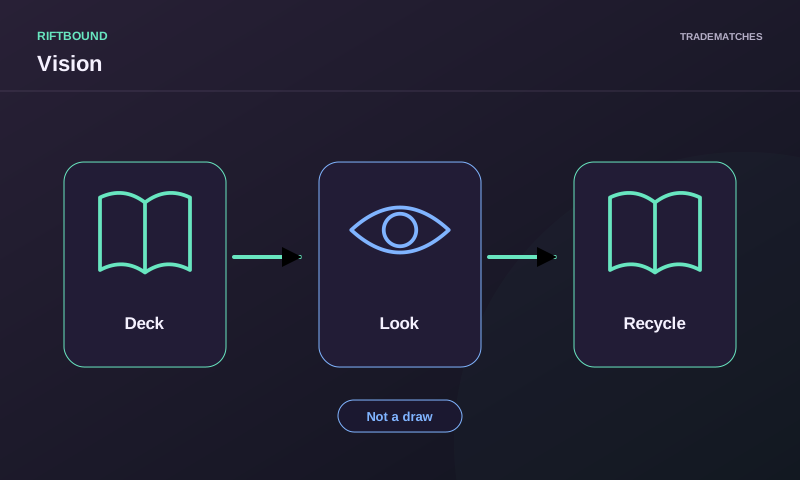
Vision in Riftbound is a triggered ability that lets you predict when the permanent enters the Board. Predict normally means looking at the top card of your Main Deck and choosing whether to recycle it. You do not draw that card, and several instances of Vision resolve separately rather than automatically showing several different cards.
The July 16, 2026 core rules use the action name “predict” in rule 817. Read that current wording alongside rule 436, especially if you learned the keyword from an older introductory description.
Start with the permanent's entry trigger
Vision is a triggered keyword present on permanents. Its shorthand describes predicting when the card is played, and the rules identify the trigger as the permanent entering the Board. That event is the starting point for the ability, not the beginning of every subsequent turn.
Having a permanent with Vision on the Board does not let you repeatedly inspect your deck whenever you want. Predict is a limited action: you perform it when a game effect instructs you to. The keyword supplies a particular triggered instruction rather than continuous permission.
If an unusual effect moves a permanent between locations, identify whether the actual movement satisfies the current entry rules. Do not assume every change of position is another entry to the Board. The precise movement and any card-specific instructions matter.
Predicting is not drawing
Looking at the top card gives you information. Drawing would move a card into your hand under the draw rules. Vision's ordinary predict instruction does not perform that movement, so your hand size does not automatically increase when you keep the card on top.
Likewise, an effect that reacts specifically to drawing is not triggered merely because you have looked at a card. Use the action actually performed. Informal phrases such as “Vision draws you a better card” can describe a tactical hope while giving the wrong rules explanation.
Suppose your hand has four cards and you resolve ordinary Vision. You inspect the top card and leave it there. Your hand still has four cards, and that card remains in the Main Deck. A later draw may take it, but that later action is separate.
Keeping the top card preserves the immediate information
If you choose not to recycle the inspected card, it stays on top. You can use the information when considering a later draw or effect that interacts with the top of the deck, provided nothing changes that position first.
A later shuffle, recycle interaction or other deck manipulation can invalidate the knowledge. Do not continue treating a previously inspected card as guaranteed to be next after an intervening effect changed the deck. Record the action sequence rather than only the first reveal.
The choice to keep is not a promise that the card will be useful by the time you draw it. You are deciding based on the current hand, resources and board. A future opponent response may change the value of a card you correctly chose to keep earlier.
Recycling is the alternative to keeping
If you do not want the top card in that position, Vision allows you to recycle it according to the game's recycle procedure. The action is not discarding it from your hand, putting it into the Trash or banishing it from the game.
Use the correct physical procedure and avoid leaving the card in an improvised side pile. A card moved to the wrong zone can create confusion about later effects that count, recover or inspect cards in that zone. The word on the instruction determines the movement.
Recycling also does not itself give you a replacement draw through Vision. You have changed the deck situation, but your hand does not automatically gain the new top card. If another effect later instructs a draw or a new predict, follow that separate instruction.
Two instances can inspect the same card
The current rules explicitly state that multiple instances of Vision trigger separately. Each gives its own choice about recycling. If you keep the top card during the first resolution and nothing intervenes, the next resolution sees the same card.
Imagine two pending Vision triggers and a useful card on top. You keep it with the first, then inspect that same card with the second. You have not looked two cards deep simply because there were two triggers.
If you recycle during the first resolution, the second resolves using the resulting deck state. It may offer a different decision, but do not make the next inspection until its own resolution permits it. Resolve the abilities sequentially instead of taking a two-card preview in advance.
| Instruction or sequence | What you inspect | What happens to your hand |
|---|---|---|
| One ordinary Vision | Top Main Deck card | No automatic card added |
| Two Vision triggers, keep first, nothing intervenes | Same top card again | No automatic card added |
| Two Vision triggers, recycle first | Top card in the resulting state | Still no automatic draw |
| Explicit Predict 2 instruction | Two available top cards together | Looking remains distinct from drawing |
Predict 2 is different from two ordinary predictions
Rule 436 describes predicting more than one card at once. You look at the specified number, recycle any number of them and put the remaining cards back on top of the Main Deck in any order. That is not the same procedure as resolving two ordinary one-card Vision triggers.
The simultaneous information can support a different choice. With Predict 2, you can see both cards before deciding which to recycle and how to order those you keep. With separate predictions, your first choice happens before the second inspection.
Read the actual number in the instruction. When no number is supplied, the rules presume one. Do not upgrade ordinary Vision to Predict 2 because a permanent has the keyword twice or because you remember another card with a larger prediction effect.
A short deck does not turn predicting into Burn Out
If instructed to predict more cards than remain in your Main Deck, predict as many as possible. The current rules state that this shortage does not cause Burn Out as a result of predicting.
For example, an explicit Predict 3 with only one card available lets you inspect the available card under that instruction. It does not create two imagined cards or automatically execute the draw-shortage procedure. Other actions later can still have their own consequences.
Keep this exception narrow. It describes the predict action, not every interaction with an empty or short deck. If a later instruction tells you to draw, apply the draw rules then rather than assuming Vision's short-deck treatment also governs that different action.
Decide using a concrete next-turn need
When evaluating the inspected card, ask what it contributes to your current plan. A playable answer to the present board can be more useful than a powerful card you cannot use soon. Alternatively, a longer game plan may justify keeping a card that supports a later turn.
These choices depend on the deck and situation; Vision does not provide a universal list of cards to keep. Consider your hand, accessible resources, expected timing and whether another effect is likely to move the top card before you can draw it.
Avoid describing every recycle choice as correcting a mistake in deck construction. A well-built deck can contain cards with different roles, and their usefulness changes during a game. Vision lets you evaluate one relevant piece of information at a particular moment.
Respect hidden information while resolving
Looking at a card is not the same as revealing it publicly. Follow the instruction about who may inspect the card and do not announce or display hidden information unless the effect requires it. Keep the physical deck organized while making the choice.
If you accidentally reveal extra cards, stop and use the event's appropriate correction procedure. Do not quietly reorder them to manufacture the outcome you wanted. At a tournament, a judge can assess the information and fix the situation under the applicable policy.
For practice, use face-up sample cards so both players can see the intended procedure. Once comfortable, repeat the exercise using the proper hidden-information handling. This separates learning the decision process from learning how to move cards cleanly during a game.
Use a resolution log for complicated sequences
Record each pending Vision trigger, the card inspected at its resolution and whether it was recycled. Add any intervening shuffle, draw or other manipulation. That log explains why a later trigger may inspect the same card or a different one.
It also prevents an older observation from being treated as current deck knowledge. “I saw this on top earlier” is incomplete if another effect subsequently moved cards. The last relevant action is what determines the top card for the next instruction.
Consult the current rules hub when a card combines Vision with a special entry or deck effect. The general keyword explanation supplies the normal procedure, while the exact card can add conditions or instructions that change the sequence you need to follow.
Frequently asked questions
Does Vision put a card into my hand?
Not by itself. Its predict instruction lets you inspect and optionally recycle; drawing is a separate action.
Do two Vision instances automatically show two different cards?
No. If you keep the first card and nothing intervenes, the second instance sees the same top card.
Does predicting with too few cards cause Burn Out?
No. Rule 436 says to predict as many cards as possible without performing Burn Out as a result of that predict action.