Riftbound: Recycle, Trash and Banish explained
On this page
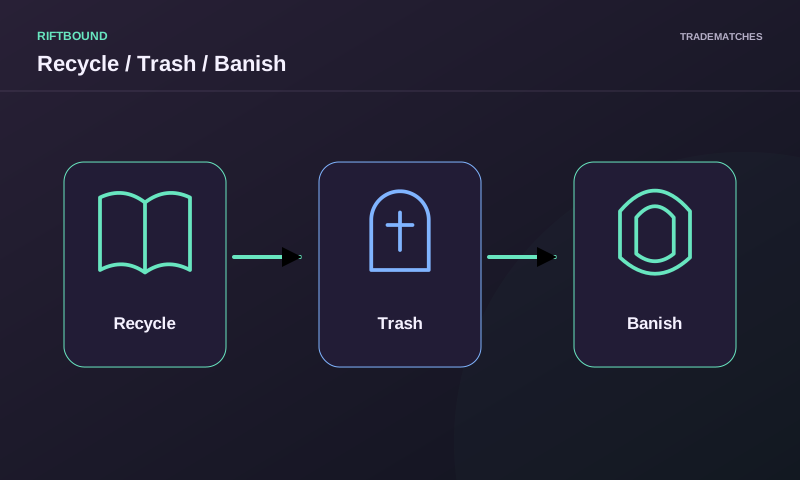
In Riftbound, Recycle puts cards on the bottom of their corresponding deck, trash is a zone holding cards sent there through particular procedures, and Banish moves a card to banishment. These are not three names for one destination, nor do they grant interchangeable recovery permissions.
For an instruction, check the origin, destination and whether the movement is a cost or an effect. Recycling a rune does not put it under the Main Deck. Banishing a unit is not killing it, and having cards in your trash does not let you recycle them whenever you choose.
Actions and zones are different concepts
Recycle is an action whose result places a card in a deck rather than its original zone. Trash is a zone, not a universal instruction to recover or remove cards. Banish is another action, with banishment as its destination.
That distinction helps avoid treating Discard, Kill and Banish as interchangeable translations of removal. They can operate from different origins and cause different consequences even when the card stops being available on the board.
An effect can require recycling from the trash, but it can also specify another origin. Do not silently add “from the graveyard” to every Recycle instruction. Use the zone identified by the actual cost or effect being resolved.
A card in banishment is not also in the trash. An effect recovering a card from your trash does not automatically gain permission to search banishment. Recovery difficulty follows specific permissions rather than the fact that both zones are outside the board.
Recycle's precise destination
Rule 416 of the core rules places recycled cards on the bottom of their appropriate deck. Main Deck cards go to the Main Deck, while runes go to the Rune Deck. Keep the two decks separate throughout the movement.
Cards return to their corresponding own deck regardless of which player is instructed to perform the action. Controlling a card or executing an effect does not turn an opponent's card into part of your deck. Establish ownership before mixing physical materials.
Recycle does not ordinarily shuffle the whole deck. Placing one card underneath does not reorder the other cards. An effect can explicitly instruct a shuffle, but that additional instruction must exist rather than being imported as a habit from another game.
When two or more cards are recycled simultaneously to the Main Deck, their order on the bottom is random. For multiple runes recycled simultaneously to the Rune Deck, their owner chooses the order. This explicit difference can matter to later instructions.
| Movement | Destination | Relevant ordinary order |
|---|---|---|
| Recycle one Main Deck card | Bottom of its own Main Deck | One card; no whole-deck shuffle |
| Recycle several simultaneously to Main Deck | Bottom of its own Main Deck | Random order among those cards |
| Recycle several runes simultaneously | Bottom of their own Rune Deck | Owner chooses their order |
| Banish | Banishment | Not the bottom of either deck |
Recycle as a cost versus an effect
When recycling is part of a cost, you must be able to complete it to pay. Do not announce an activation requiring three eligible cards when only two exist in the required zone. Part of the cost does not purchase a proportionate part of the ability.
The rules use Vi, Destructive as an example: its ability requires recycling one card from the trash to receive the stated increase. With an empty trash, you cannot pay that cost and activate it through that procedure. A promise to recycle later does not repair the missing payment.
When recycling is part of an effect, do as much as possible under that instruction. If it instructs three eligible cards from the trash and only two exist, recycle the available two. That resolution rule does not transfer to a cost requiring complete payment.
Before acting, locate the requirement within the full text. Cost wording and resolution wording can look similar while performing different jobs. Read the separators and entire ability instead of treating every number beside Recycle as an optional choice.
The rules also explain that the ordinary instruction to recycle X from a zone does not target the recycled cards. Do not automatically import the procedure for a spell choosing a target. A separate selection elsewhere in the text needs its own check.
Understanding the trash
The trash holds cards arriving through procedures such as discarding, killing permanents or resolving particular spells. The route matters. A unit card discarded from hand has not necessarily been a unit that died on the board.
Trash cards are public information, and their order does not ordinarily determine which card you may recover. Arrange them for visibility while keeping ownership and zone boundaries clear. Reorganising a zone does not authorise movement out of that zone.
An effect watching whether a unit died needs that actual event. Do not trigger it solely because a unit card appeared in the trash through another procedure. The destination alone does not establish how the card arrived or which abilities should react.
Recovery depends on the text granting it. An instruction may require a unit, a card meeting a condition or a specific quantity. A large trash does not let you ignore these requirements or choose a card that is actually in another zone.
What Banish does
Banish moves a card directly from its origin to banishment. Rule 427 distinguishes it from Kill and Discard. Banishing a permanent therefore does not automatically produce every consequence of killing it, while banishing a hand card is not automatically discarding it.
Banishment is public and unordered. It can represent a harder-to-recover destination or a temporary holding space while an effect is processed. It does not mean every banished card must be inaccessible for the rest of the game.
Specific text can refer to a card that the same object banished and describe a later movement. Preserve that association. Permission concerning one linked card does not authorise recovering any other banished card of your choice.
When two separate effects banish cards, distinguish their associations. Another copy with the same name does not automatically inherit every card banished by an earlier copy. The connection can belong to a particular instance of the object or effect.
If a permission lasts for a specified period, keep that duration separate from the zone itself. Remaining in banishment does not preserve an expired permission indefinitely. Read the full instruction before attempting a later recovery or play.
Three practical distinctions
First, an ability requires recycling two cards from your trash as a cost. You have one card there and another in banishment. Those two cannot pay together: one is in the wrong origin. Both quantity and zone must match, rather than merely owning two off-board cards.
Second, an effect instructs you to recycle two available runes from the specified zone. Put them under the Rune Deck in the permitted order. Do not put them under the Main Deck or combine both decks because each contains cards capable of being recycled.
Third, an effect banishes a unit. Do not move it through the trash first for convenience. The movement is direct to the specified destination. Inserting a nonexistent intermediate step can make you apply an ability to an event that never happened.
These are rules examples rather than recommendations for a competitive list. Check card legality separately when building a deck. Understanding a rulebook's ability example does not establish that every printing is permitted in every event.
Tokens and physical organisation
Tokens have special treatment after leaving the board. When moved to a Non-Board zone other than the Chain, they cease to exist after movement. Do not store a token reminder in the trash as though it were a recoverable card.
A recycled token likewise does not remain as a deck card. It follows the destination corresponding to its type and then ceases to exist under token rules. Remove the physical reminder so it cannot appear in a later draw as material that never belonged in the deck.
For ordinary cards, keep trash and banishment visibly separate. Where an effect links a banished card to its source, use an arrangement preserving that connection. The board should communicate the information needed for later permissions without hiding public cards.
Announce the origin and destination when performing a movement likely to be confused. “Recycle these two from trash to Main Deck” is clearer than simply removing them from the pile. Clear statements help the opponent follow the distinction without relying on where your hand happened to place a card.
Frequently asked questions
Does Recycle shuffle the entire deck?
Not by itself. It puts cards on the bottom of the corresponding deck. Several cards recycled simultaneously to the Main Deck are randomised among themselves, but that does not mean shuffling the cards already inside.
Can I pay Recycle 3 with only two cards?
Not when it is a cost requiring three eligible cards. When it is an effect instruction, apply the rule of doing as much as possible. Establish the instruction's role in the full ability before choosing how to resolve it.
Is a banished card permanently lost?
Not necessarily. Some effects authorise later movement or use banishment temporarily. The permission must actually exist and concern the relevant card. An ability mentioning only the trash does not retrieve a card from banishment.