Deploying a Leader in Star Wars: Unlimited
On this page
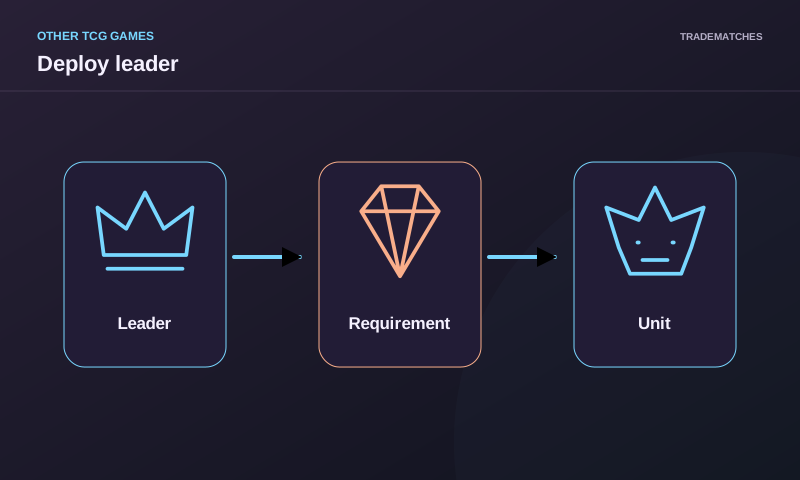
The leader of Star Wars: Unlimited starts on its horizontal side, under the base. When you meet the resource requirement of its epic action, you can spend an action to deploy it as a unit.
Read the specific leader's requirement
There is no universal number of resources for all leaders. The threshold is on the card and the epic action is used once per game. Having the necessary resources does not obligate you to deploy immediately: perhaps it is better to do another action first and preserve the surprise or protect the base.
When you deploy, it becomes a unit
Rotate the leader to its unit side and place it on the indicated arena according to its text and rules. The official guide describes that it enters prepared, so it can influence immediately if its other requirements are met. Do not treat the deployment as playing another card from your hand or paying an printed cost that the action does not require.
If it is defeated, it is not re-launched
When the deployed leader is defeated, it returns to its horizontal side. Its epic action has already been consumed, so you normally cannot deploy it again in that game. For building the deck, this is a good reason to check when it reaches its threshold and what units or Events will help during that decisive turn.
What does "deploying" the leader mean
The leader of Star Wars: Unlimited starts on its horizontal side, next to the base, with a different function than when it is a unit. Its epic action allows you to deploy it when you control the amount of resources indicated on its card. When you do so, it becomes a unit and enters the corresponding arena. It is one of the most important moments of the game because it adds a unit without robbing it from the deck. Do not confuse it with playing a regular unit from your hand: the leader was already available from the beginning and its epic action has a restriction of once per game.
The resource requirement is not a universal number. A leader can require a different amount from another, and the text of each card can introduce nuances. That is why it is not enough to remember "leaders come on turn four" or a similar rule. Look at the number and instructions of your copy. Counting the resources you control does not automatically mean you must exhaust them to pay that number: the deployment action is governed by its text, which normally establishes a threshold of resources, not the printed cost of a unit from your hand.
Controlling resources is not paying them
This distinction avoids a common error. If your leader's deployment says you must control six resources, check how many resources you have in play. Do not interpret routinely that you must exhaust the six to activate the epic action. The text of the leader decides the requirement and any additional cost that may exist. A player coming from other games may see a large number and assume it works as the cost of a card played from the hand. In Star Wars: Unlimited, it is better to read the full phrase before moving resources.
Imagine you control five resources and the leader requires six: you still cannot use that action under normal rules. When you reach six, you get the possibility, not an obligation. You can perform another action in the phase and wait for a later opportunity if the table's state suggests it. If an effect temporarily changes the number of resources you control, check the condition again when activating. Do not substitute the card's text for a "round expected" calculation.
The epic action is used once
Epic actions are limited to once per game. Once you deploy your leader, mark it mentally or with the card's status that this opportunity has already been used. If the leader unit is defeated and returns to its horizontal side, you cannot deploy it again with the same epic action in that game. It may retain other functions indicated by its horizontal side, but the spent action does not reset. This rule influences the timing of risking it: deploying too early can expose you to losing the unit when you still needed its presence.
For example, you deploy the leader on a table where the opponent has several units ready to attack. Its entry can offer a strong play, but it also gives the opponent a clear target. If it is defeated, you recover the card in the configuration marked by the rules, not a second opportunity to deploy. The correct decision depends on the pressure on the bases, the arenas, and what you can do immediately with that unit. The rule of once makes the risk more important than in a card you could simply redraw.
Deploying consumes your action
During the action phase, players alternate actions. Using the epic action to deploy is the action you choose in that turn of action, so the opponent gets the next opportunity to act according to the normal sequence. Do not deploy, play a unit from your hand, and attack as if it were a single free action. If the leader enters ready, that describes its state; it does not eliminate the alternation. The possibility of attacking later depends on when the turn returns to you, the arena, and the applicable rules for that unit.
Before announcing the deployment, ask yourself what the opponent can do immediately. If they have an obvious response, perhaps it is better to do another action first. If you need the leader to help close the game, perhaps it is better to take the risk now. The exact moment depends on the board, but the regulatory procedure is clear: check the requirement, announce the epic action, turn the card to the unit side, and continue the alternation. Thinking about the opponent's action avoids timing errors.
Place the leader in the correct arena
When deployed, the leader becomes a unit and enters the arena indicated by its card and the rules. Do not leave it under the base as if its unit text already functions from there. Nor place it in a different arena because there you have better attacks. Arenas are part of the interaction in Star Wars: Unlimited: a unit from one arena is not automatically treated as a unit from another. Verify the unit side and place it before calculating attacks, abilities, or protection.
The entry status is important. The official explanation of initiation indicates that deployed leaders enter ready, unlike many regular units. This can open a subsequent action in the same phase, but not an additional instant action upon deployment. If a particular card modifies how it enters or what it can do, apply that text. When preparing a plan, separate "ready" from "I can act with it now without giving a turn." They are different statements.
How does it affect the resource plan
A simple way to plan is to read the threshold of your leader when building the deck. If you need to reach a specific number, evaluate how many rounds you can develop resources regularly. Reserving a card as a resource in the regroup phase often brings you closer to that moment; deciding not to do so can delay it. This does not mean you always must place a card in resources: sometimes you need it in your hand. It means the deployment should not surprise you for not having counted the requirement in advance.
The choice of the leader also relates to the curve of other cards. If you plan to deploy as soon as you reach the threshold, you might want to have subsequent actions that benefit from its presence. If your deck needs an important card in that round, you will have to choose the order of actions against the opponent. Do not confuse controlling six resources with having six available to spend on another card: the "ready" or "exhausted" status and the control requirement are evaluated differently. Read each cost and each condition separately.
Two possible moments scenario
You have enough resources at the beginning of your opportunity to act. You can deploy now, before the opponent develops more board, or play a card from your hand and leave the deployment for later. In the first plan, you ensure the leader's presence earlier, but expose its unit to the next opponent's action. In the second, you preserve the surprise and may provoke a response from the opponent, but you risk the situation changing and making deployment no longer beneficial. Neither option is automatically correct. The important thing is that the rule allows you to decide when to use the epic action once the requirement is met.
If a player says to you, "you should deploy as soon as you had resources," ask them to point out the phrase that forces you to do so. The threshold grants permission, not a forced action. Similarly, do not expect the leader to deploy at the start of a round without spending your action opportunity. The decision is part of the strategy and the turn exchange, so it is better to announce it clearly.
Common errors
The first is using a numerical requirement learned from another leader. The second is exhausting resources that the deployment only requires control of. The third is deploying twice after the unit is defeated. The fourth is treating the action as free and doing another immediately. The fifth is placing the unit in the wrong arena. To avoid them, read both sides of the leader, mark if the epic action has already been used, and indicate the arena before proceeding. These are five quick checks that avoid almost all usual initiation disputes.
If a new set introduces a leader with exceptional text, apply its writing and the complete current rules. This guide explains the general sequence; a particular ability may add conditions or effects. Before buying a deck focused on that leader, check its real threshold and test in which round you usually reach it. This way you evaluate the card by the game you actually play, not by a vague expectation of "it comes early."
Common questions
Is it mandatory to deploy as soon as I have resources?
No. You can choose the moment to spend the action as long as you continue meeting the condition.
Can I deploy it twice?
No through its normal epic action; it is one use per game.