Hyperspace vs Showcase in Star Wars: Unlimited
On this page
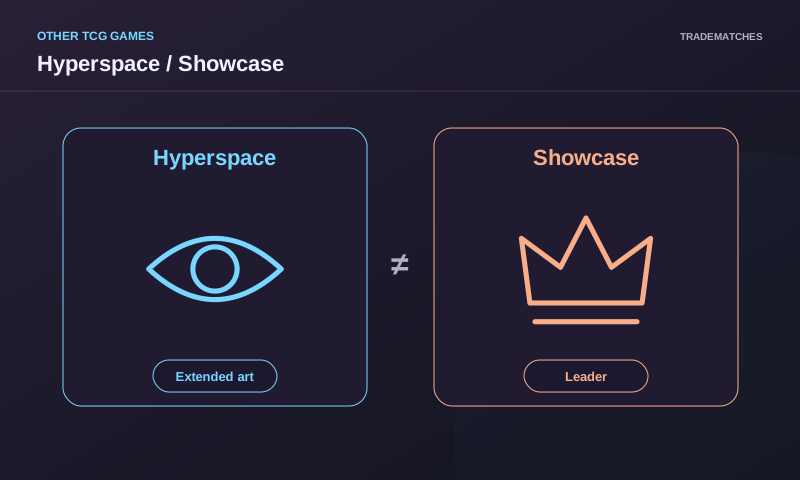
In Star Wars: Unlimited, Hyperspace is an alternate frame that shows more of the same card’s artwork. Showcase is a special Leader variant with different art, frame and treatment. A Hyperspace card may be foil or non-foil; “foil” describes shine rather than a third rarity.
Three questions to identify a copy
- Is it a Leader, Base or another card? The official Showcase explanation concerns Leaders, while Hyperspace can appear on different card types.
- Is it the same art with a more open frame? That points toward Hyperspace. Alternate Leader art with its own frame calls for a Showcase check.
- Does it have a shiny finish? Record foil separately. Hyperspace foil exists, so “Hyperspace” alone may not describe the whole version.
Do not identify a card by old pack odds
Fantasy Flight has changed product composition over time. Pull rates and slots from launch boosters do not necessarily describe 2026 packs. Identify the physical printing and consult the guide for its exact set and product. Prestige variants and organised-play promos also exist; do not force them into either category in this comparison.
How to list or request a variant
Write “name, set, number, language, normal/Hyperspace/Showcase and foil/non-foil” as applicable, plus condition and photos of both sides. For example: “Leader X, Showcase, Spanish, tilted front photo showing finish.” An aesthetic variant does not change the card’s game rules, but it may greatly change which printing a collector wants.
Separate card, variant, and finish
When two people say "the same card," they may be referring to the same game text and different physical objects. In Star Wars: Unlimited, it is advisable to register three separate data points. First, the identity of the card: name, set, number, and whether it is a Leader, Base, or another type. Second, the visual variant: standard print, Hyperspace, Showcase, or another documented version. Third, the finish: with bright foil or without it, when that combination exists. A buyer who asks for "Hyperspace" might accept a copy without foil; another specifically seeks Hyperspace foil. Writing both attributes avoids a beautiful photo or a brief description replacing the precise reference.
The official guide for the first inserts describes Hyperspace as a variant with an alternate border that reveals more illustration. It also explains that an insert could contain a Hyperspace copy in different spaces, even in the foil space. Therefore, Hyperspace and foil are not synonyms. The visual category and the bright treatment are independent questions. Later product compositions changed, so you should not deduce a card's version based on its position when opening a specific insert, nor apply old extraction numbers to a current expansion.
How to recognize Hyperspace in hand
Place the card next to an official image of the standard print of the same set. Look at the border before the shine: the Hyperspace version opens more space for the illustration, while the game text of the equivalent card maintains its function. Verify the name, number, and set icon. Seller photos may be cropped or show cases with reflections; request a full front view where the corners and edge of the design are visible. If the image only shows the center of the illustration, it does not allow for proper verification of the variant.
After that, tilt the copy under uniform light to know if it is foil. A front photo can hide the shine, and a plastic reflection can simulate it. Request two images of the real card, one front without filters and another slightly tilted, plus the reverse to evaluate the condition. Do not use a catalog photo as proof of the copy's finish. When you are only organizing your collection, you can temporarily mark it as "Hyperspace, foil pending confirmation" until you see the card out of the case or with proper lighting.
What makes Showcase different
Showcase was introduced as a special variant of Leader with alternative illustration, singular border, and its own foil treatment. The verification starts with the type of card: if someone calls Showcase a Base or a regular unit, request the official link of that print before assigning it to that category. A Hyperspace Leader card remains Hyperspace; it does not become Showcase because it is a Leader, because it shines, or because it is hard to find. Identify the art and border of the specific print in the set's catalog.
For a collecting purchase, the difference can be decisive. Two versions of the same Leader allow the same function, but a collector who completes Showcase will not replace that piece with Hyperspace foil. In the announcement, avoid phrases like "Showcase Hyperspace" unless the publisher describes it specifically; these are categories that require checking the real reference. Nor assume that every premium-looking card is Showcase: there are promotions, Prestige variants, and organized game prizes with their own design. The commercial name of the variant must come from an identifiable source.
A five-step identification method
First, locate the full name and printed number; several cards of known characters may share part of the name. Second, identify the set through its symbol or code, without relying solely on the language of the announcement. Third, compare art and border with the gallery or official guide of the product to classify the version. Fourth, verify the finish with side light and photos of the physical copy. Fifth, evaluate the condition of the front, back, edges, and corners. This order separates identity issues from conservation issues and avoids discussing prices of a variant that has not yet been confirmed.
Save the results in a list of four columns: card, set/number, variant, and finish. Add language and condition as additional fields. If a data is missing, leave it blank instead of completing it by intuition. A honest list of "variant to be verified" causes less confusion than one that assigns Showcase to every visually appealing copy. When exchanging, agree whether the transaction depends on a specific variant and request photos before fixing the value of the set. Once the card is received, compare the print with those images and keep the conversation open until both parties confirm the exchange.
The frequency of inserts changes with the product
The first official articles explained how these variants appeared in the inserts of the release. A subsequent communication announced changes in the distribution: more guaranteed presence of Hyperspace and Hyperspace foil in certain products and the elimination of a foil class with a normal border in those future inserts. This illustrates why a historical number is not a universal identifier or an automatic valuation. The probability depends on the expansion and the product, and there may be reprints or promotions outside the standard insert. For a specific card, consult the official publication of its set and the product it comes from.
A rare extraction does not guarantee perfect condition or authenticity. Before paying a premium for a Showcase, review detailed photos and reasonable provenance; if the value is high, agree on appropriate shipping protection. When selling, describe what you can demonstrate: variant, language, code, and visible condition. Avoid promising "one out of many inserts" if the calculation comes from an article from another era. Buyers need to know exactly which example they will receive, not a probability estimate that may no longer apply to this expansion.
Example of an announcement and search list
A useful announcement can say: "Leader [full name], [set and number], Showcase according to the official gallery, Spanish language; real photos of the front inclined and reverse; visible defect in the upper corner." If the card is Hyperspace, indicate additionally "foil" or "without foil" after verifying it. If you do not know the finish, write "foil to be confirmed" and provide clear images. Do not use the word "mint" as a substitute for photos: variant and condition are separate data. If a brand or scratch is only visible when tilting the card, add that image instead of leaving it to appear after the exchange.
In your wish list, you can distinguish between play priority and collection priority. "Any legal print of this Leader for playing" opens more options than "only Spanish Showcase without marks." Both requests are valid, but they do not lead to the same exchange. Specify which attributes are mandatory and which are negotiable. If you accept Hyperspace non-foil as an alternative to a normal copy, state it explicitly. For premium cards, compare the specific photo with the set's catalog before evaluating the transaction. Accuracy saves time for the other person and avoids receiving a version that, although beautiful, does not complete your collection.
Before closing the exchange
Confirm in writing the identity, variant, finish, language, and condition; then decide if the price or the offered cards are still meaningful. If the seller cannot show the code or the complete border, delay the classification. An additional photo usually resolves the doubt better than a discussion about terms. Note the exact variant in your inventory when it arrives and do not combine normal copies, Hyperspace, and Showcase under a single entry if your goals are collection-based. For playing, they may be equivalent in function; for exchanging, they are not.
Frequently asked questions
Can a Leader be Hyperspace without being Showcase?
Yes. Hyperspace is a different treatment; Showcase has its own alternate art and frame.
Does Hyperspace mean foil?
No. Hyperspace describes the frame and may also come in foil.