Star Wars: Unlimited Exploit: reducing the cost
On this page
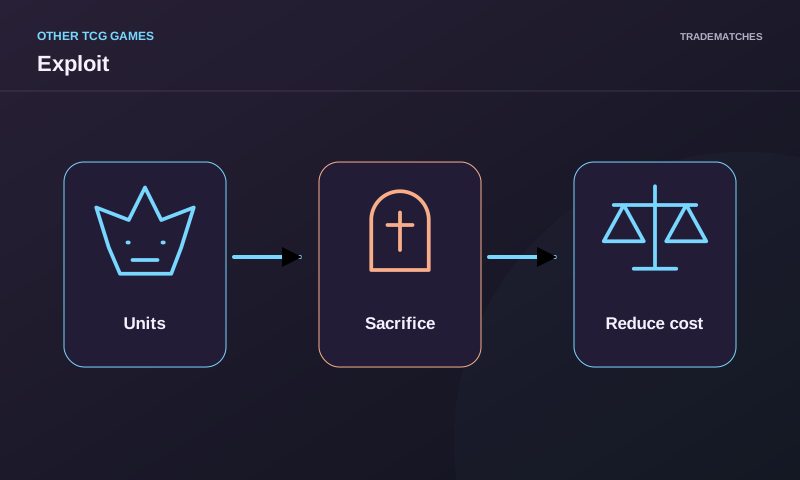
Exploit, called Sacrificio in the official Spanish explanation of Star Wars: Unlimited, allows you to defeat your own units to reduce the cost of a card. Each unit used reduces that cost by two, to the maximum indicated by the ability. It is optional: having Exploit 2 does not force you to lose two units nor does it allow you to sacrifice rival units.
Read the ability number
The number accompanying Exploit indicates how many units you can use at most. With Exploit 2, you can choose none, one or two if you have legal units under your control. It does not describe a total reduction of two resources. The reduction is obtained per unit: one provides two reduction and two contribute four.
That is why, before paying, distinguish the limit of units and the reduced amount. An annotation such as "Exploit 2 = minus two" may result in an incorrect account. Write, if you need it to learn, chosen units multiplied by two. Then apply that amount to the corresponding cost, taking into account the other elements of the calculation.
An example without aspect penalty
Consider a card whose applicable cost is seven and which has Exploit 2. Without using units, you need to pay seven resources. If you use one of your own units, the reduction is two and five are left. If you use two, the reduction is four and there are three left. The decision depends on your available resources and the value of the units you would have to defeat.
Being able to pay three doesn't mean the play is always good. If you deliver two units capable of attacking several times in the following turns, you have also paid with a board presence. The correct comparison includes the cost of resources and the strategic cost of these units. The ability offers a way to play a card earlier, but does not render the chosen units worthless.
The aspect penalty also matters
Check your aspects before counting the reduction. A card may have an applicable cost higher than its printed value because of aspect penalties. The official explanation shows that Exploit can reduce the resulting cost, including such penalties. Do not treat it as a restricted discount to the figure in the corner of the card.
If a card with printed cost seven has a penalty of two, the starting point of the example will be nine. One unit used leaves seven and two leaves five, assuming there are no other modifiers. You can write "7 + 2 − 4 = 5" to check the calculation. The conceptual order consists of knowing all the cost and reduction available, not forgetting the aspect because you will sacrifice.
A reduction does not produce new resources
Reducing a cost below what you would have to pay does not add the difference to your resources. If the applicable cost is three and a reduction allowed reduces it by four, you do not receive a resource as change. The payment of resources can be zero; it does not become a negative number that finances another card.
That helps decide how many units to use. If you can pay the remaining difference with resources, it may be preferable to keep one unit instead of sacrificing another whose discount you no longer need. Don't look for the maximum ability automatically. Find the combination that allows you to play the card and keep the best possible status after payment.
Only units under your control
The ability uses units that you control. You cannot point out an enemy unit as payment and describe it as a capture or withdrawal of the opponent. Nor can you replace a unit with an upgrade, a hand card, or a resource just because they have a character illustration. You must meet the category and area required by the procedure.
Unit tokens can be candidates when they are units under your control. The official explanation presents that relationship with unit tokens, but that does not make any marker a unit. Ensure that the token represents a real object created by a rule or card. A die used to track experience is not a unit available for Exploit.
Defeat has consequences
Exploit defeats the chosen units. It does not return them to hand to play again or keep them exhausted on the table. Your improvements and any abilities related to defeat need the corresponding resolution. Check these interactions in the current text of the cards and in the rules, especially if several consequences appear during payment.
For a first game, announce the chosen units and the final cost before moving them. So the opponent can check the calculation and recognize what is happening. If a combination depends on an ability triggered by being defeated, do not presume a sequence of resolution by intuition. Resolve payment and abilities in the windows that actually correspond; the new unit does not exist on the table before its entry is completed.
Do not confuse payment with later effect
A card can enter and then have its own ability. Exploit is part of how you pay to play it; it is not a later order to defeat units when it is already in play. This separation affects what units you can count on and what information you use during selection. Do not count the unit you are trying to play as if it were already on the board to pay for its own entry.
Another mistake is to announce the card, spend all resources on a different action and then claim that it will be compensated with Exploit. Each action needs to legally complete its costs when appropriate. Keep the decisions separate and verify that you can satisfy the payment of the specific card before starting the procedure.
When to keep a small unit
A unit with few statistics can contribute more than its attack: an ability, a presence in a given arena, or a threat that forces the rival to spend an action. Before using it, ask what you lose on the next turn. If you only value their current statistics, you could deliver a piece that supported the whole table plan.
On the other hand, a unit that can hardly influence later can be a reasonable payment to access a decisive card earlier. Compare complete positions. In one, you keep the two units and play a cheaper card; in another, you defeat them and enter the card with Exploit. You don't need a perfect prediction: just recognize which actions and defenses are still available in each option.
How to test the ability in a deck
Practice with a fixed hand and table. Count available resources, calculate the cost without Exploit and test each legal amount of units. Write down which cards you can play next and how many useful units are left. This exercise teaches more than memorizing "the tokens are free": creating a token may also have consumed a previous card, action or resources.
When looking for copies for the deck, check the Exploit number and the exact card aspects. Two units of the same character can have different functions. An alternative illustration does not justify a different account if it represents the same card, while a similar name also does not guarantee that they share ability. Complete identity avoids purchases based on an incomplete summary.
Count the full cost before selecting units
For a hypothetical example, a card costs seven resources and an aspect penalty adds two. Start from nine. If its Exploit value permits defeating two units and you use both, the four-resource reduction leaves five to pay, assuming no other modifiers. Starting from seven would ignore part of the cost. This demonstrates the calculation rather than describing a named card or suggesting every card permits two sacrifices.
Compare that play with keeping the units and paying the full cost. One may be your only presence in an arena or have a valuable action remaining. Even a cheap token stops contributing after it is defeated. Evaluate resource savings alongside the loss of board presence.
If you want to reduce a cost to zero, first check the maximum number allowed by the ability and the units you actually control. You cannot add opposing units or defeat more than permitted to create spare resources. Complete the calculation before announcing your selection. A cost reduction helps pay for that card; it does not create an extra resource reserve for the next play.
Frequently asked questions
Are Exploit and Sacrificio different abilities?
In this context, they are the English and Spanish denominations of the same ability. Retain the number that appears next to it when comparing texts.
Does Exploit 2 require defeating two units?
No. You can use up to two. One reduces the cost by two; two reduce it by four, if you can choose them legally.
Can I use rival units?
Not as payment for this ability. They must be units under your control that comply with the procedure.