Star Wars: Unlimited aspect penalty explained
On this page
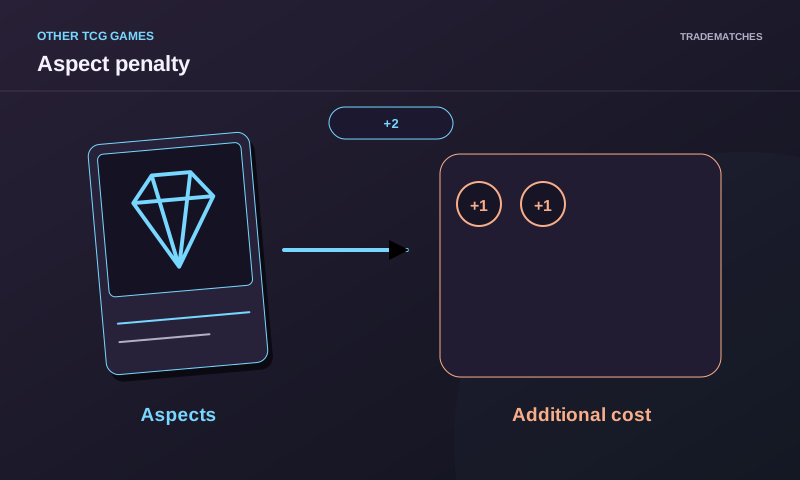
In Star Wars: Unlimited you can play a card whose aspect does not match your Leader and Base, but you pay two additional resources for each aspect icon that is missing. The aspect penalty modifies the cost when playing, not the physical identity of the card.
Add the icons of Leader and Base
Your Leader provides aspect icons and your Base provides another. Compare those icons with the icons of the card you want to play. An icon that already provides that combination does not generate a penalty; for each required icon that is missing, add two to the cost. Read exceptions printed on Leaders, Bases or other cards.
Example of cost
If a unit costs 3 and has an Aggression icon that your Leader and Base do not provide, it costs 5 resources when playing it. If you do not lack any icons, keep its cost at 3. A card with multiple missing icons can accumulate more than one penalty; do not confuse the number of colors illustrated with the aspect symbols.
Decision when drawing the deck
A card out of aspect can be legal and still be slow for your resource curve. Before exchanging for a playset, note the real cost in your Leader and Base combination. The official guide gives examples and remembers that certain abilities may ignore specific penalties.
What does it mean to pay an aspect penalty
The aspects of Star Wars: Unlimited guide the construction of a deck, but the general rule allows including a card of an aspect that your Leader and your Base do not provide. The cost appears when you play that card: you pay two additional resources for each missing aspect icon. Therefore, the penalty is a cost calculation for a play, not an automatic prohibition when storing the card in your deck. This explains why two players can carry the same unit and pay different amounts for it. The combination of Leader and Base that each one chose determines which icons are covered.
The word "each" is important. A card with an uncovered icon adds two; if it lacks two icons, it adds four, except if an applicable effect changes the calculation. Do not pay two for "being out of aspect" when multiple icons are missing. Nor do you take the penalty for icons that your Leader or Base do provide. Count the symbols of the card and compare with the aspect sources of your deck before announcing the final cost.
The step-by-step calculation
First, read the printed cost of the card you are about to play. Second, identify its aspect icons. Third, look at the icons provided by your Leader and your Base. Fourth, mark each icon of the card that is not covered and add two resources for each. Finally, apply any specific modification from the text of a card that allows ignoring or changing a penalty. This order avoids jumping directly to a remembered figure from another game. When a card or Base special modifies aspects, you need to read that specific text; the shortcut "always two more" can fail.
Simple example: a unit costs three and has an aspect icon that your combination does not provide. Its ordinary cost when playing it would be five resources. If you have four resources available, you cannot pay five through this general path. If you have the aspect, the cost returns to three before considering other effects. It is the same physical card and the same printed cost; what changes is the penalty derived from your Leader and Base. Leaving both figures written next to a list facilitates deciding if it deserves a spot.
Two missing icons are not a single problem
Suppose a card printed costs four and shows two aspect icons that your combination does not provide. The general rule adds four resources: two for each icon. The total would be eight before other modifications. Such a card can still be legal in your deck, but perhaps it is not realistic to play it when you need it most. If only one of those icons is missing, the increment is two and the total is six. The difference between six and eight can completely change the turn in which the card enters play.
Before copying a list, do not focus only on the number of cards of each color or symbol. Mark which ones you will pay at normal cost, which with two extra, and which with four. A table with three columns reveals if your deck depends on many costly effects that you may never be able to play in time. The strategic problem is not "having cards of another aspect" in abstract, but how much the plays that are central to winning delay you.
Leader and Base are checked together
The Leader provides aspects and the Base provides its own. Do not look only at the Leader and conclude that a card is out of aspect if the Base already covers the icon. Nor count an icon of a card in your hand as if it were a permanent source of aspect for all others. The basic reference for construction and penalty is the combination of Leader and Base, except for special texts that change that situation. When changing the Base, revisit the real costs of the cards on the list, even if you do not change any unit.
Imagine you keep the same Leader and replace the Base to get another aspect. Several cards that you previously paid with two extra resources might now cost normally, while others may start paying the penalty. The change is not only about the ability or life points of the Base; it also alters the economy of the deck. Make a list of the most important cards and check their cost in both configurations. This comparison is more useful than saying that a Base is "better" without relating it to the cards you plan to play.
A card exception is read literally
The game includes effects that allow ignoring aspect penalties under specific conditions. Do not extend an exception to the entire game or all cards just because a Base or a special ability helped in a turn. Read when it can be used, which card affects it, and how many icons it ignores. If a card allows ignoring one, it could still leave another icon uncovered. If it changes the cost of a specific play, do not rewrite the aspect identity of the entire deck. For a new interaction, consult the current text and complete rules before paying.
When an effect allows playing a card without paying its cost or with an alternative cost, it is also advisable to avoid memorized formulas. The interaction between that text and the penalty may depend on how "playing" the card is defined and the exact wording of the effect. This guide resolves the general rule of two resources per missing icon; a card that creates an exception needs its own reading. Highlighting the specific text is more precise than asserting that all reductions work the same way.
How does it affect the resource curve
A unit with a printed cost of two is usually thought for an early moment. If it pays two extra for a missing aspect, it behaves like a four-resource play in your deck. It may still be worth it for its effect, but it no longer fulfills the function it had in a list where the aspect was covered. When planning turns, write the real cost in your setup. This avoids initial hands full of "cheap cards" that you actually can't play early.
The penalty also influences when to place cards as resources. If a key piece needs six in your deck instead of four, you must reach that amount and possibly reserve resources for it. Evaluate if the advantage of that card compensates for delaying another action. There is no universal rule for how many cards out of aspect to include; it depends on the Base, the Leader, printed exceptions, and the function of each card. A test of several games reveals the real cost better than a "splash" label.
Common errors when counting icons
The first is declaring any card with an foreign aspect illegal. The second is adding only two even if two icons are missing. The third is charging two for an icon that the Base already provides. The fourth is focusing only on the printed cost when comparing two cards. The fifth is applying a limited exception from one card to all plays. To avoid these, say out loud "printed cost, required icons, available icons, missing icons, additional cost." That phrase works even when you are in a hurry and reduces discussions at the table.
If you show a decklist to someone else, indicate the Leader and the Base next to the card you are asking about. Without that information, no one can calculate your general penalty correctly. And if you are going to a tournament, check the legality of the format: the penalty responds to how much it costs to play, not whether a print is allowed in that event. Separating legality, construction, and cost is the clearest way to evaluate a card before buying it.
FAQ
Is a card out of aspect illegal?
Not necessarily. Usually you can play it by paying the corresponding extra cost.
Is the penalty one time per card?
It is counted for each missing aspect icon, not simply per card.