Star Wars: Unlimited keywords explained: Grit, Restore, Piloting, Sentinel and more
On this page
In Star Wars: Unlimited, Grit gives a unit +1 power for each damage counter on it, Restore heals your base when the unit attacks, and Piloting lets a Pilot be played as an upgrade on a friendly Vehicle. Those three are the keywords players search for most, so they come first in this guide. After them come the core rules that trip people up (resources and the regroup phase, the aspect penalty, deploying leaders, passing and taking the initiative, uniqueness, the two arenas) and every other keyword, from Ambush to Hidden. We checked each rule on 21 October 2026 against Comprehensive Rules version 9.0, dated 9 October 2026. Rule numbers appear in brackets so you can look them up.
Some things apply to all keywords. They are printed in bold red text and resolve automatically unless their definition says "may" (7.5.1–7.5.2). A keyword that resolves like a "When Played" ability is not itself a "When Played" ability, which matters for cards that count those (7.5.1). If a unit is given a keyword it already has, the copies only add up when the keyword has a number after it, like Raid 2. A keyword followed by a cost or a dash and text, like Smuggle or Bounty, counts as a separate ability each time (7.5.4). When a card and the rules disagree, the card wins (1.3.1).
If you come across a keyword that isn't covered here, or want to see what the equivalent mechanic is called in another game, look it up in the TradeMatches keyword glossary: it includes the Star Wars: Unlimited keywords and points to the guide that explains them.
All keywords and rules at a glance
| Keyword or rule | What it does | When it matters | Two copies |
|---|---|---|---|
| Grit | +1 power per damage on the unit | Always; damage taken in the same combat counts only afterwards | No extra effect |
| Coordinate | Turns on its text while you control 3 or more units | Checked continuously | Each one is separate |
| Restore X | Heal X damage from your base | On Attack, before combat damage | Values add up |
| Piloting [cost] | Play the Pilot as an upgrade on a friendly Vehicle | While playing the card | Each one is separate |
| Overwhelm | Excess combat damage goes to the enemy base | Attacking a unit | No extra effect |
| Saboteur | Ignore Sentinel; defeat the defender's Shield tokens | Choosing a target; On Attack | No extra effect |
| Ambush | Attack an enemy unit right after entering play | When Played / Deployed / Created | Still one attack |
| Raid X | +X power while attacking | During the attack | Values add up |
| Bounty | An opponent resolves the effect | When the unit is defeated or captured | Each one is separate |
| Smuggle [cost] | Play the card from your resources | While it is a resource | Each one is separate |
| Exploit X | Defeat up to X friendly units; 2 less cost each | Determining the cost | Values add up |
| Sentinel | Enemies in this arena must attack it | Choosing a target | No extra effect |
| Shielded | The unit enters with a Shield token | When Played / Deployed / Created | — |
| Hidden | Can't be attacked in the phase it arrived | That action phase | No extra effect |
Grit: +1 power for every damage on the unit
Grit is a constant ability that reads "This unit gets +1/+0 for each damage on it" (7.5.6.a). A 2/5 unit with Grit and 3 damage counters attacks for 5. Grit never changes HP, so the same unit still dies when it reaches 5 damage. Healing it lowers its power again, and so does anything that removes damage counters.
The timing trap: damage in the same combat
In a normal attack, the attacker and the defending unit deal their combat damage at the same time (6.3.4.a). Grit only sees the new damage once all of it has been dealt (7.5.6.c). The rules give this example: an undamaged 2/2 with Grit defends against a 1/3 attacker. The Grit unit deals 2, not 3, even though it ends the combat with 1 damage, 3 power and 1 remaining HP.
When Grit does hit harder in the same fight
Things change when one unit deals its combat damage first. The unit that goes second must survive that damage before it hits back, and if it has Grit it gets the bonus from the damage it just took (6.3.5.c, 7.5.6.d). The rules use Shoot First, an event that gives +1/+0 and makes the attacker deal combat damage before the defender. Battlefield Marine (3 power) attacks Baze Malbus, Temple Guardian, a 2/5 with Grit. The Marine deals 4 first. Baze survives with 1 HP left, now has 6 power, and deals 6 back, which defeats the Marine.
Several copies of Grit
Grit has no number, so a unit that gains it twice still gets only +1 per damage (7.5.6.b, 7.5.4). Admiral Yularen, Fleet Coordinator, for instance, can give Grit to your Vehicles; a Vehicle that already had it gains nothing more.
Common Grit mistakes
- Adding the HP lost to the unit's HP. Grit only raises power.
- Counting combat damage from the current exchange when both units deal damage simultaneously.
- Forgetting that a Shield token that prevents damage also prevents the Grit bonus, because no counter is placed (1.9.9).
- Assuming Grit protects the unit. Opponents often finish a damaged Grit unit with an event before it attacks.
Coordinate: abilities that switch on at three units
Coordinate is followed by a dash and an ability, and it means "While you control 3 or more units, this card gains the following ability" (7.5.15.a). It is checked all the time, so the ability turns on and off as your board changes. With two units it is inactive; play a third and it works immediately; lose one and it stops.
What counts towards three
- Every unit you control in both arenas, including the unit with Coordinate itself.
- Token units count, because they are units in play.
- A deployed leader unit counts. A leader that is still on its leader side does not, because it is not a unit.
- A Pilot attached as an upgrade does not count. While a card is attached as an upgrade it is an upgrade, not a unit, for all purposes (3.5.6).
- Enemy units never count. You need 3 units you control.
Example: Ahsoka Tano, Snips
This leader shows both uses. On her leader side, "Coordinate — Action [Exhaust]: Attack with a unit. It gets +1/+0 for this attack." Once deployed (her Epic Action needs 5 resources), her unit side reads "Coordinate — This unit gets +2/+0." With Ahsoka and two other units in play, she attacks with +2 power. If an opponent defeats one of the others before she attacks, she is back to her printed power. A unit with Coordinate still has the keyword when the ability is off, which matters for cards that look for units with keywords (7.5.15.c).
Restore: healing your base when the unit attacks
Restore X resolves like "On Attack: Heal X damage from your base" (7.5.9.a). It triggers whenever the unit attacks, whether it attacks a unit or the base, and it heals before any combat damage is dealt, because On Attack abilities resolve in the Begin attack step (6.3.3). Admiral Ackbar, Brilliant Strategist has Restore 1. Luke Skywalker, Jedi Knight has Restore 3.
Rules that decide close games
- It heals your base, never the attacking unit.
- Healing can't remove more damage than the base has, and you can't heal a base above its HP (1.9.3, 3.2.4). Restore 3 on a base with 1 damage heals 1.
- Copies add up: Restore 1 plus a granted Restore 2 gives Restore 3 (7.5.9.b). Hera Syndulla, We've Lost Enough as a Pilot gives Restore 1 to the Vehicle she is attached to.
- The heal has already happened if the attacker dies in combat. Nothing undoes it.
- An effect that says bases can't be healed this phase stops Restore, since the heal is the whole effect.
Worked example
Your base has 24 damage on 30 HP and your opponent has a 4-power unit ready. You attack their Sentinel with Ackbar. Restore 1 resolves first and your base drops to 23 damage. Ackbar then takes the Sentinel's combat damage. Restore did not make the attack safer for Ackbar; it bought you one point of base HP in a race, and that is how to judge it.
Piloting: playing a Pilot as a unit or as an upgrade
Piloting [Y] means "You may play this unit as an upgrade on a friendly VEHICLE unit without a PILOT upgrade on it by paying cost Y instead of its printed cost" (7.5.17.a). The cost in brackets includes aspect icons, so the aspect penalty still applies to it. Chewbacca, Faithful First Mate shows the choice: a 5-cost 5/6 ground unit, or Piloting [3] as an upgrade that gives a Vehicle +3/+3 and his protection text.
How the two modes work
- You declare which way you are playing the card when you show it (6.2.1.a).
- As an upgrade, the card uses its power and HP modifiers, not its unit stats (2.9.1, 2.11.1).
- The split text box only shows which text applies in each mode. The card has all of it either way (2.13.3).
- The Vehicle can be in either arena. A ground Pilot can fly a space Vehicle, because as an upgrade it has no arena of its own.
- If the Vehicle leaves play, the Pilot upgrade is defeated and goes to the discard pile (3.6.11).
"Play a unit", "play an upgrade" and searching
If an effect tells you to play a unit, you can't use Piloting. If it says play an upgrade or a non-unit card, you can. "Play a card" allows either (7.5.17.c). In your deck, hand or discard pile a Pilot is still a unit, so "search your deck for an upgrade" can't find it (7.5.17.d).
One Pilot per Vehicle, with exceptions
The normal limit is one Pilot on a Vehicle. Millennium Falcon, Get Out And Push overrides it: you may play or deploy 1 additional Pilot on it (3.6.3.c). Some Pilot leaders, such as Wedge Antilles, Leader of Red Squadron, can deploy either as a unit or as an upgrade on a friendly Vehicle without a Pilot (3.4.4.a). A unique Pilot also follows the uniqueness rule in both forms (8.29.3.a); see uniqueness below.
Resources and the regroup phase
Resources in Star Wars: Unlimited are cards placed facedown in your resource zone: you start with 2, and in each regroup phase you may add 1 more from your hand after drawing 2 cards. To pay a cost you exhaust that many ready resources (1.7.2). A resource is a blank card while it is facedown. Its name, aspects and abilities don't count unless a rule says so, as with Smuggle (1.7.8).
Setup
Each player draws 6 cards, may take one mulligan, then chooses exactly two cards from hand and puts them into play as resources, facedown and ready (5.2.1.d–f). The player with the initiative decides on the mulligan first.
With 3 copies of a card in a 50-card deck, the Premier minimum (9.2.2.a), the chance of having it in your 6-card opening hand is 32.4% (1 − C(47,6)/C(50,6), a hypergeometric distribution). If you always mulligan when it is missing, that rises to 54.3% (1 − 0.676²), because the new hand is drawn again from all 50 shuffled cards (5.2.1.e). For other deck sizes, or to count the draws of the first regroup phases, use the opening hand probability calculator.
The five steps of the regroup phase
- Start of the phase: effects that expire or trigger now do so (5.5.1.a).
- Each player draws 2 cards (5.5.1.b).
- Starting with the player who has the initiative, each player may resource 1 card from hand, facedown and exhausted. You can also choose not to (5.5.1.c, 1.4.5).
- Each player readies everything they control: units, resources and leader (5.5.1.d).
- End of the phase: "for this phase" and "for this round" effects expire (5.5.1.e).
Because you draw before resourcing, you choose the resource from a hand that already includes the two new cards. The new resource enters exhausted, but step 4 readies it straight away, so in practice it is available in the next action phase.
Details players ask about
- You may look at your own resources at any time. Your opponent only knows how many are ready and exhausted (1.7.3–1.7.4).
- You may rearrange your resources after announcing it, as long as the number of ready and exhausted ones stays the same (1.7.4).
- A resource is not discarded when you pay with it. It stays in the zone, exhausted.
- Credit tokens sit in the resource zone but are not resources, so they don't count for a leader's deploy threshold (4.5.4).
- If you must draw from an empty deck, you deal 3 damage to your own base per card instead (8.6.1).
Overwhelm: excess damage to the base
Overwhelm means "While attacking, this unit deals its excess combat damage to the defending player's base" (7.5.7.a). In the rules' example, a 5-power unit with Overwhelm attacks a unit with 3 remaining HP, defeats it and deals 2 to the base. The damage to the unit and the base is dealt at the same time (7.5.7.c).
When nothing goes through
- If the defending unit would not be defeated, there is no excess and the base takes nothing (6.3.5.d).
- A Shield token prevents all of that combat damage, so the defender isn't defeated and nothing reaches the base (7.5.7.e). That is why Overwhelm and Saboteur work so well together.
- Overwhelm only works while attacking. A defending unit with Overwhelm doesn't push damage anywhere.
When everything goes through
If the defending unit leaves play before combat damage, for example because an On Attack ability defeated it, all of the attacker's combat damage is excess and goes to the base (1.9.11.b, 7.5.7.f). The unit has dealt combat damage to the base, but it is not considered to have attacked the base (7.5.7.d), so "when this unit attacks a base" effects don't trigger. Version 9.0 added the general rule on excess damage: when an effect doesn't say where the excess goes, it stays on the unit or base receiving the damage (1.9.11.a).
Overwhelm doesn't let you ignore Sentinel. If there is an enemy Sentinel in the arena, you still have to attack it, but the excess can still reach the base. A unit that "can't attack bases", such as one wearing the Entrenched upgrade, can still damage the base through Overwhelm, as the card's official rules note confirms.
Saboteur: ignoring Sentinel and removing Shields
Saboteur in Star Wars: Unlimited does two things: you may ignore Sentinel when choosing what the unit attacks, and when it attacks, all Shield tokens on the defending unit are defeated (7.5.10.a). Rebel Pathfinder, a 2/3 for 2, is the classic example.
- Ignoring Sentinel means choosing the target as if no enemy unit in that arena had Sentinel. The enemy units keep the keyword (7.5.10.b). You may attack any unit there or the base.
- The Shield removal is an On Attack trigger, so it happens in the Begin attack step, before combat damage (6.3.3).
- It only removes Shields from the defending unit. Attacking the base removes none.
- Saboteur on an attacker with Overwhelm is a strong combination: the Shields are gone before damage, so the excess reaches the base.
Example
Your opponent has a Sentinel 3/3 and a 4/4 with a Shield token in the ground arena. Your Rebel Pathfinder may skip the Sentinel and attack the 4/4. Its Shield is defeated on attack, then the Pathfinder deals 2 and takes 4, which defeats it. Hitting the base for 2 might have been the better use. Saboteur widens your options; it doesn't make each one good.
Ambush: attacking as soon as the unit arrives
Ambush lets a unit attack an enemy unit right after it is played, deployed or created, even though it entered play exhausted (7.5.5.a). The current rules wording is "may attack that enemy unit, even if this unit is exhausted". Older printed reminder text says "ready and attack"; either way the unit ends the attack exhausted. Han Solo, Reluctant Hero is a 7-cost 6/6 with Ambush that also deals its combat damage before the defender.
- Ambush can only attack units, never the base.
- If there is no enemy unit it can attack, nothing happens (7.5.5.c). A ground unit can't use it against an empty ground arena, even if the space arena is full.
- Normal attack restrictions apply. If there is an enemy Sentinel in its arena, the Ambush attack must target the Sentinel, unless the unit has Saboteur.
- Ambush resolves in the same window as When Played abilities and Shielded, in the order you choose (7.6.13.b). If you resolve Ambush first, the attack and its triggers are completed before your other When Played abilities (7.5.5.f).
- Two copies still give only one attack (7.5.5.b). Admiral Piett gives Ambush to each friendly non-leader unit that costs 6 or more, using the printed cost (1.8.6).
Raid: extra power while attacking
Raid X means "While attacking, this unit gets +X power" (7.5.8.a). The bonus starts in the Begin attack step and ends with the attack (7.5.8.c). It does nothing on defense. Copies add up: Raid 1 plus Raid 2 is Raid 3 (7.5.8.b). Pirated Starfighter has Raid 1; Cantina Braggart, a 0/3, has Raid 2.
Rallying Cry gives each friendly unit Raid 2 for the phase, but only units already in play when it resolves. Units you play afterwards don't get it (7.7.3.d). And negative modifiers still count when power is at 0. The rules give this example: Cantina Braggart gets −2/−2 from Make an Opening, which leaves it at 0 power. When it attacks, Raid 2 adds +2, but the −2 is still applied, so it attacks with 0 (8.15.4).
Ambush and Raid are often mentioned together, but they answer different questions. Ambush decides whether a unit can attack the turn it arrives. Raid decides how hard it hits whenever it attacks.
The aspect penalty
The aspect penalty in Star Wars: Unlimited is 2 extra resources for each aspect icon on a card that your leader and base don't provide (8.1.1). A card with two missing icons costs 4 more. Neutral cards with grey borders have no icons and never pay it (1.5.6.c). Your leader provides two icons and your base one (1.5.6.b).
Double icons
Each icon on your leader or base covers only one icon on a card (8.1.2). Luke Skywalker, Faithful Friend provides Vigilance and Heroism. To play Protector, which has two Vigilance icons, without paying extra, you need a second Vigilance icon from your base, for example Capital City.
| Card (printed cost and icons) | With Luke, Faithful Friend + Capital City | Cost to pay |
|---|---|---|
| Protector (1; Vigilance, Vigilance) | Both icons provided | 1 |
| Death Trooper (3; Vigilance, Villainy) | Villainy missing | 5 |
| Saw Gerrera, Extremist (4; Aggression, Aggression) | Both icons missing | 8 |
How it interacts with other cost changes
- Increases, including the penalty, are applied before reductions such as Exploit (6.2.3.a). The final cost can't go below 0.
- Smuggle and Piloting costs list their own icons, and the penalty applies to them too (7.5.14.a, 7.5.17.a).
- Playing a card "for free" skips the penalty, but not additional non-resource costs (8.1.3).
- Some cards tell you to ignore the penalty, like Hera Syndulla, Spectre Two for SPECTRE cards. The card still has its aspects for other effects (8.10.2).
- Effects that check a card's cost use the printed cost, not what you paid (1.8.6).
Bounty: who collects and when
A Bounty is collected by an opponent of the unit's controller, when that unit is defeated or captured, and collecting it is optional (7.5.13.a, 7.5.13.e). Bounty resolves like "When Defeated/When Captured", except that the ability is controlled by an opponent.
- Each Bounty is a separate ability. A unit can have several and can even be given the same one twice (7.5.13.b).
- If you defeat or capture your own unit with a Bounty, for example with Exploit, you still have to choose an opponent to collect it (7.5.13.f).
- With more than two players, the opponent who defeated or captured the unit is the one who may collect (7.5.13.g).
- It resolves in the same window as the unit's When Defeated or When Captured abilities (7.5.13.c). If both players have triggers, the active player chooses which player resolves theirs first (7.6.10).
Some upgrades put a Bounty on an enemy unit. Wanted costs 0 and gives the attached unit "Bounty — Ready 2 friendly resources." Play it on an enemy unit, and when you defeat or capture that unit, you are the opponent who readies 2 resources.
Deploying a leader and Epic Actions
To deploy a leader you use its Epic Action once you control the resources it asks for; it costs no resources, the leader flips to its unit side and enters the ground arena ready (3.4.4). Luke Skywalker, Faithful Friend reads "Epic Action: If you control 6 or more resources, deploy this leader." Chewbacca, Walking Carpet needs 7; Ahsoka Tano, Snips needs 5. The number on the leader side's cost box is that threshold in most cases (2.6.1).
What deploying is and isn't
- Using the Epic Action is your action for that turn. You can deploy even if the leader is exhausted from using its other ability (3.4.4).
- The leader is deployed, not played, so "When Played" doesn't trigger. Ambush, Shielded and Support work because they also say "When Deployed".
- Each Epic Action can be used once per game; mark it with the epic action counter (7.2.4).
- Your leader unit can attack the same round, because it enters ready.
- Pilot leaders such as Wedge Antilles or Boba Fett, Any Methods Necessary may instead deploy as an upgrade on a friendly Vehicle without a Pilot (3.4.4.a).
When the leader unit is defeated
It flips back to its leader side and returns to your base zone exhausted. The Epic Action stays used, so a leader that deployed with it can't deploy again this game, but other leader-side abilities still work (3.4.5). If an effect would return the leader unit to hand, move it elsewhere out of play or give control of it to an opponent, it is defeated instead (3.4.6). Card effects that check cost treat the leader unit side's printed cost as its cost (1.8.7).
Passing and taking the initiative
Passing does nothing and lets you act again later in the phase; taking the initiative ends your participation in the action phase but makes you the first player next round (1.15.5–1.15.6). The action phase ends as soon as both players pass consecutively.
| Pass | Take the Initiative | |
|---|---|---|
| Effect | Nothing; your opponent acts | You take the initiative counter and flip it to "taken" |
| Can you act later this phase? | Yes, if your opponent acts in between | No; you pass automatically for the rest of the phase |
| Limit | None | One player per round |
| Ends the phase | If the opponent passed just before | If the opponent passed just before |
Both actions fit into the structure of a round: an action phase in which players alternate one action at a time, and a regroup phase with five fixed steps (5.3–5.5). The diagram puts them together; the regroup steps are explained under resources and the regroup phase.
Rules around the counter
- You can take the initiative even if you already hold the counter (1.15.5).
- After taking it you still resolve your triggered abilities, for example from your opponent's attacks (1.15.5.b).
- If nobody takes it, whoever holds it keeps it and goes first next round (1.15.5.d).
- "While you have the initiative" effects only check who holds the counter, not whether it is taken or available (1.12.2.c). Baze Malbus gains Sentinel while you have it.
- Every action other than passing must change the game state (1.16.2).
Worked example
You hold the initiative. You play a unit; your opponent attacks; you pass; your opponent plays a card. You can still act, because the passes weren't consecutive. You attack, your opponent passes, and you take the initiative. Since your opponent passed on the action just before, the phase ends immediately and you start next round (1.15.5.c).
The uniqueness rule
You can control only one copy of a unique card with the same name and subtitle at a time; if a second one enters play under your control, you immediately defeat one of them (8.29.3). Unique cards have the unique icon before the name. The rule checks name and subtitle together, so Luke Skywalker, Faithful Friend and Luke Skywalker, Jedi Knight can both be in play for you (8.29.3).
- It only applies to cards in play, in any form. A unique Pilot attached as an upgrade and a second copy played as a unit break the rule (8.29.3.a).
- Hand, deck, discard pile and resources don't count (8.29.4). A facedown copy among your resources is a blank card (1.7.8).
- It is per player. You and your opponent may each have the same unique card (8.29.5).
- You may still have up to 3 copies in a Premier deck (8.5.5).
- Defeating the extra copy is not a triggered ability and happens at once, but any triggers from playing or defeating either copy still resolve (8.29.3). You count as having defeated it (1.18.1).
In practice, playing a second copy of your unique unit can be a deliberate trick: you get its When Played ability, keep the fresh copy and send the damaged one to the discard pile. Its When Defeated ability, if it has one, also triggers.
Capture and rescue
A captured unit is placed facedown under the unit that captured it, with all damage removed and all its upgrades defeated; it comes back into play, exhausted and under its owner's control, when it is rescued or when the guarding unit leaves play (8.33.1–8.33.4).
- A captured card has left play and is out of play, but it is open information (8.33.1).
- The capturing unit is "guarding" it (8.33.2).
- A rescued unit enters play but is not played, so "When Played" abilities don't trigger (8.33.3). It is a new copy and keeps nothing from before (8.7.3).
- If the guard leaves play for any reason, all units it was guarding are rescued at once (8.33.4). This is resolved before other waiting abilities (1.16.5.c).
- A captured token unit is set aside instead and is gone (8.33.5).
- Bounties trigger on capture as well as on defeat (7.5.13.a).
Rescue effects free a captured card without removing the guard. Unexpected Escape, for 1 resource, reads "Exhaust a unit. You may rescue a captured card guarded by that unit." The captured unit returns to its owner, even if someone else controlled it when it was captured.
Smuggle: playing a card from your resources
Smuggle [Y] lets you play the card from your resource zone by paying Y instead of its printed cost, then replace it with the top card of your deck (7.5.14.a). It only works while the card is a resource. A resource whose facedown side has Smuggle has the keyword, and your opponent doesn't know about it (7.5.14.d).
- It is a modified Play a Card action, so it counts as your action and the card is played: When Played abilities trigger, and a unit enters exhausted (7.5.14.c, 7.5.14.f).
- The Smuggle cost includes aspect icons and the penalty applies (7.5.14.a).
- The card can be exhausted to help pay its own Smuggle cost, because it is still a resource while you pay (7.5.14.e).
- The replacement resource enters exhausted (7.5.14.g). With an empty deck you can still smuggle; you just don't replace it and take no damage (7.5.14.h).
Example: DJ, Blatant Thief has Smuggle [7 resources, Cunning, Cunning] and "When played using Smuggle: Take control of an enemy resource." With a Cunning leader and base you have both icons, so you pay 7, and DJ can be one of the 7 resources you exhaust. Your top card becomes a new exhausted resource and you take one from your opponent until DJ leaves play. Tech, Source of Insight gives every friendly resource Smuggle at its cost plus 2 and its aspect icons.
Exploit: defeating your own units to pay less
Exploit X means "While playing this card, you may defeat up to X friendly units. For each unit defeated this way, this card costs 2 less" (7.5.16.a). It is used in the Determine cost step (7.5.16.c), after increases like the aspect penalty (6.2.3.a). Copies add up (7.5.16.b).
Example: Hailfire Tank costs 8 and has Exploit 2. In a Villainy deck, defeating two friendly units brings it to 4. In a deck without Villainy it starts at 10 with the penalty, and two defeated units bring it to 6.
- The cost can't go below 0, so defeating extra units beyond that point saves nothing (1.8.4).
- When Defeated abilities of the units you defeat resolve after the play, in the same window as the new card's When Played abilities (7.5.16.d). You choose the order.
- If a defeated unit had a Bounty, your opponent collects it (7.5.13.f).
- Token units can be defeated for Exploit; they are set aside (3.7.3).
- Effects that check cost still read the printed 8 (1.8.6).
Sentinel: the unit that must be attacked
Sentinel means "Units in this arena can't attack your non-Sentinel units or your base. Abilities this unit has or gains can't prevent this unit from being attacked" (7.5.11.a). If you have several Sentinels in an arena, the attacker picks which one (7.5.11.b).
- It only affects its own arena. A ground Sentinel doesn't protect your space units, and an enemy space unit can attack your base past it.
- Saboteur ignores it (7.5.11.c).
- Sentinel overrides "can't be attacked" and Hidden (7.5.11.d, 7.5.18.b).
- It applies to Ambush attacks and to attacks made by abilities, because those are normal attacks (6.3.0.b).
- A unit that loses Sentinel for the phase, for example from SpecForce Soldier, can't regain it that phase (8.14.1).
- In multiplayer games, a Sentinel only protects its controller (11.4.4).
Cell Block Guard is a plain 3/3 Sentinel. Protector, an upgrade, gives Sentinel to the attached unit. Baze Malbus gains it only while you have the initiative, which links Sentinel to the initiative decision.
Sentinel, Ambush and Saboteur all apply within the same steps of an attack. The diagram follows the order of rule 6.3 and shows where each one comes in.
Shielded, Shield tokens and Experience tokens
Shielded means "When Played/When Deployed/When Created: Give a Shield token to this unit" (7.5.12.a). A Shield token is an upgrade with +0/+0 and the text "If damage would be dealt to attached unit, prevent that damage. If you do, defeat a Shield token on it" (3.7.6). It stops one whole instance of damage, whatever the amount.
- With several Shields, only one is defeated per instance of damage (3.7.6.a).
- Indirect damage and other unpreventable damage ignore Shields, and the Shields stay (8.35.2.a, 1.9.13).
- Saboteur defeats all Shields on the defending unit before damage.
- A Shield blocks Overwhelm completely: no damage to the unit means no excess.
- Tokens are set aside, not discarded, when defeated (3.7.3).
Shield or Experience?
An Experience token is an upgrade that gives +1/+1, and each one adds up (3.7.5). A Shield stops one hit; Experience makes the unit permanently bigger. A 2/2 with a Shield survives one big attack and is still a 2/2. A 2/2 with an Experience is a 3/3 that keeps it until it leaves play. Experience does not heal damage already on the unit, but the extra HP means that damage is further from defeating it. Crafty Smuggler, a 2/2 with Shielded, is the simplest example of the first; Hera Syndulla, Spectre Two's leader unit, hands out Experience when she attacks.
Hidden
Hidden is current in the 9.0 rules. It means "This unit can't be attacked if it was played/deployed/created this phase" (7.5.18.a). From the next phase on, the unit can be attacked normally, although it still has the keyword. The official set mechanics page adds that Hidden units can still be damaged and defeated by abilities in that phase.
A unit with both Hidden and Sentinel can be attacked (7.5.18.b). Third Sister, Seething With Ambition is built around it: her leader action plays a unit from your hand that gains Hidden for the phase, and her unit side has Hidden for the phase she deploys.
Ground and space arenas
Ground units can attack enemy ground units and the enemy base; space units can attack enemy space units and the enemy base; neither can attack units in the other arena unless a card says so (4.3.3–4.3.4, 4.4.3–4.4.4). A unit that attacks a base stays in its arena (3.2.3).
- Each unit's arena type, top right of the card, says where it is played (2.5.1). Deployed leaders go to the ground arena under rule 3.4.4.
- Abilities can still deal damage across arenas (4.3.4).
- Sentinel only matters in the attacker's arena.
- "Can" abilities add options. Strafing Gunship, a space unit, "can attack units in the ground arena" and may still attack space units (8.3.1). Its rules note adds that an enemy space Sentinel stops it from attacking non-Sentinel ground units.
- The first unit played in the game fixes which side of the base zone is ground and which is space for the rest of the game (4.3.2).
- A unit moved to another arena by an ability keeps its damage, upgrades and status, and doesn't leave play (8.36).
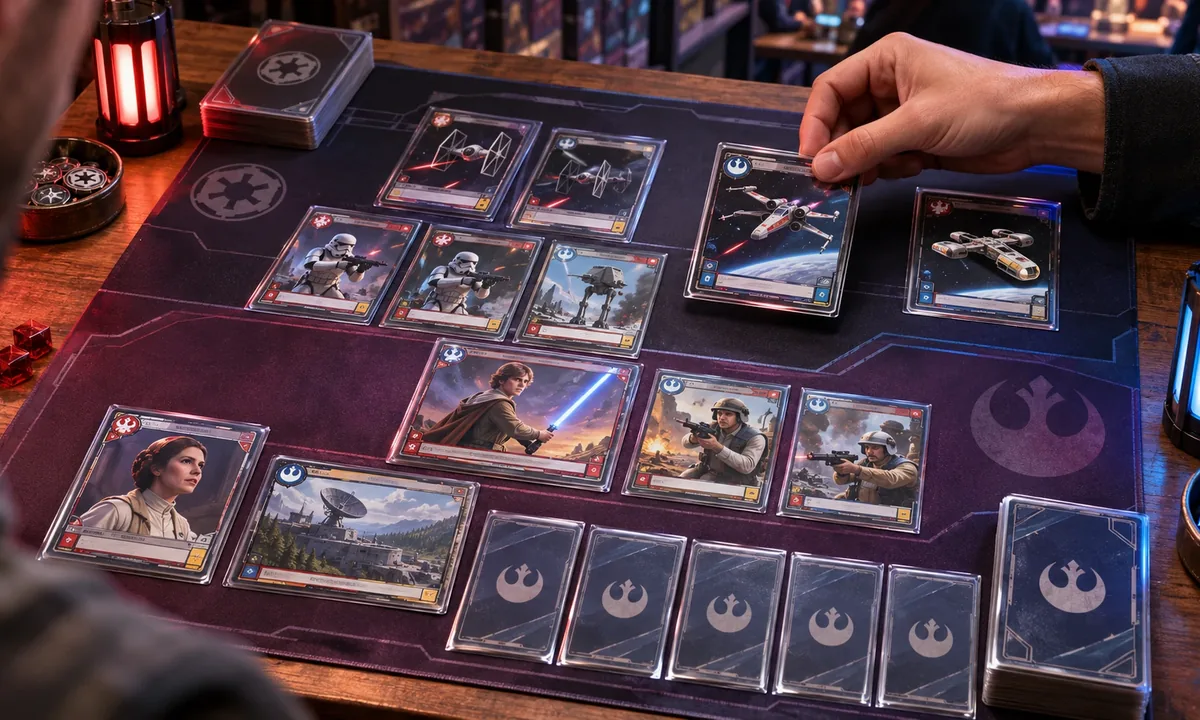
This is how the table looks. Your base and leader start in your base zone, the base at the top centre and the leader below it (5.2.1.a–b); the two arenas are shared with your opponent, one on each side of the base zones, and resources have their own zone (4.1.1).
Twin Suns: the multiplayer format with two leaders
A Twin Suns deck has exactly 2 different leaders, 1 base and at least 80 other cards, with only one copy of each card (12.2.1–12.2.2). The official format page adds that the two leaders' starting sides can't have both Heroism and Villainy between them. Both leaders provide their aspect icons, and they deploy and are defeated independently (12.3.2–12.3.3).
Counters instead of passing
There are two extra counters, blast and plan, besides the initiative. Taking the blast counter deals 1 damage to each opponent's base. Taking the plan counter draws 1 card, then you put 1 card from hand on the bottom of your deck (12.5.2). Take the Initiative becomes "Take an Available Counter": you take any untaken counter and are then out of the phase (12.5.3). You can't simply pass while counters are available, and you must pass after taking one (12.6.1.a). Blast and plan return to the centre at the start of each regroup phase (12.5.5).
Elimination and winning
The player who eliminates an opponent heals 5 damage from their own base (12.6.2). Once one player is eliminated, the game ends at the end of that phase, and the player with the most remaining base HP wins; tied players share the victory (12.7). Other multiplayer rules apply: a Bounty goes to the opponent who defeated the unit, and a Sentinel only protects its own controller.
Indirect damage
Indirect damage is dealt to a player, who must assign it, divided as they choose, among their own units and base (8.35.1). It is unpreventable, so Shields and "can't be damaged" don't stop it, and Shield tokens are not defeated by it (8.35.2). You can't assign more to a unit than its remaining HP (8.35.3), and all of it from one ability is dealt at once (8.35.5). It still counts as dealt by the player whose ability caused it, so that player defeats any unit it kills (8.35.4). Boba Fett, Any Methods Necessary deals 1 indirect damage to a player when you deal non-combat damage and exhaust him.
Disclose
To disclose aspect icons you reveal any number of cards from your hand that together show at least those icons (8.38.1). You may reveal more than needed (8.38.2). If you can't meet the requirement, you are not considered to have revealed anything (8.38.3). Leia Organa, Of A Secret Bloodline discloses one aspect, then gives an Experience token to a unit that shares no aspect with the revealed card.
Plot, Support, Fortify and the Force
Plot lets you play the card from your resources when you deploy a leader, replacing it with the top card of your deck; the card must already be a resource when the leader deploys (7.5.19). Support lets you attack with another unit when this unit enters play, and that unit gains this one's other abilities for the attack (7.5.20). Fortify, new in the 9.0 rules, means the upgrade attaches to your base instead of a unit (7.5.21). The Force token is created in your base zone; you can only have one, "the Force is with you" while you have it, and using the Force defeats it (8.37).
Icons 2027 Edition, the first Icons set, releases on 20 November 2026; products and dates are covered in the Star Wars: Unlimited Icons 2027 guide. If you are not sure whether a card in another language is the same card, rule 2.2.2 says its name always counts as the English name; the guide to card languages and editions covers the trading side.
That date and those of the other Star Wars: Unlimited sets are in the TradeMatches release calendar, along with the other games we cover.
Trading for the cards you need
Missing a Pilot for your Vehicles or a third copy of a Sentinel? TradeMatches lets you list the cards you have and the ones you want, shows matching collectors nearby and has a chat for your province.
FAQ
Does Grit increase HP in Star Wars: Unlimited?
No. Grit only adds power, one point per damage counter on the unit. Its HP and the damage needed to defeat it stay the same.
Does Restore work when attacking a unit?
Yes. Restore triggers whenever the unit attacks, whatever the target, and the base is healed before combat damage.
Does Saboteur defeat Shields when attacking the base?
No. It defeats Shield tokens on the defending unit, and an attack on a base has no defending unit. It still lets the attacker ignore Sentinel to reach the base.
Can a leader with Ambush attack when deployed?
Yes, if it has Ambush on its unit side or gains it, because Ambush also triggers when a unit is deployed. It needs an enemy unit it can attack.
Can I play a Pilot on an enemy Vehicle?
Not with Piloting. The keyword only allows a friendly Vehicle unit without a Pilot.
Do Credit tokens count towards deploying my leader?
No. Credit tokens are created in the resource zone but are not resources, so they don't count for an Epic Action that asks how many resources you control.
Sources and checks
On 21 October 2026 we read the keyword chapter (7.5), the attack and play steps (6.2–6.3), the regroup phase (5.5), the additional rules (8.1–8.38) and the Twin Suns chapter (12) of Comprehensive Rules 9.0, dated 9 October 2026, which is the version linked from the official How to Play page that day. We compared it with version 8.0 to see what changed, and checked every card text quoted here in the official card database.