Pass or take initiative in Star Wars: Unlimited?
On this page
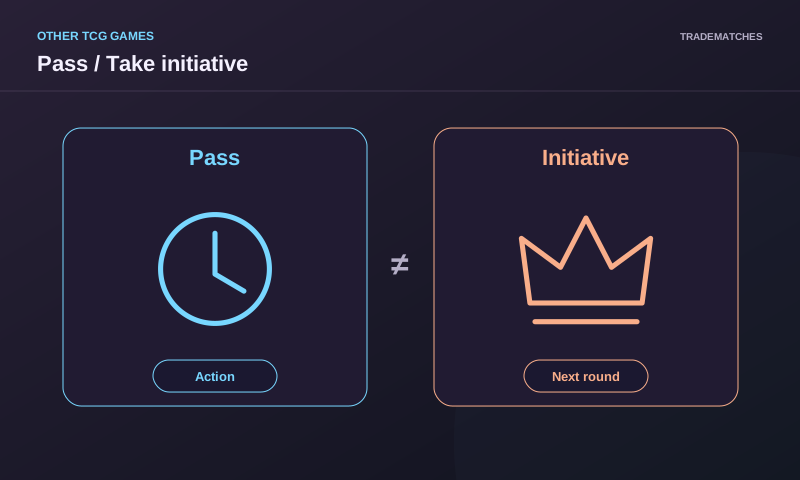
Pass and take the initiative consume an action in Star Wars: Unlimited, but they do not have the same effect. If you pass, you might act later in this phase; if you take the initiative, you will act first in the next round and you will not do any more actions in this phase.
Passing preserves flexibility
Actions alternate between players. When you pass, you do nothing in that turn of action and the opponent decides what to do next. If the phase continues, you can choose another action when it is your turn again. A phase ends when both players pass according to the sequence of rules.
Taking the initiative commits the rest of the phase
Only one player can take the initiative indicator each round. When you do so, you secure the first action of the next round, but you automatically pass in all your remaining opportunities in this phase. If your opponent still has resources and units prepared, he may be able to chain actions without an active response from you.
Example of decision
You have a useful attack and the opponent still has two cards in hand. Passing may induce a play and leave you to attack later; taking the initiative now secures the next round, but you give up that attack in the current phase. Look at the table state before choosing.
Two actions that seem the same but commit differently
In Star Wars: Unlimited, passing and taking the initiative occupy an action opportunity. In both cases, you do not play a unit or attack at that moment, but the consequences are different. Passing is a provisional decision: you let the opponent act and you can choose another action when it is your turn again, if the phase continues. Taking the initiative secures the marker for the next round and commits you to pass in your remaining opportunities of this action phase. That difference is strategic. If you still have a play you want to make, taking the initiative too early may give the opponent several actions without your response.
Passing preserves the possibility of returning
The action phase alternates opportunities between players. When you pass, you do not play a card action in that opportunity and the opponent decides theirs. If the opponent continues playing and the phase continues, you can play, attack, pass again, or take the initiative when it is your turn again, according to the rules. Do not mark your side as "out of the round" for a single pass. Many games use that pass to gain information: you want to see which unit the opponent lowers or in which arena the opponent acts before committing your response.
Imagine you have a unit ready and a event card in hand. You pass to see if the opponent attacks first. If he attacks, the phase does not end because of your pass and you can choose an action when you regain the opportunity. Maybe you play the event or attack with your unit. If the opponent also passes in the sequence that ends the phase, instead, you will not have an infinite opportunity to reconsider. Passing preserves flexibility while the phase remains open, it does not guarantee the opponent will give you information.
Taking the initiative fixes who starts next
The initiative marker identifies who will have the first action in the next round. Taking it in the current phase gives you that right even if you cannot gain immediate advantage. Only one player can take it each round. Once claimed, the other cannot wait and claim the same marker again. That future first turn can be decisive when both players want to deploy a unit, eliminate a threat, or attack a Base before the opponent intervenes.
The counterpart is clear: whoever takes the initiative automatically passes in their remaining opportunities of this action phase. You cannot claim it and then attack with a unit you left ready for later in the same phase. You also cannot reserve an event and decide to use it later as an ordinary action of that phase, unless specific text and windows indicate another interaction; consult the corresponding rule. For the basic flow, think of taking the initiative as voluntarily closing your actions of this phase in exchange for starting the next.
The right moment depends on what remains on the table
Before taking the initiative, look at your ready units, playable cards, and available resources. If you do not have an additional useful action, securing the next turn may be a great choice. If you have two important attacks prepared, perhaps giving them away is too costly. Look at the opponent as well: if he still has many ready units and resources, he may be able to chain actions while you pass. The future marker does not protect your Base from attacks he can receive now.
Suppose the opponent has two ready units and you have one. You take the initiative before using yours. The opponent can act with his units during the rest of the phase while you continue passing. If your unit could eliminate a threat or attack the Base, you lost that ordinary opportunity by claiming the marker. In another position, without ready units and without cards you want to play, the same decision could be efficient. The rule is the same; it changes the cost of opportunity.
When both pass, the regrouping phase begins
The action phase ends when the condition of both players' passes is met that establish the rules. After that, the regrouping phase begins, with its robbing steps, resources, and preparation. Do not continue playing actions from the previous phase once it is closed. If you are unsure if a previous pass remains relevant after an intermediate action, reconstruct the exact sequence: who passed, who acted, and who is the current opportunity. The official guide describes how a pass can be followed by a new action if the opponent continues, so it is not enough to say "I already passed" without remembering what happened next.
Taking the initiative counts as a decision to pass in what remains of the phase. This can contribute to the closure when the other player also stops acting. Do not confuse the end of the phase with the end of the entire round: the regrouping phase still has its own procedures. The marker obtained will be relevant for determining who starts with the first action of the next round, not for returning to the start of the phase that just closed.
An example sequence
Player A performs an action. Player B passes. A plays another card, so B can have another opportunity to decide if he acts when the sequence allows. B then performs an attack. A, without any more useful actions, takes the initiative. From that moment on, A will continue passing in the current phase. B can use the remaining actions before the phase closes. In the next round, A will have the first opportunity because he took the marker. The example shows why B's early pass was not a definitive retreat and why A's initiative changes his options afterward.
Now invert the situation: B sees that A still has a ready unit capable of attacking and decides to pass instead of taking the initiative. If A also decides to close, perhaps B lost the opportunity to claim the marker; if A acts, B can reconsider when it is his turn. Passing is useful to measure the opponent's disposition, but it has uncertainty. Taking the initiative eliminates that uncertainty about the next turn in exchange for closing your own actions. Choosing wisely requires valuing both.
What to do when you are ahead or behind
If your Base is under pressure, you may need to use defensive actions before claiming a future advantage. If you have a way to win in the current phase, taking the initiative before using it would usually be counterproductive. If the table is stabilized and acting first in the next round can give you victory, the marker gains value. These are strategic questions, not exceptions to the rules: the effect of passing and taking the initiative is stable; what changes is the utility of each choice.
A good habit is to count your remaining actions before touching the marker. Highlight ready units, resources, and cards you really plan to play. Ask yourself what the opponent can do if you give up all remaining action opportunities. Then evaluate what you gain by starting the next round. This way, the choice stops being an automatic gesture at the end of the turn and becomes an informed decision.
Common mistakes
The first is believing that passing prevents you from acting again in the phase. The second is believing that taking the initiative allows you to act normally. The third is trying to have both players claim the marker in the same round. The fourth is forgetting the pressure the opponent can exert after you close your actions. The fifth is mixing the next round with the regrouping phase. To resolve them, leave the marker visible, say out loud "pass" or "take the initiative" and indicate if you still have actions possible in the current phase.
When teaching the rule to someone else, do two short simulations: one in which you pass and the opponent acts, and one in which you take the initiative with a ready unit. Seeing the different results on the table often clarifies more than a definition. For multi-player formats or cards with special text, consult the current rules of that format: this article describes the basic flow of the standard two-player game.
FAQ
Does passing prevent me from acting again?
No necessarily. You can act when it is your turn again if the phase remains open.
Can both players take the initiative?
No. The marker is taken once per round.