Yu-Gi-Oh! Ash Blossom: which effects can it negate?
On this page
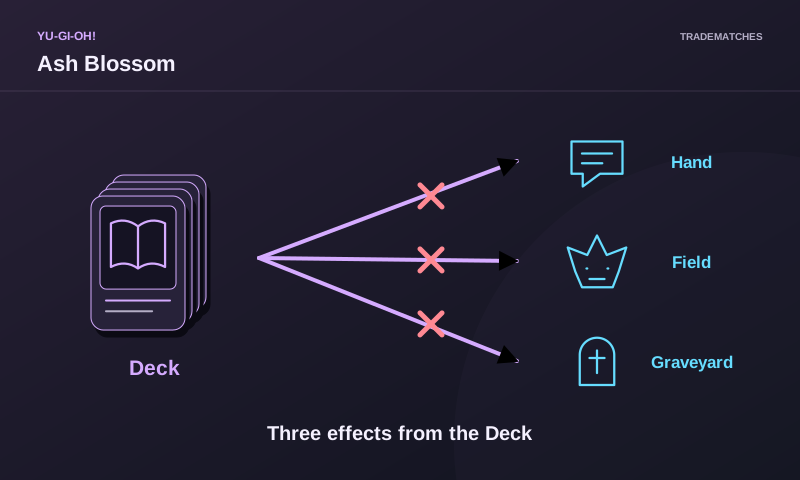
Ash Blossom & Joyous Spring can negate an activated effect that includes one of three kinds of interaction with the Deck: adding a card to the hand, Special Summoning from the Deck, or sending a card from the Deck to the Graveyard. It does not negate every effect that mentions the Deck, every Special Summon, or every card played by the opponent.
The practical decision is made when the relevant card or effect is activated. Read what that activation includes, distinguish its effect from its cost, and check whether Ash Blossom can legally respond. This guide uses simple invented effect descriptions so that the reading method stays useful across changing decks and releases.
Start with the current card text
The official Ash Blossom database entry is the reference for its wording. It identifies the three qualifying effect categories, the discard payment and the restriction on using the effect once per turn.
Do not replace that text with the shortcut “stops searching.” Searching is one familiar application, but the other categories explain why the card also matters against certain draws, Deck-based Special Summons and effects that send cards from the Deck to the Graveyard.
Conversely, a card doing something useful with another zone may be outside all three categories. Returning a card from the Graveyard to the hand is not adding it from the Deck. Special Summoning from the hand is not Special Summoning from the Deck. The origin written in the activated effect is central to the decision.
The three categories in ordinary examples
Imagine an activated effect that adds a named monster from the Deck to the hand. That fits the first category. An activated effect that draws cards also adds cards from the Deck to the hand, so the fact that it uses the word “draw” rather than “search” does not put it outside the category.
Now imagine an activated effect that Special Summons a monster directly from the Deck. That fits the second category. If an otherwise similar effect Special Summons only from the Graveyard, that portion alone does not provide Ash Blossom's activation condition.
Finally, imagine an effect whose resolving instruction sends a card from the Deck to the Graveyard. That fits the third category. Compare it with an effect that banishes a card from the Deck: the stated destination is different, so that operation alone is not one of Ash Blossom's three listed categories.
| Simplified activated effect | Qualifying category on this wording |
|---|---|
| Add a card from Deck to hand | Deck to hand |
| Draw a card | Deck to hand |
| Special Summon from Deck | Deck-based Special Summon |
| Send a card from Deck to Graveyard | Deck to Graveyard |
| Return only a Graveyard card to hand | None of the three from that instruction |
| Special Summon only from hand | None of the three from that instruction |
These examples isolate one operation at a time. A real card can include other instructions or restrictions, so read the complete activated effect before applying the table.
A qualifying cost is not a qualifying effect
Suppose a hypothetical activation sends a card from the Deck to the Graveyard as a cost, while its effect only increases a monster's ATK. The Deck movement happened to pay for the activation; it is not the effect Ash Blossom is checking. That cost alone does not make the ATK effect eligible.
This is a frequent source of confusion because both operations may appear on the same line of text. Problem-Solving Card Text separates the activation procedure from the resolving effect. Read the semicolon and locate the instruction rather than looking for the word “Deck” anywhere on the card.
Now change the hypothetical wording so that the resolving effect sends the Deck card to the Graveyard. The origin and destination are identical, but the method has changed. That is why a correct ruling needs more than a description of where the physical card ended up.
Konami's rulebook explains costs and Chains. Use those concepts together with the current card text when evaluating a complicated activation.
What does Ash Blossom actually negate?
Ash Blossom negates the effect to which it responds. Its text does not say that it negates the activation, destroys the card or returns already paid costs. Those results should not be added by habit because another negation card works differently.
Imagine an opponent pays an activation cost and you legally respond with Ash Blossom. If Ash Blossom resolves successfully, the opponent does not get the negated effect. The paid cost is still paid. This distinction can matter even when the opponent's card remains somewhere visible afterward.
If an activated effect includes several connected operations and qualifies for Ash Blossom, you are negating that effect, not merely crossing out the word “Deck.” Follow the complete wording and current ruling for the actual card. Avoid improvising a partial result simply because only one of its operations originally supplied the activation condition.
Multiple effects on one card require careful reading
A physical card can have more than one effect. A Deck interaction in an unrelated effect elsewhere on that card does not automatically make every activation of the card eligible for Ash Blossom.
Likewise, cards with modes, choices or conditional instructions require the wording of the effect actually activated. Do not assume that every option printed on a card is part of the current activation, or that a casual paraphrase of an opponent's chosen option captures all its instructions.
For an unfamiliar card, ask which effect is being activated and inspect the current database wording. If the interaction depends on whether a conditional Deck instruction is included, use an official ruling or a judge rather than a universal shortcut. The three-category test is the starting point; it is not a substitute for reading complicated text.
Timing matters as much as eligibility
Ash Blossom responds to the relevant activation. You cannot wait until the opponent has successfully searched, seen the selected card and completed the resolving effect, then decide to apply Ash Blossom retrospectively.
Nor can you freely insert its activation halfway through an effect that is resolving. Chains are built before their effects resolve, and the opportunity to respond depends on the proper activation sequence. A card fitting one of the three categories is not sufficient if the required timing has already passed.
At the table, clearly announce the activated effect and offer the appropriate response opportunity. If both players are uncertain about which Chain Link Ash Blossom would respond to, settle that before resolution. In organised play, request a judge when the sequence is disputed.
The once-per-turn restriction belongs to the named effect
Ash Blossom's current text limits use of its effect once per turn. Holding another physical copy does not provide an unrestricted second use of the same named effect during that turn. The restriction is not written as “once for each card you happen to hold.”
This matters when an initial attempt is itself negated. Do not assume that a failed result means the effect was never used. Check the exact wording of the restriction and the event that happened. “Use” and “successfully resolve” are different ideas in card text.
The discard payment also matters for hand planning. Assess what stopping the opponent's effect would achieve before spending the card. A legally eligible activation is not automatically the best moment to use your available interaction. That strategic choice depends on the visible game state, not a universal list of targets guaranteed to win a duel.
A quick two-column exercise
Write an unfamiliar activated effect in two columns: the activation procedure on one side and the resolving instructions on the other. Mark any Deck interaction in each column. Then apply Ash Blossom's categories to the resolving effect, not to a combined summary of everything the physical card mentions.
Next, replace the Deck origin with the Graveyard in your hypothetical example. Does the same category still apply? Finally, add an unrelated second effect elsewhere on the card. This exercise highlights why card identity, activated-effect identity and actual origin are distinct checks. It also gives you a clearer question to ask a judge when the real wording is complicated.
Frequently asked questions
Can Ash Blossom stop an activated draw effect?
An activated effect that draws from the Deck falls within adding cards from the Deck to the hand. Check that you have the correct response timing and that no other restriction prevents activation. Drawing normally in the Draw Phase is a different situation from an activated draw effect.
Can it negate every Special Summon?
No. Its listed category concerns an effect that Special Summons from the Deck. A Special Summon from another zone does not qualify merely because it is a Special Summon. Read the full activated effect for any other qualifying Deck instruction.
Does Ash Blossom destroy the opponent's card?
Its own effect does not say to destroy that card. It negates the relevant effect. Any later movement of the opponent's card follows the rules and its own text, rather than an additional destruction instruction supplied by Ash Blossom.