Negating activation vs effect in Yu-Gi-Oh!
On this page
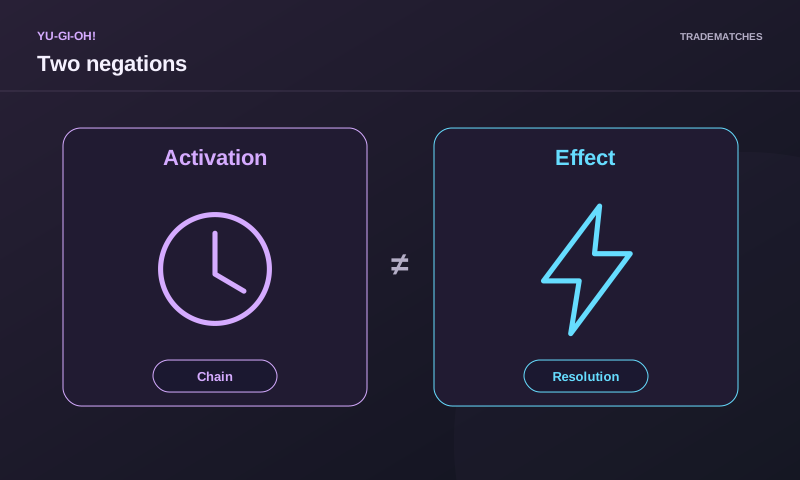
In Yu-Gi-Oh! TCG, negating activation and negating the effect can prevent the same immediate outcome, but they describe different moments. If you negate activation, the card or ability does not successfully activate. If you negate the effect, the activation did occur, but the effect fails to produce its intended result when resolving, depending on the scope of the negation. This distinction matters for cards that react to an activation, for written limits such as "you can only activate once" or "you can only use once," and for effects that remain in the field. Never assume that negating implies destruction: destruction or banishment only occurs if the card that negates explicitly states it. Always read the full text of both the response and the original card before removing anything.
First, there is an activation and a Chain
Many Magic, Trap, and Monster effects activate by forming a Chain. When activated, conditions are checked, targets are selected, and costs indicated before the semicolon in modern text are paid. Then the opponent may add a legal response. When the Chain resolves in reverse order, a response can negate the activation or negate the effect of the link it responds to. These are different operations; neither implies that the cost already paid automatically returns to hand or that the selected target ceases to have been chosen in the past.
Konami explains in its Problem-Solving Card Text guide that the two points separate the activation condition from the semicolon, which separates activation actions from what happens upon resolution. For example, a Trap that says "When a Trap is activated: pay 1000 LP; negate the activation and destroy it" pays those LP when the response is activated, not after determining whether the opponent can defend. Similarly, an effect that is attempted to be negated may have already paid its cost. Identify each link, its cost, and its negation text before adding or subtracting resources.
What does negating activation mean?
A card that says "negate activation" intervenes in the act of activating the specified card or effect. If the negation succeeds, that activation is not considered successful for any rules that depend on it. This may change if a player has already used a card with a limit such as "you can only activate one per turn," but the specific outcome requires reading the restriction and the rules of that card. Do not convert this possibility into a universal permission to repeat: some limitations refer to "using" an effect, others to summoning, others have additional conditions, and a prior attempt may have consumed resources no longer available.
Negating activation is often accompanied by another instruction, such as "and if you do, destroy that card," but the second part is not automatic. If the text only negates activation and does not say to destroy, do not add destruction by intuition. If a card negates the activation of a Monster effect, it does not necessarily mean the physical Monster disappears from the field. The card's fate depends on its zone, the type of activation, and what the response actually orders. A negation may affect a Chain link without erasing all other characteristics of the Monster.
What does negating an effect mean?
A card that says "negate that effect" allows the activation to exist but prevents the negated effect from applying its result when resolving, according to the scope of the negation. The difference matters for texts that say "when your opponent activates an effect": the activation occurred even though its result was later negated. It also matters for usage limits and for cards that check whether a Magic or Trap card was successfully activated. There are different ways to negate effects: a response to a specific link, a temporary negation of a Monster's up-facing effects, or a continuous effect that suppresses them while a condition is met.
Example: A Monster activates a skill that searches for a card. Your response says "negate that effect." A Chain is formed, the response resolves, and the search does not occur if the negation applies. The Monster may remain in the field if the response does not order its destruction. If instead your response says "negate the activation and, if you do, destroy that card," the result includes an additional destruction action only under the stated conditions. Both responses can prevent the immediate search, but they leave different activation histories and may result in different boards.
Negating effects of a Monster facing up
A Magic or Trap card may state that the effects of a Monster facing up are negated "until the end of the turn" or while a certain card is in play. This text is not identical to responding "negate activation" to a specific ability. It may affect continuous Monster abilities and attempts to activate abilities under that negation, depending on the card, zone, and moment. If the Monster leaves the field, a previously activated ability may be evaluated differently; consult the text and official resolution. Avoid generic phrases like "my Monster is negated, so everything it says in any zone is nonexistent."
The scope of the word "effects" can vary. Some cards negate only an activated effect; others negate all effects of a specific Monster in play; others prevent activating effects rather than negating their results. "You cannot activate" is a prior prohibition, not a negation applied after a legal activation. When an opponent announces a play, show which phrase of your card responds and which object is affected. This avoids debates about abilities activated in the Graveyard or hand, where a negation limited to a Monster facing up in the field may not apply.
Costs paid before negation
If a card requires discarding a card, paying LP, sacrificing a Monster, or disengaging Materials as a cost to activate an effect, that payment occurs when forming the corresponding link. Negating activation or effect afterward does not automatically return the cost. Modern text places the cost before the semicolon to help identify it. If the action appears after the semicolon, it may be part of the resolution and may not occur when the effect is negated. Determining what came before and what came after is more reliable than inferring it from the card's appearance.
Abstract example: "discard a card; draw two cards." If discarding is a cost, the card leaves the hand when activating. If the opponent negates the effect, you do not draw the two cards, but the discarded card does not return simply due to that negation. If the opponent negates activation, the payment also does not revert automatically. The response can be highly advantageous precisely because it negates after the opponent has committed resources. Therefore, before activating an effect vulnerable to a known response, evaluate whether you can assume losing the cost. This is not an invented penalty: it is the standard sequence of activation and resolution.
"You can only activate" and "you can only use"
The limits of a card must be read word by word. "You can only activate one [card] per turn" and "you can only use this effect once per turn" do not describe exactly the same count. When activation is negated, the first may be treated differently from the second. Therefore, avoid stating without further qualification that "if they negate me, I can repeat" or "I can never repeat." Check the updated text in the official Neuron database and the applicable resolution. Also verify whether you possess another copy, whether the effect has a cost you can no longer pay, and whether the activation condition still exists.
A card may contain multiple simultaneous restrictions: by card name, by specific effect, by turn, or by duel. Even if a negation does not consume a limit on activation of a class, it may consume a limit on use or make it impossible to meet the requirements again. Some cards prohibit Special Summoning after using their effect or limit your Extra Deck for the rest of the turn. These restrictions resolve according to their wording. The activation/effect comparison indicates where to look, but the response to retry a play always requires the actual text.
Destroying, banishing, and negating are not synonyms
"Negate activation and destroy that card" contains two linked instructions. "Negate that effect" may leave the card on the field. "Banish that card" moves the card to another zone, but by itself does not guarantee that an effect already in the Chain is negated. An activated effect may resolve even if its source card leaves the field, unless its text or the rules for that card type require otherwise. If you want to prevent a result, confirm that your response negates what you need or that moving the card actually changes its resolution. Do not attribute to "destroy" a negation effect not stated in the card.
The difference becomes apparent when choosing which response to keep in hand. A card that destroys a threat may be useful in the long term, but may not prevent a skill already activated. A negation of effect may stop the skill now, but leave a body or Continuous Card that will still matter later. A negation of activation with destruction might do both, but may only respond to a certain type of card or require a high cost. Read the condition, cost, speed, and target before evaluating which is worth purchasing or including in your deck.
Step-by-step Chain example
Player A activates a Magic Card whose effect searches for a Monster; this activation creates Link 1. Player B activates a Trap that can respond to a Magic activation, such as Link 2, and pays its cost. Both pass. Link 2 resolves first: if it says "negate activation and destroy," both instructions apply according to its text. Then Link 1 does not perform the search because its activation was negated. If the Trap from Player B said "negate that effect," the search would not occur either, but the activation of Link 1 would have existed. This difference may matter for other cards even if the immediate hand result is the same.
On another board, Player B could respond by simply destroying the Magic Card without negating its activation or effect. Do not automatically assume the search fails: the resolution of cards requiring staying in the field depends on their type and text. A Normal Magic card may behave differently from a Continuous or Equipment card. The example only teaches how to classify the response; for a real sequence, identify the card type and exactly what it says. Resolving the Chain backwards avoids deciding the effect of Link 1 before applying Link 2.
How to check a negation in tournament or casual play
Form four questions: What was activated exactly, a card or an effect?; Does the response negate that activation, that effect, or all effects of a card?; What cost was already paid upon activation?; Does the response add destruction, banishment, or duration? Then read the usage restrictions of both cards and consult the current wording. This short list resolves most confusion because it separates facts that are often mixed in the phrase "I negate." In an event, if the case affects a usage limit or an ability in another zone, call a judge before playing a second copy based on an assumption.
When studying a deck, mark responses by their actual text: "negates activation of Magic/Trap," "negates activation of Monster effect," "negates Monster effects until end of turn," or "destroys without negating." Two cards with similar appearances may address different problems. If you want to protect a combination, identify which of your steps can receive each type of negation and what resources you will have paid when it occurs. This preparation turns a seemingly technical rule concept into a concrete decision about deck construction and turn sequence.
Frequently Asked Questions
Does negating an effect destroy the card?
No, by itself. Destruction or banishment must appear in the text of the card that responds or come from another applicable rule or effect.
Are costs returned if activation is negated?
No automatically. Costs paid upon activation have already been paid; consult only explicit exceptions.
Can I reuse a card whose activation was negated?
It depends on the exact wording of its limit, whether it refers to "activating" or "using," and whether conditions and resources still exist. Consult the current card and its official resolution.